Russian resupply ship docks at International Space Station
Jul 04, 2010
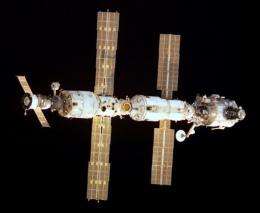
The International Space Station as seen in 2000 when the space shuttle Endeavour approached for docking. An unmanned Russian resupply vessel docked at the International Space Station (ISS) Sunday, two days after an earlier attempt failed, the Russian and US space flight control centres said.

An unmanned Russian supply vessel docked Sunday without trouble at the International Space Station, two days after a technical glitch forced a similar maneuver to be aborted.

Space officials said they managed to avoid the radio signal problems that forced them to abandon last week's docking of the Progress M-06M cargo ship, launched on June 30, is carrying 2.6 tonnes of fuel, food and water for the three Russia and three US astronauts on the station.

"At 20:17 pm Moscow time (16H17 GMT), the 'Progress M-06M' docked at the 'Star' module of the ISS," the Russian Mission Control Centre said in an Internet statement.

An attempted docking on Friday was aborted when a radio link with the ISS was lost about 25 minutes before the planned rendezvous.

Sunday's successful docking was done automatically under the supervision of experts in Moscow and the ISS team, it said, without using the radio link.

Progress launched from the Baikonur Cosmodrome in Kazakhstan on June 30.

It is the 40th Russian cargo vessel to dock at the station, the centre said.

In contrast to the troubles that plagued the first rendezvous attempt, Sunday's second try "was executed flawlessly," the US space agency NASA said on its website.

The space ship's failure to dock last week after flying past the ISS was notable largely because it was rare mishap in a space programme which usually strives for and achieves pinpoint accuracy.

During the mishap "in the beginning everything was normal, then the automatic (docking) mode failed, and later the station's crew could not dock the vessel in manual mode," a Russian space centre spokesman told the Itar-Tass news agency.

The automatic docking system also failed during the last Progress supply ship docking in May although the process was successfully carried out manually.

The ISS, which orbits 350 kilometres (220 miles) above Earth, is a sophisticated platform for scientific experiments, helping test the effects of long-term space travel on humans, a must for any trip to distant Mars.

Progress is carrying 1,918 pounds (862 kilos) of propellant, 110 pounds (50 kilos) of oxygen, 220 pounds (100 kilos) of water and 2,667 pounds (1,210 kilos) of experiment equipment, spare parts and other supplies to the station.

The rendezvous occurred 220 miles (350 kilometers) above Earth as both the ISS and resupply ship flew over the point where the borders of China, Kazakhstan, Mongolia and Russia intersect.

Progress is similar in appearance and design elements to the Russian Soyuz spacecraft, which brings crew members to the station, serves as a lifeboat while they are there and returns them to Earth. And unlike Soyuz, Progress has a refuelling module and a cargo module.

Explore further: Curiosity Mars rover drills second rock target

add to favorites email to friend print save as pdf

Related Stories

Russian cargo ship fails to dock with ISS (Update)

Jul 02, 2010

An unmanned Russian Progress cargo ship on Friday failed to dock as planned with the International Space Station (ISS) after flying past the facility in a rare mishap, mission control said.

Russian cargo ship docks with ISS

Jul 29, 2009

A Russian cargo ship, launched Friday from the Baikonur space station in Kazakhstan, docked Wednesday with the International Space Station, the Russian news agency Interfax said.

Russian space cargo vessel heads for ISS

Feb 03, 2010

A Russian cargo vessel took off Wednesday from the Baikonur space centre in Kazakhstan heading for the International Space Station (ISS), the control centre announced.

Russian cargo spacecraft nearing ISS

Jun 17, 2005

MOSCOW, June 17 (UPI) -- A Russian cargo spacecraft has been launched into orbit successfully and will reach the International Space Station Saturday, Russian space officials said.

Recommended for you

Proba-V opens its eyes

14 hours ago

(Phys.org) —Earth watcher Proba-V is in good health following its launch last week. The Vegetation imager has been switched on and the first image has been captured over western France.

Mice, gerbils perish in Russia space flight

May 19, 2013

A number of mice and eight gerbils sent into space in a Russian capsule destined to find out how well organisms can withstand extended flights perished during their journey, scientists said Sunday as the ...

Mars rover Opportunity examines clay clues in rock

May 18, 2013

(Phys.org) —NASA's senior Mars rover, Opportunity, is driving to a new study area after a dramatic finish to 20 months on "Cape York" with examination of a rock intensely altered by water.

User comments : 3

Adjust slider to filter visible comments by rank

Display comments: newest first

Hesperos
not rated yet Jul 04, 2010
Loose wire? Cracked circuit board?
Shootist
not rated yet Jul 05, 2010
cosmic ray reset a bit
rwinners
not rated yet Jul 05, 2010
Aliens!

More news stories

Slow earthquakes: It's all in the rock mechanics

(Phys.org) —Earthquakes that last minutes rather than seconds are a relatively recent discovery, according to an international team of seismologists. Researchers have been aware of these slow earthquakes, ...

Lab sets a new record for creating heralded photons

(Phys.org) —Entanglement, by general consensus of physicists, is the weirdest part of quantum science. To say that two particles, A and B, are entangled means that they are actually two parts of an inseparable ...

Protein study suggests drug side effects are inevitable

A new study of both computer-created and natural proteins suggests that the number of unique pockets – sites where small molecule pharmaceutical compounds can bind to proteins – is surprisingly small, meaning drug side ...

Do salamanders hold the solution to regeneration?

Salamanders' immune systems are key to their remarkable ability to regrow limbs, and could also underpin their ability to regenerate spinal cords, brain tissue and even parts of their hearts, scientists have ...