New US satellite to monitor debris in Earth orbit
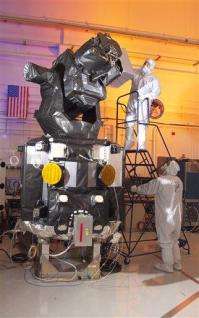
(AP) -- A new U.S. Air Force satellite will provide the first full-time, space-based surveillance of hundreds of satellites and thousands of pieces of debris that could crash into American and allied assets circling the Earth.
If all goes as planned, the Space-Based Space Surveillance satellite, scheduled for a July 8 launch from Vandenberg Air Force Base, Calif., will have an unobstructed, around-the-clock view of the increasingly heavy traffic in Earth orbit - something the Air Force doesn't have now.
Currently, the Air Force relies on a ground-based network of radar and optical telescopes around the globe to monitor about 1,000 active satellites and 20,000 pieces of debris. The telescopes can be used only on clear nights, and not all radar stations are powerful enough to detect satellites in deep space orbit, about 22,000 miles from Earth.
From its orbit about 390 miles above the Earth, the new satellite will have a clear view of deep space, unaffected by daylight or weather.
"It really has tremendous capabilities," said Todd Citron, director of advanced space and intelligence systems for Boeing Co., prime contractor for the satellite, known as SBSS.
Citron said SBSS will revolutionize "space situational awareness," the military term for knowing not only where the objects are, but where they're headed and what might be in their path.
An Air Force official was more cautious.
"We do know that the sensor is going to provide a lot of capability," said Col. J.R. Jordan, mission director for the SBSS launch and vice commander of the Air Force Space Superiority Systems Wing. "We haven't really come up with broad statements" about how much SBSS is expected to improve monitoring, Jordan said.
SBSS was built by Ball Aerospace & Technologies Corp. in Boulder, Colo., working with Boeing. It carries an optical camera on a swivel mount, so the camera's view can be changed without burning fuel to move the satellite, and will concentrate on satellites and debris in deep space. It will beam information to ground stations.
A command center at Schriever Air Force Base, Colo., will oversee day-to-day operations of SBSS in orbit. The SBSS system, including ground-control facilities, cost $500 million.
It is the first satellite dedicated solely to space situational awareness, Jordan said. The Air Force space surveillance network previously had partial use of a satellite called the Midcourse Space Experiment, which was designed to track missiles but could also monitor objects in orbit. It's no longer functioning.
Millions of pieces of space debris are orbiting the Earth, from tiny pellets of escaped coolant to spent rocket stages and dead satellites, said Brian Weeden, a former Air Force space operations officer who is now the technical adviser for the Secure World Foundation, a Colorado think tank and advocacy group that focuses on the use of space.
The Air Force monitors objects that are at least 10 centimeters across, or about 4 inches, big enough to destroy a satellite or a module of the International Space Station with a direct hit, Weeden said.
Almost all are man-made, because natural bodies caught in Earth orbit tend to be smaller.
The military shares some of the information with civil and commercial space operators, who can maneuver satellites or the space station out of harm's way. President Barack Obama's National Space Policy, released Monday, pledged U.S. cooperation with other nations on monitoring debris.
Like ground-based sensors, SBSS won't continuously track objects but will make spot checks and use the data to predict trajectories. The entire network collects about 400,000 observations daily, the Air Force said.
Space junk has collided with satellites at least twice. In 1996, a French satellite was damaged by a rocket fragment. In 2009, a satellite owned by Bethesda, Md.-based Iridium Communications was destroyed in a collision with a derelict Russian satellite.
Iridium said it had no warning before the collision but has since been getting more accurate data from the government on potential collisions.
In 2007, China purposely destroyed one of its own satellites with a missile in a test, creating an estimated 2,400 pieces of debris at least 5 centimeters across and prompting criticism from the U.S. and others.
More information:
Ball Aerospace & Technologies Corp.: http://www.ballaerospace.com/
Boeing Co. Defense, Space & Security: http://www.boeing.com/bds/
Schriever Air Force Base: http://www.schriever.af.mil/
Secure World Foundation: http://www.secureworldfoundation.org/
Vandenberg Air Force Base: http://www.vandenberg.af.mil/
©2010 The Associated Press. All rights reserved. This material may not be published, broadcast, rewritten or redistributed.


