A Black Hole Slingshot?
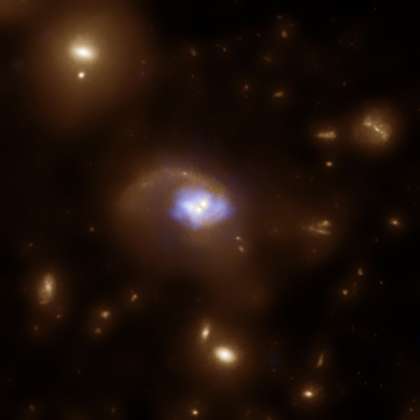
(PhysOrg.com) -- Evidence for a recoiling black hole has been found using data from the Chandra X-ray Observatory, XMM-Newton, the Hubble Space Telescope, and several ground-based telescopes.
This black hole kickback was caused either by a slingshot effect produced in a triple black hole system, or from the effects of gravitational waves produced after two supermassive black holes merged a few million years earlier.
The discovery of this object, located in this composite image, comes from a large, multi-wavelength survey, known as the Cosmic Evolution Survey (COSMOS). This survey includes data from Chandra, HST, XMM- Newton, as well as ground-based observatories. Of the 2,600 X-ray sources found in COSMOS, only one -- named CID-42 and located in a galaxy about 3.9 billion light years away -- coincides with two very close, compact optical sources (The two sources are seen in the HST data, but they are too close for Chandra to resolve separately.) In this image, the X-ray source detected by Chandra is colored blue, while the Hubble data are seen in gold.
The galaxy's long tail suggests that a merger between galaxies has occurred relatively recently, only a few million years earlier. Data from the Very Large Telescope and the Magellan telescope give evidence that the difference in speed of the two optical sources is at least three million miles an hour.
The X-ray spectra from Chandra and XMM-Newton provide extra information about CID-42. Absorption from iron-rich gas shows that gas is moving rapidly away from us in the rest frame of the galaxy. This could be gas in the galaxy between us and one of the black holes that is falling into the black hole, or it could be gas on the far side of the black hole that is blowing away.
Taken together, these pieces of information allow for two different scenarios for what is happening in this system. In the first scenario, the researchers surmise that a triple black hole encounter was produced by a two-step process. First, a collision between two galaxies created a galaxy with a pair of black holes in a close orbit. Before these black holes could merge, another galaxy collision occurred, and another supermassive black hole spiraled toward the existing black hole pair.
The interaction among the three black holes resulted in the lightest one being ejected. In this case, the optical source in the lower left of the image is an active galactic nucleus (AGN) powered by material being pulled along by, and falling onto, the escaping supermassive black hole. The source in the upper right is an AGN containing the black hole that resulted from a merger between the two remaining black holes.
In this slingshot scenario, the high-speed X-ray absorption can be explained as a high-speed wind blowing away from the AGN in the upper right that absorbs light from the AGN in the lower left. Based on its optical spectrum, the AGN in the upper right is thought to be obscured by a torus of dust and gas. In nearly all cases a wind from such an AGN would be undetectable, but here it is illuminated by the other AGN, giving the first evidence that fast winds exist in obscured AGN.
An alternative explanation posits a merger between two supermassive black holes in the center of the galaxy. The asymmetry of the gravitational waves emitted in this process caused the merged black hole to be kicked away from the center of the galaxy. In this scenario, the ejected black hole is the point source in the lower left and a cluster of stars left behind in the center of the galaxy is in the upper right. The observed X-ray absorption would be caused by gas falling onto the recoiling black hole.
Future observations may help eliminate or further support one of these scenarios. A team of researchers led by Francesca Civano and Martin Elvis of the Harvard-Smithsonian Center for Astrophysics (CfA) will publish their work on CID-42 in the July 1st edition of The Astrophysical Journal.
The second scenario, concerning the recoil of a supermassive black hole caused by a gravitational wave kick, has recently been proposed by Peter Jonker from the Netherlands Institute for Space Research in Utrecht as a possible explanation for a source in a different galaxy. In this study, led by Peter Jonker from the Netherlands Institute for Space Research in Utrecht, a Chandra X-ray source was discovered about ten thousand light years, in projection, away from the center of a galaxy. Three possible explanations for this object are that it is an unusual type of supernova, or an ultraluminous X- ray source with a very bright optical counterpart or a recoiling supermassive black hole resulting from a gravitational wave kick.
Provided by Chandra :: Photo Album


