Russian capsule carrying 3 docks at space station
Jun 17, 2010 By MARCIA DUNN , AP Aerospace Writer
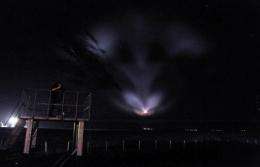
A Russian Soyuz TMA-19 rocket with US astronauts Doug Wheelock, Shannon Walker and Russian cosmonaut Fyodor Yurchikhin blasts off from Kazakhstan's Russian-leased Baikonur cosmodrome on June 16. A Russian space ship carrying a Russian cosmonaut and two US astronauts on Friday docked successfully with the International Space Station, mission control officials said.

(AP) -- The International Space Station received three new residents with Thursday's arrival of a Russian capsule, doubling the size of its female crew to an all-time high.

NASA, meanwhile, was keeping close watch on three pieces of space junk that could come uncomfortably close to the orbiting outpost this weekend. They are old Russian and Chinese satellite and rocket parts.

The Soyuz spacecraft - launched two days earlier from Kazakhstan - docked at the orbiting outpost as the vessels zoomed 220 miles above the Atlantic near Argentina.

It's NASA's method of getting U.S. astronauts to and from the space station for lengthy missions, and will become the only means of getting people there, period, once the shuttles stop flying late this year or next. Private companies like Space Exploration Technologies, which successfully launched a test rocket into orbit from Cape Canaveral two weeks ago, hope to pick up the slack.

Russian space officials said the docking went exactly as planned and demonstrated the reliability of the Soyuz.

The early evening arrival of the latest Soyuz means there are now two women living full time at the space station for the first time ever. No previous space station ever had two female residents at the same time, so the docking marked a historic first.

Shannon Walker, a physicist from Houston, joins Tracy Caldwell Dyson, a California-born chemist on board the space station since April. Walker took Amelia Earhart's watch into orbit. Four men also are on board now: three Russians and one American. Each will stay for six months and return via a Soyuz.

Wednesday, by coincidence, marked the 47th anniversary of the launch of the first spacewoman, Soviet cosmonaut Valentina Tereshkova.

And Friday is the 27th anniversary of the launch of America's first woman in space, Sally Ride.

Four women were at the space station in April, but only for 1 1/2 weeks. Three of them were brief shuttle visitors.

NASA wants to re-evaluate the orbit of the space station Friday - taking into account any changes as a result of the Soyuz docking - before deciding whether to move the outpost away from three pieces of worrisome space junk.

Mission managers decided there was no need to dodge a fourth piece of junk, which was expected to pass the station at a safe distance early Friday. That, too, was a chunk of an old Russian satellite.

Arriving with Walker was American Douglas Wheelock and Russian Fyodor Yurchikhin, both of whom visited the space station before. Walker is making her first spaceflight ever; she is married to NASA astronaut Andrew Thomas.

Explore further: Russia retrieves mice, newts from space

3 /5 (1 vote)
add to favorites email to friend print save as pdf

Related Stories

Astronauts get go ahead for Good Friday launch

Apr 01, 2010

(AP) -- A NASA astronaut and two Russian colleagues received the thumbs-up Thursday for a mission that will boost the population of the International Space Station to six.

ISS crew prepares for repositioning

Mar 13, 2007

The Expedition 14 crew aboard the International Space Station was making final preparations Wednesday for a repositioning rocket firing.

ISS crew repositions Soyuz spacecraft

Sep 27, 2007

The Expedition 15 crew of the International Space Station moved a docked Soyuz TMA-10 spacecraft Thursday to make room for the Expedition 16 crew's arrival.

Recommended for you

Russia retrieves mice, newts from space

24 minutes ago

A Russian capsule filled with 45 mice and 15 newts along with other small animals returned from a month's mission in orbit on Sunday with data scientists hope will pave the way for a manned flight to Mars.

Mars rover Opportunity examines clay clues in rock

May 18, 2013

(Phys.org) —NASA's senior Mars rover, Opportunity, is driving to a new study area after a dramatic finish to 20 months on "Cape York" with examination of a rock intensely altered by water.

NASA's STEREO detects a CME from the sun

May 17, 2013

On 5:24 a.m. EDT on May 17, 2013, the sun erupted with an Earth-directed coronal mass ejection or CME, a solar phenomenon that can send billions of tons of solar particles into space that can reach Earth ...

Nine-year-old Mars rover passes 40-year-old record

May 17, 2013

While Apollo 17 astronauts Eugene Cernan and Harrison Schmitt visited Earth's moon for three days in December 1972, they drove their mission's Lunar Roving Vehicle 19.3 nautical miles (22.210 statute miles ...

Bright explosion on the Moon

May 17, 2013

For the past 8 years, NASA astronomers have been monitoring the Moon for signs of explosions caused by meteoroids hitting the lunar surface. "Lunar meteor showers" have turned out to be more common than anyone ...

User comments : 2

Adjust slider to filter visible comments by rank

Display comments: newest first

CarolinaScotsman
5 / 5 (1) Jun 18, 2010
Tell the guy writing article titles that a comma should go after "3". Otherwise, people will be wondering what the astronauts will do with three docks.
rwinners
not rated yet Jun 22, 2010
I wondered, briefly, how they got three docks into (onto) that soyez capsule too.

More news stories

Galaxy's Ring of Fire

Johnny Cash may have preferred this galaxy's burning ring of fire to the one he sang about falling into in his popular song. The "starburst ring" seen at center in red and yellow hues is not the product of ...

Fracking risks to ground water assessed

(Phys.org) —Extraction of "unconventional" gas from sedimentary rocks such as shale could provide a clean energy source and help some regions to become energy independent, but concerns have been raised ...