Russian, US astronauts blast off to ISS
Jun 15, 2010
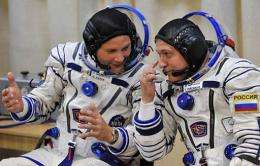
Russian cosmonauts Fyodor Yurchikhin (R) and US astronaut Doug Wheelock (L) speak at the Kazakhstan's Russian-leased Baikonur cosmodrome. A Russian cosmonaut and two American astronauts blasted off Wednesday for a restaffing mission to the International Space Station, Russian television showed in a live broadcast.

A Russian cosmonaut and two American astronauts blasted off Wednesday for a restaffing mission to the International Space Station, Russian television showed in a live broadcast.

The Soyuz-FG rocket lifted off on schedule from Russia's Baikonur cosmodrome in the Kazakh steppe at 01:35 am (2135 GMT Tuesday) carrying Russian cosmonaut Fyodor Yurchikhin and US astronauts Shannon Walker and Douglas Wheelock.

In a pre-flight press conference, the US astronauts admitted to some apprehension about the mission, but voiced their readiness and gratitude.

"I am very happy to be going and maybe just a little afraid," Walker said as quoted by the RIA Novosti news agency, with Wheelock echoing the sentiment.

Yurchikhin's young daughter Elena told her father in a public goodbye that she wanted to follow in his footsteps as a cosmonaut, complaining though that "Mom won't let me" fly to space just yet.

"I am with your mother on this 100 percent," Yurchikhin answered.

Russia's Vesti-24 television news channel showed the team sitting calmly in the cockpit as the rocket fired off into the night sky.

The Soyuz is due to dock on Friday with the ISS, where the team is expected to conduct several scientific tests, unload three Progress shuttles, and assemble an experimental satellite, space officials quoted by RIA Novosti said.

The astronauts would also maintain an Internet blog and an email mailbox to supply information on the station and space as a whole.

The mission is the last launch by a Soyuz rocket to the ISS before the US space shuttle program is mothballed later this year, leaving the burden of travel to the ISS entirely on Russian spacecraft.

Despite losing the shuttles Columbia and Challenger in a pair of disasters the programme was considered a resounding success and soon took on the lion's share of responsibility for transporting US astronauts.

A successor to the space shuttle is scheduled to take off no earlier than 2015.

Explore further: Communications satellite launched into space

add to favorites email to friend print save as pdf

Related Stories

New space station crew will bid farewell to shuttle

May 31, 2010

One Russian and two Americans set to fly to the International Space Station voiced nostalgia Monday for the retiring US space shuttle, which will make its final visit to the ISS this year.

Astronauts dock at International Space Station

Dec 22, 2009

A Russian rocket carrying three astronauts from Japan, Russia and the United States docked at the International Space Station Wednesday, the Russian flight control centre said.

Recommended for you

Dark, massive asteroid to fly by Earth on May 31

May 24, 2013

It's 1.7 miles long. Its surface is covered in a sticky black substance similar to the gunk at the bottom of a barbecue. If it impacted Earth it would probably result in global extinction. Good thing it is ...

Research team explains 'Lazarus' comets

May 24, 2013

Astronomers from the University of Antioquia have discovered a graveyard of comets. These once-dormant comets, dubbed by astronomers as "The Lazarus comets," are now rejuvenated.

NASA ships sensors for seafaring satellite to France

May 24, 2013

(Phys.org) —Three NASA-built instruments that are integral components of the next in a series of U.S./European ocean altimetry satellites have arrived in France for integration with their spacecraft in ...

Trip into space with DiCaprio costs $1.55m

May 24, 2013

Leonardo DiCaprio is going to get closer to stars of a different kind as he heads into space aboard the Virgin Galactic, and a well-heeled bidder at the Cannes Film Festival has paid 1.2 million euros (1.5 million) to be ...

User comments : 0

More news stories

Galaxies fed by funnels of fuel

(Phys.org) —Computer simulations of galaxies growing over billions of years have revealed a likely scenario for how they feed: a cosmic version of swirly straws.

Century-old science helps confirm global warming

(Phys.org) —Ocean measurements taken more than 135 years ago during the scientific expedition of HMS Challenger have provided further confirmation of human-produced global warming over the past century.