Japanese space probe Hayabusa close to home
Jun 08, 2010 by Lin Edwards report
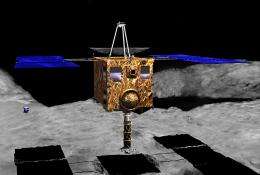
Artist's impression of Hayabusa in proximity to Itokawa's surface.

(PhysOrg.com) -- Hayabusa, the Japanese space probe launched in 2003, is returning home from its five-billion-kilometer round-trip journey to collect samples from the asteroid 25143 Itokawa.

According to the , JAXA, the has successfully fired its thrusters for its third Trajectory Correction Maneuver (TCM) to set it on course for a landing at the Woomera Test Range in the South Australian outback. Only one more correction maneuver remains, and is scheduled for later this week.

The spacecraft’s sample return capsule containing any samples is scheduled to detach from the probe and land at Woomera at about 1400 GMT on June 13. The US space agency, , is sending a DC-8 flying laboratory from California to South Australia to record the re-entry and landing using its barrage of image and spectrographic cameras.

There is no guarantee of success of the return mission but Hayabusa has already transmitted detailed images and scientific observations from on and around the asteroid Itokawa, which will help scientists to better understand the asteroids. Until the capsule is opened scientists will not know for certain if the probe succeeded in gathering any samples, but scientists are hopeful the capsule may contain at least small residues for analysis.

The asteroid Itokawa was discovered in 1998 and named after a Japanese scientist Hideo Itokawa, a pioneer of the Japanese space program nicknamed “Dr Rocket”. It is a mere 540 meters wide and orbits about 300 million kilometers from Earth.

Hayabusa cost around 138 million USD to develop. It reached Itokawa in 2005 and landed twice to collect samples of surface materials, but it apparently failed to fire a metal bullet that was designed to dislodge samples for collection. It left behind a time capsule wrapped in film and bearing the names of 880,000 people from 149 countries who had all responded to JAXA’s public invitation to be listed.

The craft has had other problems including a leaking thruster, battery problems, broken wheels, and a fuel leak in 2005 that drained the craft’s propellant tanks, leaving only the ion thrusters to guide the craft back to Earth. The ion thrusters have low acceleration, which has meant each trajectory correction has taken longer than it would have done with the chemical engines.

The problems and malfunctions resulted in the mission lasting longer than originally planned because communications with Earth were lost for several weeks in late 2005 when the craft was due to head home. When communications were restored it was too late, and the craft had to wait until April 2007 for the positions of the and Earth to be ideal again.

Hayabusa, which means falcon in Japanese, is currently around 3,600,000 km away from Earth. The sample return capsule will land on Earth but the spacecraft itself will burn up as it re-enters Earth’s atmosphere. The mission has fueled the public imagination in Japan, and the spacecraft has a large following of fans. There are also proposals the spacecraft be granted a National Honor award.

Hayabusa is the world’s first spacecraft to land on a body other than the moon and take off again.

Explore further: Collisions of coronal mass ejections can be super-elastic

Related Stories

AKARI's observations of asteroid Itokawa

Aug 23, 2007

The space-borne infrared observatory AKARI, observed asteroid Itokawa last month with its Infrared Camera. The data will be used to refine estimates of sizes of potentially hazardous asteroids in the future.

Stardust Mission Status Report

Jan 06, 2006

Ten days before its historic return to Earth with the first-ever samples from a comet, NASA's Stardust spacecraft successfully performed its 18th flight path adjustment. This second-to-last scheduled maneuver ...

Spacecraft Could Save Earth from Asteroids

Sep 04, 2009

(PhysOrg.com) -- British space engineers working for a space company in Stevenage in England, have designed a "gravity tractor" spacecraft to deflect any asteroids threatening to collide with Earth. The announcement ...

Recommended for you

NASA head views progress on asteroid lasso mission

10 hours ago

Surrounded by engineers, NASA chief Charles Bolden inspected a prototype spacecraft engine that could power an audacious mission to lasso an asteroid and tow it closer to Earth for astronauts to explore.

Ecuador satellite collides with Russian space junk

10 hours ago

A small Ecuadoran satellite collided in orbit with the remains of a Russian rocket, but it is too soon to know how much damage it might have sustained, Quito's space agency said Thursday.

Forecast for Titan: Wild weather could be ahead

May 22, 2013

(Phys.org) —Saturn's moon Titan might be in for some wild weather as it heads into its spring and summer, if two new models are correct. Scientists think that as the seasons change in Titan's northern hemisphere, ...

SDO observes mid-level solar flare

May 22, 2013

UPDATE 16:30 p.m. EDT: The M7-class flare was also associated with a coronal mass ejection or CME, another solar phenomenon that can send billions of tons of particles into space. While this CME was not Ea ...

User comments : 2

Adjust slider to filter visible comments by rank

Display comments: newest first

Chef
not rated yet Jun 08, 2010
Cheers to JAXA! This is a great accomplishment for Humanity. Fingers crossed for the sample's survival.
Aceterp
not rated yet Jun 08, 2010
Way to go Japan!!! now go ahead and get started on that DeathStar and a robot made HAloKitty moon condo. ;)

Joking aside.. will be interesting to see how the re-entry goes.

More news stories

A hidden population of exotic neutron stars

(Phys.org) —Magnetars – the dense remains of dead stars that erupt sporadically with bursts of high-energy radiation - are some of the most extreme objects known in the Universe. A major campaign using ...

Hubble reveals the ring nebula's true shape

(Phys.org) —The Ring Nebula's distinctive shape makes it a popular illustration for astronomy books. But new observations by NASA's Hubble Space Telescope of the glowing gas shroud around an old, dying, ...

NASA head views progress on asteroid lasso mission

Surrounded by engineers, NASA chief Charles Bolden inspected a prototype spacecraft engine that could power an audacious mission to lasso an asteroid and tow it closer to Earth for astronauts to explore.

Controlling mood through the motions of mitochondria

(Medical Xpress)—Regulating the distribution of power in neurons is done by a system that makes the national electric grid look simple by comparison. Each neuron has several thousand mitochondria confined ...

A quantum simulator for magnetic materials

Physicists understand perfectly well why a fridge magnet sticks to certain metallic surfaces. But there are more exotic forms of magnetism whose properties remain unclear, despite decades of intense research. ...