Quantum Dots See In The Dark
June 16, 2004

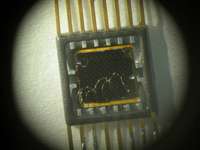
Quantum Dot IR Replicator Unit

Researchers at the University of Southern California and the University of Texas at Austin have built and tested a device based on nanostructures called quantum dots that can sensitively detect infrared radiation in a crucial wavelength range. Quantum dot IR receptor unit.


The atmosphere is opaque to most infrared, but it is transparent for a narrow "window" between 8 and 12 microns. Night vision goggles, military target tracking devices and environmental monitors utilize this range of wavelengths.

Anupam Madhukar, holder of the Kenneth T. Norris Chair in the USC Viterbi School of Engineering with appointments in the departments of materials science, biomedical engineering and physics, says "a class of existing infrared detectors are based on what is called 'quantum well' technology. But we have created a detector based on different physics--quantum dot physics--that works at least as well and has the potential to perform better."

Madhukar worked with Joe C. Campbell, who holds the Cockrell Family Regents Chair in the UT Austin College of Engineering's department of electrical and computer engineering. The two engineers described the device in the April 24 issue of Applied Physics Letters.

The device uses self-assembled "quantum dots," island-like pyramidal structures made of semiconductors. Each dot has a core of indium arsenide surrounded by gallium arsenide and an indium-gallium arsenide alloy. A single dot is approximately 20 nanometers (2 millionths of a centimeter) in base size and about 4 nanometers in height.

The three-dimensional confinement of electrons within these structures creates unique, characteristic behavior. By using varying proportions of the materials and changing synthesis procedures, engineers can tailor quantum dots for use in lasers, detectors, optical amplifiers, transistors, tunneling diodes, and other devices.

"Quantum dots are emerging as the most viable semiconductor nanotechnology for future higher performance communication systems, biomedical imaging, environmental sensors, and infrared detection," said Madhukar.

Unlike their alternatives, quantum dot infrared detectors strongly absorb radiation shining perpendicular to the plane of an array of quantum dots.

By contrast, the alternate quantum well detectors don't pick up radiation that shines straight down on them. To achieve this "necessitates additional processing steps," Madhukar said. This increases the cost of the well detectors.

When the engineers benchmarked the new device using standard tests, its detectivity was nearly 100 times higher than the previously reported peak for quantum dot systems. The new range is competitive with the corresponding values for the well-established quantum well infrared photo detectors.

"It is about an order of magnitude lower than a third technology, mercury-cadmium-telluride material based infrared detectors. These now provide the best available performance, but suffer from materials uniformity and long-term stability issues," said Campbell.

The researchers expect that placing the dot arrays in a configuration called a "resonant cavity," which traps the radiation and bounces it back and forth between mirroring walls, will make them more sensitive.

Source of this public release is University of Southern California.


Rank not rated yet
Tags

Relevant PhysicsForums posts

More news stories

Stunning image of smallest possible five-ringed structure

Scientists have created and imaged the smallest possible five-ringed structure – about 100,000 times thinner than a human hair – and you'll probably recognise its shape.

Nanotechnology / Nanophysics

created 6 hours ago | popularity 4.4 / 5 (5) | comments 1 | with audio podcast

'Unzipped' carbon nanotubes could help energize fuel cells, batteries

Multi-walled carbon nanotubes riddled with defects and impurities on the outside could replace some of the expensive platinum catalysts used in fuel cells and metal-air batteries, according to scientists at ...

Nanotechnology / Nanomaterials

created 12 hours ago | popularity 3 / 5 (2) | comments 0 | with audio podcast

Dopant gives graphene solar cells highest efficiency yet

(Phys.org) -- By taking advantage of graphene’s favorable electrical and optical properties, and then adding an organic dopant, researchers have achieved the highest power conversion efficiency yet for ...

Nanotechnology / Nanophysics

created May 21, 2012 | popularity 5 / 5 (10) | comments 14 | with audio podcast feature

In nanorod crystal growth, nanoparticles seen as artificial atoms

In the growth of crystals, do nanoparticles act as "artificial atoms" forming molecular-type building blocks that can assemble into complex structures? This is the contention of a major but controversial theory ...

Nanotechnology / Nanophysics

created May 24, 2012 | popularity 4.8 / 5 (6) | comments 0 | with audio podcast

First direct observation of oriented attachment in nanocrystal growth

Berkeley Lab researchers have reported the first direct observation of nanoparticles undergoing oriented attachment, the critical step in biomineralization and the growth of nanocrystals. A better understanding ...

Nanotechnology / Nanophysics

created May 24, 2012 | popularity 4.7 / 5 (3) | comments 0 | with audio podcast


Change in developmental timing was crucial in the evolutionary shift from dinosaurs to birds: study

At first glance, it's hard to see how a common house sparrow and a Tyrannosaurus Rex might have anything in common. After all, one is a bird that weighs less than an ounce, and the other is a dinosaur that ...

Computer model used to pinpoint prime materials for efficient carbon capture

When power plants begin capturing their carbon emissions to reduce greenhouse gases – and to most in the electric power industry, it's a question of when, not if – it will be an expensive undertaking.

T cells 'hunt' parasites like animal predators seek prey, study shows

By pairing an intimate knowledge of immune-system function with a deep understanding of statistical physics, a cross-disciplinary team at the University of Pennsylvania has arrived at a surprising finding: T cells use a movement ...

Yale study concludes public apathy over climate change unrelated to science literacy

Are members of the public divided about climate change because they don't understand the science behind it? If Americans knew more basic science and were more proficient in technical reasoning, would public consensus match ...

Land and sea species differ in climate change response: study

(Phys.org) -- Marine and terrestrial species will likely differ in their responses to climate warming, new research by Simon Fraser University and Australia’s University of Tasmania has found.

10 million years needed to recover from mass extinction

It took some 10 million years for Earth to recover from the greatest mass extinction of all time, latest research has revealed.