Mars Contamination Dust-Up
A new study finds that microbes on spacecraft might be able to survive on Mars longer than previously thought. The key to their survival? Dust.
Microbes on spacecraft from Earth might be able to briefly survive the harsh environment of Mars thanks to a thin layer of dust, a new study reports. Such a finding could complicate efforts to discover whether or not there is any native martian life.
Since NASA's early years, the space program has been concerned not only with the potential contamination of Earth from extraterrestrial life sneaking back with astronauts, but also of terrestrial microbes hitchhiking aboard our probes and invading other places in the solar system. The 1967 International Outer Space Treaty mandates that any spacecraft exploring the rest of the solar system must be pristine enough to prevent such contamination.
Despite precautions such as clean rooms and sterilization before flight, recent studies find that diverse communities of microorganisms still find their way onto spacecraft at the time of launch — indeed, these safety measures ensure that only the most resilient species survive.
In addition, as unforgiving as the interplanetary ride from Earth to Mars is, microbes are hardy enough to survive the trip — extreme-loving microbes from our planet are, after all, capable of surviving extraordinary heat, cold, radiation and toxicity, among other conditions lethal to humanity.
Still, past research from microbiologist Andrew Schuerger at the University of Florida and his colleagues had suggested that Mars might be too hostile even for the hardiest Earth microbes. The ultraviolet light from the Sun shining through the red planet's tenuous atmosphere can prove devastating, especially short-wave ultraviolet-C rays, tests of bacteria under simulated martian conditions revealed.
However, now Schuerger and his colleagues suggest terrestrial bacteria could survive on Mars after all. The key might be the dust on the red planet itself.
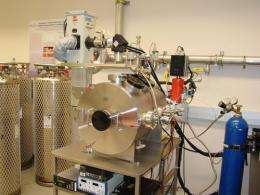
The researchers tested two known bacterial spacecraft contaminants — Escherichia coli and Serratia liquefaciens — with Mars-like conditions, mixing them into simulated martian soils and subjecting them to ultraviolet-C irradiation, environments both very dry and salty, cold down to minus 50 degrees C (minus 58 F) and atmospheric pressures roughly 140 times less than Earth's at sea level. During the week-long study, they found that E. coli, commonly found in human guts, could survive on the surface of Mars for at least seven days if it were protected from ultraviolet rays by nooks and crannies in spacecraft or by thin layers of dust — roughly 200 to 500 microns thick, or two to five times the width of a human hair.
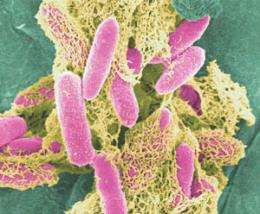
Still, while the E. coli persisted, the scientists found that its colonies did not grow under these conditions in tests. This means that while the microbes will be present, they will not grow and spread.
Previous research by Schuerger and his colleagues had found that the blue-green algae Chroococcidiopsis could survive a simulated Mars atmosphere when shielded by a millimeter-thick layer of sand. However, the algae also did not grow, and it is not a typical spacecraft contaminant.
While a thin layer of dust or sand could help protect microbes against solar ultraviolet rays, there are at least 10 other factors to contend with on the surface of Mars in addition to the five potentially lethal or "biocidal" factors the researchers tested. These other biocidal factors include galactic cosmic rays, solar particles such as protons or neutrons, or high soil concentrations of toxic heavy metals.
"Whenever multiple biocidal factors are combined, the survival rates plummet quickly," Schuerger said.
It’s hard work to see just how difficult a time terrestrial microbes face on Mars. "There are no full-Mars simulations published yet that include all of the 15 biocidal factors combined," Schuerger said. "It is nearly impossible to conduct such experiments. I am attempting to combine between two and four factors in new research, but the work goes slowly because multi-factored experiments are much more difficult than single-factor experiments."
While terrestrial microorganisms might not be able to grow on the martian surface, "they might be able to grow at some depth in the subsurface. We are trying to establish limits on microbial growth for both the surface and the subsurface of Mars."
Time is another important factor. “The experiments with E. coli were only run for seven days," Schuerger added. "The community still lacks mid- to long-term data on microbial survival under martian conditions that stretch for weeks, months and years."
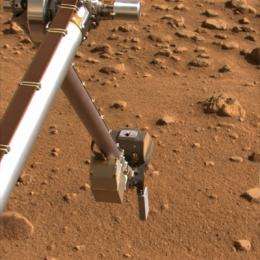
When the Mars Phoenix mission landed on Mars in 2008, it did not immediately begin to conduct science experiments. The Phoenix lander did not take its first soil sample until sol 4, the fourth martian day after landing (a day on Mars is 24 hours and 40 minutes). Phoenix did not actually dig into deeper layers of the soil, where microbes like E. coli could potentially survive, until sol 10. Presumably such a delay could ensure that when future Mars missions begin their tests for life, any traces of hitchhiking microbes will have long since been extinguished.
"Microorganisms found on spacecraft will have a very tough time surviving, growing, and replicating on Mars," Schuerger concluded.
The scientists detailed their findings in the April issue of the journal Applied and Environmental Microbiology.
Source: Astrobio.net


