Scientists say the American lion is not a lion after all
May 18, 2010 by Lin Edwards report
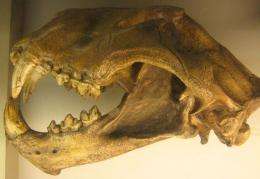
Panthera atrox skull. Image credit: Wikipedia.

(PhysOrg.com) -- There has been some debate over the last century or so about whether the extinct American lion, Panthera atrox, which dates from the Pleistocene, is related to present day African lions (Panthera leo) or to the jaguar (Panthera onca). Most paleontologists consider P. atrox as a lion, and have in the past even classified the American lion as Panthera leo rather than a separate species. Now a new study has challenged previous classifications and found the American lion was a distinct species and more similar to the jaguar than the lion.

The best preserved fossils of Panthera atrox have been found in the La Brea tar pits in Los Angeles and are mostly housed in the University of California Museum of Paleontology. Over the last 40,000 years the tar pits have trapped and preserved many animals in the thick asphalt deposits, because they were attracted to water that often covered and concealed the asphalt. Around 90 percent of the large animals found in La Brea were carnivores, presumably attracted to the area by the animals trapped in the sticky asphalt, and then becoming trapped themselves. The largest of the cat family found in the tar pits is the Panthera atrox.

The new study, by Per Christiansen of the Zoological Museum in Copenhagen, Denmark, and John Harris of the George C. Page Museum in Los Angeles in the U.S. used a range of statistical and shape analysis methods to compare large numbers of skulls of modern and extinct pantherine cats. They analyzed 23 dimensions on the skulls and found P. atrox has some similarities to lions but also many differences. The mandibular morphology is closer to jaguars and tigers than to lions.

The researchers concluded that P. atrox was evolved from a line of cats that immigrated into the Americas in the mid Pleistocene, and which gave rise in the late Pleistocene to P. atrox and the jaguar.

Panthera atrox was one of the largest cats ever, weighing in at over 350 kg and attacking prey animals as large as the wild horse and bison. It is believed to have inhabited open habitats, like the largest individuals of the modern jaguar, and became extinct around 10-12,000 years ago. At its height the American ranged from Alaska and the Yukon to Mexico.

The paper was published in the Journal of Vertebrate Paleontology.

Explore further: Actor Johnny Depp immortalized in ancient fossil find

More information: Per Christiansen and John M. Harris, Craniomandibular Morphology and Phylogenetic Affinities of Panthera atrox: Implications for the Evolution and Paleobiology of the Lion Lineage, Journal of Vertebrate Paleontology 29(3):934-945. 2009. doi:10.1671/039.029.0314

Related Stories

Marsupial lion tops African lion in fight to death

Jan 17, 2008

Pound for pound, Australia’s extinct marsupial lion (Thylacoleo carnifex) would have made mince meat of today’s African lion (Panthera leo) had the two big hyper-carnivores ever squared off in a fight to the death, according ...

Tracing the Roots of the California Condor

Oct 29, 2007

At the end of the Pleistocene epoch some 10,000 years ago, two species of condors in California competed for resources amidst the retreating ice of Earth's last major glacial age. The modern California condor triumphed, while ...

Scientists reveal family tree of 'super-sized lions'

Mar 31, 2009

(PhysOrg.com) -- The giant cats that roamed the British Isles, as well as Europe and North America, as recently as 13,000 years ago were lions rather than giant jaguars or tigers, a team led by Oxford University ...

New bacteria discovered in tar pits

May 17, 2007

U.S. environmental scientists have discovered the Rancho La Brea tar pits in Los Angeles contain hundreds of new species of unusual bacteria.

Recommended for you

The eloquence of the otoliths

May 16, 2013

Fish fossils that are about 23 million years old give unprecedented insight into the evolutionary history of the gobioid order, one of the most species-rich groups among the modern bony fishes.

Light cast on lifestyle and diet of first New Zealanders

May 16, 2013

(Phys.org) —A University of Otago-led multidisciplinary team of scientists have shed new light on the diet, lifestyles and movements of the first New Zealanders by analysing isotopes from their bones and teeth.

mtDNA study shows Minoans came from Europe not Africa

May 15, 2013

(Phys.org) —A new study conducted by a team of American and Greek researchers has found that the people of the ancient Minoan civilization living on the island of Crete most likely came from Europe. In ...

User comments : 4

Adjust slider to filter visible comments by rank

Display comments: newest first

21stCenturyguy
5 / 5 (1) May 25, 2010
Hello Physorg - Why is there an advertisement from a Christian organisation promoting Intelligent design on this page, on your website.......

Are you an equal opportunity science site now? Do people need a choice between actual facts and imaginary supernatural beings?
Alizee
1 / 5 (2) May 25, 2010
Why supernatural? The Earth could be terraformed by some extraterrestrial civilization in the past without problem and not only one time. Are we completely sure, all genes were originated by mutations at Earth?

Until we cannot exclude panspermia hypothesis (for example), then the creationism remains less probable, but still viable alternative to evolutionary theory in the same way, like catastrophism remains viable alternative to gradualism.

Censorship of ideas and selection of paradigm for thinking may be harmful for society, too. The advertisement from a Christian organisation A) supports the spreading of scientific theories and B) it learns people to distinguish actual facts from tales.
Alizee
1 / 5 (2) May 25, 2010
Regarding ID hypothesis, there are interesting coincidences of chaotic nature of Universe and hidden hyperdimensional reality.

I explained already, why highly organized & harmonic motion appears chaotic, when being observed as a low-dimensional projection of process in high number of extradimensions. For our animal pet the behavior of people would appear incomprehensible and chaotic, like the random nest of ants. The intelligent code for computer isn't distinguishable from random noise so easily.

And evolution of car models, cooking recipes and another memes doesn't differ so much from biological evolution from perspective of individuals - there are some random mutations in construction and their fitness is tested on the free market. We cannot accelerate car evolution very much, albeit it occurs like organized process inside of environment of intelligent creatures from its very beginning.

How such car could recognize, it's not evolved, but constructed from its silly perspective?
Alizee
1 / 5 (2) May 25, 2010
My point simple is, the archetype of omnipresent omnipotent God - which is so surprisingly firmly rooted in human minds - has its simple, but completely relevant hypergeometrical motivation.

Because such infinitely perfect, infinite, harmonic and organized deity persisting in His hidden hyperdimensional world would appear from our limited 3D perspective like omnipresent atemporal random quantum noise, which is still driving every phenomena inside of our observable Universe.

Until we revealed principles of quantum mechanics and cosmic microwave background, the idea of God was the only connection of our limited human minds with this hidden extra-dimensional reality. And we even cannot impeach the power and intelligence of such geometric God, because our intelligence, which we are so proud of, is based on the very same geometry.

The rest of Universe is intelligent by all criterions thinkable - the only reason, wh we cannot perceive it so is just the huge difference in intelligence.

More news stories

Evolution of lying

(Phys.org) —Ultimately, our ability to convincingly lie to each other may have evolved as a direct result of our cooperative nature.

Heat-related deaths in Manhattan projected to rise

Residents of Manhattan will not just sweat harder from rising temperatures in the future, says a new study; many may die. Researchers say deaths linked to warming climate may rise some 20 percent by the 2020s, ...

Kinks and curves at the nanoscale

One of the basic principles of nanotechnology is that when you make things extremely small—one nanometer is about five atoms wide, 100,000 times smaller than the diameter of a human hair—they are going ...