Australia opens up offshore oil, gas exploration
May 17, 2010
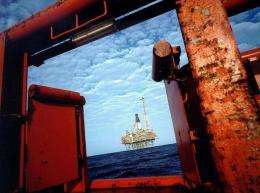
This handout photo shows an Australian offshore gas production platform in the North West Shelf (NWS) gas project. Australia on Monday said it would open more than 30 new offshore sites for oil and gas exploration, despite concerns from environmentalists that they could clash with marine sanctuaries.

Australia on Monday said it would open more than 30 new offshore sites for oil and gas exploration, despite concerns from environmentalists that they could clash with marine sanctuaries.

Federal Resources Minister Martin Ferguson said 26 of the 31 exploration areas were in Western Australia, which already has significant offshore energy projects, while others were in South Australia and the Northern Territory.

"Our energy security will be greatly enhanced by the opening up of new geological frontiers, reducing our dependence on imports," Ferguson said.

"Exploration in the areas under offer, some of which are in frontier areas, is a step towards achieving our energy security objective."

Ferguson said Australia has a 16 billion dollar (14 billion US) trade deficit in crude , refined products and LPG, which is expected to rise, possibly as high as 30 billion dollars by 2015.

The announcement means that companies will be able to bid for the right to explore the sites, which vary in size, with contracts to be awarded by May 2011 at the latest.

But conservationists were concerned by the announcement, with the Pew Environment Group saying some exploration had been approved in areas which had also been earmarked as potential marine wildlife reserves.

"Pretty much all the areas announced today are right over the top of areas that the Federal Environment Minister Peter Garrett is looking at for protection and that's because these areas are critically important for marine life," the group's Michelle Grady told ABC Radio.

The Western Australia Conservation Council said the new leases had the potential to devastate marine life along the coast which is famous for its surf beaches, dolphins and whales.

"What is happening in the Gulf of Mexico now could just as easily happen off the beaches of southwest Australia," spokesman Tim Nichol said in reference to the huge oil spill from a leaking rig in the United States.

Explore further: Climate change and wildfire: Synthesis of recent findings

add to favorites email to friend print save as pdf

Related Stories

Obama plan expands offshore oil drilling

Apr 01, 2010

President Barack Obama announced a plan to expand oil drilling off US coasts, drawing protests from green groups but charges by Republicans it did not go far enough.

Gulf spill spells uncertainty for new drilling

Apr 30, 2010

(AP) -- In the conservative Florida Pandhandle, where Sarah Palin's battle cry "Drill, Baby, Drill" is still visible on car bumpers, some are reconsidering their support of offshore drilling as a growing spill in the Gulf ...

Recommended for you

Climate change and wildfire: Synthesis of recent findings

2 hours ago

Concerns continue to grow about the effects of climate change on fire. Wildfires are expected to increase 50 percent across the United States under a changing climate, over 100 percent in areas of the West by 2050 as projected ...

Moore tornado a rarity, experts say

4 hours ago

Tornados, among the most violent of atmospheric storms, rarely reach the size and brutality of the twister that swept through an Oklahoma City suburb on Monday, experts say.

NGOs denounce Malaysia hydropower meeting

8 hours ago

Three dozen Malaysian NGOs on Tuesday denounced the world hydroelectric industry's decision to hold a conference in a Borneo state where dam projects have uprooted forests and native peoples.

User comments : 0

More news stories

Power of US tornado dwarfs Hiroshima bomb

Wind, humidity and rainfall combined precisely to create Monday's massive killer tornado in Oklahoma. The awesome amount of energy released dwarfed the power of the atomic bomb that leveled Hiroshima.

Reducing caloric intake delays nerve cell loss

Activating an enzyme known to play a role in the anti-aging benefits of calorie restriction delays the loss of brain cells and preserves cognitive function in mice, according to a study published in the May ...