Greenland glacier study will help improve sea level forecasts
May 12, 2010

(PhysOrg.com) -- Predicting sea levels could become more accurate thanks to a new discovery about how melting ice in the summer affects the movement of glaciers.

Scientists studying the have revealed a close link between ice movement and summer ice melt.

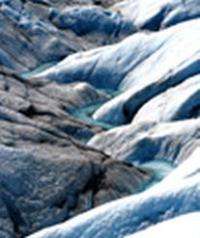
The research, published in Nature Geoscience and involving scientists from Newcastle University, showed that in summer, surface meltwater drains to the bed of the , enabling it to slide quickly towards the sea - at times, more than twice as fast in summer compared with winter.

If summers continue to become longer and warmer, glacier acceleration caused by meltwater will reach further inland, drawing down ice from a larger area of the ice sheet.

Researchers say this ice movement, which is similar to that found in Alpine , demonstrates that the ice sheet is highly sensitive to changes in climate. The study will give scientists more information to help improve predictions of sea level rise in response to .

Experts from the Universities of Edinburgh, Aberdeen, Aberystwyth and Newcastle used (GPS) receivers and climatic sensors to track a 35km section on the western edge of the ice sheet. Their findings showed how changes in surface meltwaters controlled the movement of waters underneath the ice sheet and the rate at which the ice slid over its bed.

Newcastle lead Dr Matt King, said the results took us a step closer to understanding how the ice sheet responds to changes in air temperature.

"It's clear that Greenland has played a role in in the past and will continue to in the future," explains Dr King.

"The question is, "how much?" - understanding the role of surface warming is going to be critical to getting that answer right.

"A large part of these new results are thanks to advances in the GPS analysis done here at Newcastle University - even if the ice moves a thumb's width we can see it and use that to help understand why it moved."

Explore further: Alaska volcano shoots ash 15,000 feet into the air

Provided by Newcastle University

2.9 /5 (9 votes)
add to favorites email to friend print save as pdf

Related Stories

Melting glacier worries scientists

Jul 25, 2005

Scientists monitoring a Greenland glacier have found it is moving into the sea three times faster than a decade ago, The Independent reported Monday.

New structure found deep within West Antarctic Ice Sheet

Sep 23, 2004

Ice sheet more susceptible to change than previously thought Scientists have found a remarkable new structure deep within the West Antarctic Ice Sheet which suggests that the whole ice sheet is more susceptible to future ch ...

Record warm summers cause extreme ice melt in Greenland

Jan 15, 2008

An international team of scientists, led by Dr Edward Hanna at the University of Sheffield, has demonstrated that recent warm summers have caused the most extreme Greenland ice melting in 50 years. The new research provides ...

Greenland ice cap melting faster than ever

Nov 12, 2009

Satellite observations and a state-of-the art regional atmospheric model have independently confirmed that the Greenland ice sheet is loosing mass at an accelerating rate, reports a new study in Science.

Greenland and Antarctic ice sheet melting, rate unknown

Feb 16, 2009

The Greenland and Antarctica ice sheets are melting, but the amounts that will melt and the time it will take are still unknown, according to Richard Alley, Evan Pugh professor of geosciences, Penn State.

Recommended for you

Alaska volcano shoots ash 15,000 feet into the air

14 hours ago

(AP)—One of Alaska's most restless volcanoes has shot an ash cloud 15,000 feet into the air in an ongoing eruption that has drawn attention from a nearby community but isn't expected to threaten air traffic.

NASA sees Cyclone Mahasen hit Bangladesh

May 17, 2013

NASA's Tropical Rainfall Measuring Mission satellite known as TRMM measured Cyclone Mahasen's rainfall rates from space as it made landfall on May 16. Mahasen has since dissipated over eastern India.

Rapid climate change ruled out ice age trees

May 17, 2013

Short, sharp fluctuations in the Earth's climate throughout the last ice age may have stopped trees from getting a foothold in Europe and northern Asia, scientists say.

Earth's iron core is surprisingly weak, researchers say

May 17, 2013

The massive ball of iron sitting at the center of Earth is not quite as "rock-solid" as has been thought, say two Stanford mineral physicists. By conducting experiments that simulate the immense pressures deep in the planet's ...

User comments : 1

Adjust slider to filter visible comments by rank

Display comments: newest first

TegiriNenashi
3 / 5 (2) May 12, 2010
What is the novelty of this study (compared to thousand others uncovering exactly the same topic)? They use GPS? I bet somebody else thought of this too.

More news stories

Galaxy's Ring of Fire

Johnny Cash may have preferred this galaxy's burning ring of fire to the one he sang about falling into in his popular song. The "starburst ring" seen at center in red and yellow hues is not the product of ...

Alaska volcano shoots ash 15,000 feet into the air

(AP)—One of Alaska's most restless volcanoes has shot an ash cloud 15,000 feet into the air in an ongoing eruption that has drawn attention from a nearby community but isn't expected to threaten air traffic.

Chinese, Indian airlines face EU pollution fines

Eight Chinese and two Indian airlines face fines of up to several million euros for not paying for their greenhouse gas emissions during flights within the bloc, the European Commission said on Friday.

Morocco to harness the wind in energy hunt

Morocco is ploughing ahead with a programme to boost wind energy production, particularly in the southern Tarfaya region, where Africa's largest wind farm is set to open in 2014.

US seizes Bitcoin operator accounts

US authorities seized the accounts of a Bitcoin digital currency exchange operator, claiming it was functioning as an "unlicensed money service business," court documents showed Friday.