No more blisters thanks to innovative socks
Swiss researchers and experts from armasuisse have developed novel socks which reduce the chances of blisters forming on the wearer’s feet.
The prototype footwear, made of various fibers, reduces friction at the toes and heels, absorbs perspiration and has a particularly comfortable feel. At the beginning of May the socks were subjected to a hard test at the Aarau barracks - sixty recruits wore the socks on daily route marches. Together with new combat boots, the socks form a part of armasuisse’s “New Footwear” project.
There is almost nothing that new recruits fear more that the painful blisters which develop during the first route marches when “square-bashing”. “Wear wool,” is the advice from one corner. “Always wear two pairs - thin stockings underneath hiking socks!” counsels another veteran.
Wool, hiking socks and fine stockings - these traditional items now faces serious competition from Empa’s textile laboratories. On behalf of armasuisse, the national competence center for the procurement of technically complex systems and materials, scientists from the institute’s Protection and Physiology Laboratory together with the sock manufacturer Rohner have developed these novel socks. The main requirements to be met were that the socks should be as comfortable as possible, avoid rubbing the skin, and that the fibers should take up and store sweat as quickly as possible.
Selecting the most suitable textile material for the socks from all the fibers and fiber mixtures available took a fair amount of time. In the end, the researchers chose to make the material used for the heel and toe sections of the socks - the main trouble spots - out of a special fiber, while the rest of the garment is made of a woolen mixture which absorbs dampness particularly well.
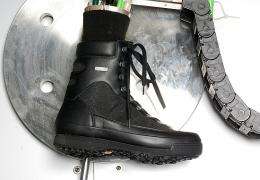
But the story does not end with developments in textile technology. After the research work on the new material in the laboratory, the novel socks were tested for their wearing properties. This meant involving Empa specialists in the fields of thermodynamics, physiology and tribology (frictional effects) in the project. Not only were the innovative socks tested on a sweating dummy foot developed jointly by Empa and armasuisse, but scientists also had soldiers in battle dress marching on a treadmill in the climate chamber.
In order to learn as much as they could about how the material behaved during the process of walking, researchers from the Technical University of Chemnitz analyzed the biomechanical properties of the soldiers’ combat boots. In actual fact, in the ideal case the boots exert the necessary pressure on the socks to allow optimal absorption of perspiration by the fibers. Boot and sock therefore create an optimal humidity transport system. The result for the user is that the socks rub less, transport sweat faster away from the sensitive areas of the skin and are comfortable to wear.
The next step was to investigate if the new, innovative sock concept would really prevent recruits from developing blisters under field conditions. At the beginning of May sixty new soldiers based in the Aarau barracks were issued with a pair of combat boots and ten single socks which they were ordered to wear over the next five days exactly according to a given schedule. The ten socks were of three different types, and with the intention of obtaining the most objective results possible the conscripts were not told anything about the individual sock types.
In order that soldiers could judge the different qualities of the footwear, and so that the researchers could document this information, the recruits wore different types of socks on each foot. Every day after the 6 kilometer route march the physiologists measured the soldiers’ feet to see how damp the skin was, if it was irritated and if blisters were already appearing. At the same time the recruits described how the socks felt. The results of this field study will play a decisive role in choosing the “sock and boot system” in which the Swiss army will march in future.
Socks are complex things, and like jackets and trousers they are functional clothing which is intended to improve the capabilities and performance of the wearer. Armasuisse and Empa have already worked together in this field in the past. In 2002, in a research project entitled «Sweat Management» staff from the two organizations together with the textile firm Eschler developed a four-layer clothing concept for the army which has been used by Swiss combat troops since 2005, protecting them from wind and adverse weather thanks to its optimal thermal regulation capabilities.
Provided by Empa


