Researchers unearth the truth about volcanic ash
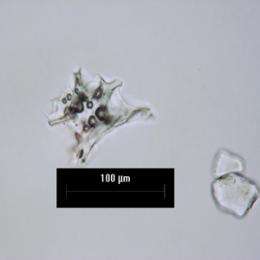
(PhysOrg.com) -- The dispersal of large ash plumes from the Eyjafjallajökull eruption in Iceland has generated widespread interest due largely to the impact on air transport and reports of ash-fall throughout the British Isles. Some reports allude to this as a unique event, which may be true as far as living memory is concerned, but there is ample evidence for such events occurring many times before in recent human history.
The RHOXTOR research group, a joint initiative between Royal Holloway, University of London and Oxford University, is dedicated to the study of past volcanic ash falls in Europe, and holds records of their sources, distributions and ages spanning the past 50,000 years and more. This provides information on recurrence intervals of volcanic activity and patterns of dispersal at the continental scale.
Dr Simon Blockley, from the Department of Geography at Royal Holloway, says: “One interesting point that emerges from our database is the common transport patterns of the Icelandic ash falls and, more importantly, the apparent absence of volcanic ash from sites in Spain. Recent investigations by the RHOXTOR team in collaboration with Spanish collaborators has found that volcanic ash is absent from sediments spanning the last 40,000 years.”
He adds, “So far the number of sites investigated in Spain for these tiny volcanic glass particles is relatively low, and there is therefore urgent need for further research, but the evidence uncovered thus far lends support to the proposal to view Spain as a potential emergency international air travel hub during times of Icelandic ash dispersal over Europe.”
Volcanic ash (tephra) is composed of particles that include volcanic glass shards that range in size depending upon distance from the source volcano. Ash that has travelled from Iceland to Britain and adjacent parts of Europe is usually composed of tiny glass particles between 0.025 and 0.1mm millimetres in size, and not usually visible to the naked eye except when concentrated in plumes.
Records of past events can be assembled because the glass falls into lakes, streams and estuaries, and on to peat and soil surfaces, where it becomes preserved within accumulating sediment. RHOXTOR is building and extending a data-base of such occurrences, and already holds information for about 25 Icelandic eruptions that have deposited detectable ash over the British Isles and parts of continental Europe during the last 15,000 years, attributed mainly to the Hekla, Katla, Grimsvötn, Askja and Torfjajökull volcanic centres. One of the most widespread of these ash dispersals, known to geologists as the Vedde Asha, erupted about 12,200 years ago, and had a remarkably similar distribution to that recorded for the Eyjafjallajökull eruption, depositing Icelandic tephra as far south as Switzerland, as far east as Russia and over much of the North Atlantic, as far west as the Labrador Sea.
The media in Britain has reported widespread claims of ash falls over cars, gardens and streets throughout Britain, but these reports are likely to have been greatly exaggerated. Members of RHOXTOR5, have been laying volcanic ash traps in various parts of Britain to establish the concentration of glass particles actually falling to ground.
Dr Blockley says, “While the process of analysis is still at an early stage, nevertheless swabs taken from cars in various parts of Britain have not included any volcanic glass, but only pollen grains and non-volcanic dust. The only samples from which volcanic glass has been recovered so far are of rainwater collected from Englefield Green in Surrey and Fort William in Scotland. These fall into an expected size range of between 0.025 and 0.1 mm in size, and are in very low concentrations.”
Provided by Royal Holloway, University of London


