Building A Handheld HIV Detector
Apr 01, 2010 By Devin Powell
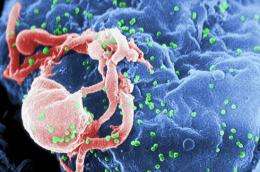
Scanning electron micrograph of HIV-1 budding from cultured lymphocyte. Credit: CDC.gov/Cynthia Goldsmith

Most Africans infected with HIV live in rural areas, where access to HIV testing has lagged behind the growing availability of HIV-fighting drugs.

Only clinics in big cities can afford the blood work equipment that allows doctors to monitor the disease’s progression and treat it early and effectively. Doctors in rural areas often prescribe treatment based only on the visible symptoms their patients show.

Responding to this need, researchers at California company Palo Alto Research Center have shrunk the inside large laboratory machines down to about the size of an iPod. Their cheap, handheld device promises to provide an immune system check-up on the spot and in less than 10 minutes.

"You need a device that a health worker can put into a backpack to reach the people in Africa or Asia," said Peter Kiesel, who presented his team's battery-powered prototype at a recent meeting of the American Physical Society in Portland, Ore.

The technology analyzes a small sample of blood drawn by a finger prick. flow through a tiny channel, illuminated by a laser beam. A detector watches patterns in the light that bounces off the cells to identify them.

The detector looks for and counts CD4+ , cells in the immune system that are killed by the . The World Health Organization recommends that antiretroviral treatment begin when a patient's CD4 count drops below 250.

"The quality of their test is great," said researcher Bernhard Weigl of PATH, a non-profit reviewing a variety of CD4 testing technologies. "If you look at their graph, it pretty much looked like the graph you would get from a big instrument."

PARC's prototype cost about $250 to build, a hundred times cheaper than the large flow cytometers currently in use. Still, getting it to market may prove challenging.

Kiesel is competing against a dozen other groups vying to fill the need for cheap, portable CD4 tests. Other technologies have been under development for years, including a half-dozen recent projects funded by the Bill and Melinda Gates Foundation that include disposable CD4 tester kits as easy to use as a home pregnancy test. Kiesler's laboratory-tested device is a couple of years behind these projects, some of which have been tested in the field in African countries.

None of these devices is currently on the market. Many have been redesigned several times in the quest for commercialization, including a device by the Austin-based biotech company LabNow, which had hoped to have its technology on the market by 2006.

In the end, Weigl suspects that health workers will use some combination of these approaches in the field. Detectors like the one at PARC, with a low cost per person tested, make sense for areas with many cases of , said Weigl. But disposable kits, which cost less initially and require no maintenance, may be a good solution for remote areas with fewer cases.

"I would be surprised if the first technologies aren't out by 2012," said Weigl. "The market is big; you're looking at many millions of users that have to get checked up every few months."

Explore further: Reading the unreadable

Provided by Inside Science News Service

4.9 /5 (7 votes)

Related Stories

Cheap, rapid check for HIV developed

Nov 02, 2005

Scientists from two New York universities say they've developed an inexpensive, hand-held sensor that can check a HIV patient's immune system in seconds.

Researchers develop quick, cheap HIV/AIDS test

Mar 27, 2007

A Cornell researcher is working to develop a quick, simple and cheap immune-system test for people in the developing world. It could help HIV/AIDS sufferers in the poorest countries get appropriate treatment to extend their ...

HIV measurement is questioned

Sep 27, 2006

Preliminary U.S. research indicates the HIV RNA level in untreated HIV-infected patients has little value in predicting the rate of CD4 cell count decrease.

Exhausted B cells hamper immune response to HIV

Jul 14, 2008

Recent studies have shown that HIV causes a vigorous and prolonged immune response that eventually leads to the exhaustion of key immune system cells--CD4+ and CD8+ T-cells--that target HIV. These tired cells become less ...

Recommended for you

New method for producing clean hydrogen

3 hours ago

Duke University engineers have developed a novel method for producing clean hydrogen, which could prove essential to weaning society off of fossil fuels and their environmental implications.

Making ice-cream more nutritious with meat left-overs

10 hours ago

Food industries are now turning meat left-over into high-protein content ingredients for food supplements, or to be added to processed food. But a EU-wide regulation covering them is still lacking.

Non-wetting fabric drains sweat

May 20, 2013

(Phys.org) —Waterproof fabrics that whisk away sweat could be the latest application of microfluidic technology developed by bioengineers at the University of California, Davis.

Protein study suggests drug side effects are inevitable

May 20, 2013

A new study of both computer-created and natural proteins suggests that the number of unique pockets – sites where small molecule pharmaceutical compounds can bind to proteins – is surprisingly small, meaning drug side ...

Attacking MRSA with metals from antibacterial clays

May 17, 2013

In the race to protect society from infectious microbes, the bugs are outrunning us. The need for new therapeutic agents is acute, given the emergence of novel pathogens as well as old foes bearing heightened antibiotic resistance.

User comments : 0

More news stories

New method for producing clean hydrogen

Duke University engineers have developed a novel method for producing clean hydrogen, which could prove essential to weaning society off of fossil fuels and their environmental implications.

Protein study suggests drug side effects are inevitable

A new study of both computer-created and natural proteins suggests that the number of unique pockets – sites where small molecule pharmaceutical compounds can bind to proteins – is surprisingly small, meaning drug side ...

Beautiful 'flowers' self-assemble in a beaker

By simply manipulating chemical gradients in a beaker of fluid, materials scientists at Harvard have found that they can control the growth behavior of crystals to create precisely tailored structures—such ...

Attacking MRSA with metals from antibacterial clays

In the race to protect society from infectious microbes, the bugs are outrunning us. The need for new therapeutic agents is acute, given the emergence of novel pathogens as well as old foes bearing heightened antibiotic resistance.

Power of US tornado dwarfs Hiroshima bomb

Wind, humidity and rainfall combined precisely to create Monday's massive killer tornado in Oklahoma. The awesome amount of energy released dwarfed the power of the atomic bomb that leveled Hiroshima.

Amazon plans greenhouse-style headquarters

US online giant Amazon has unveiled plans for a futuristic greenhouse style headquarters "where employees can work and socialize in a more natural, park-like setting."