New ways of measuring catastrophic risks may enhance Air Force efforts
Mar 31, 2010
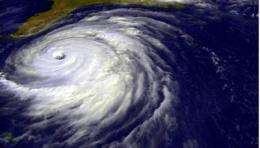
Noted AFOSR-funded researcher, Dr. Graciela Chichilnisky is pioneering a new approach for measuring, anticipating and managing catastrophic risks, sometimes called "Black Swans" or natural catastrophes like hurricanes, tornadoes, tsunamis and floods that may possibly enhance the US Air Force's capabilities of preparing for disasters. (Photo Credit: NASA)

Noted Air Force Office of Scientific Research-funded researcher, Dr. Graciela Chichilnisky is pioneering a new approach for measuring, anticipating and managing catastrophic risks, sometimes called "Black Swans" or natural catastrophes like hurricanes, tornadoes, tsunamis and floods that may possibly enhance the Air Force's capabilities of preparing for disasters.

"This research is important because it will provide solid foundations to help the Air Force and the public better prepare for the impact of catastrophic risks, communicate to experts and make decisions that can enhance national security," said Chichilnisky from her office at the Columbia University Consortium on Risk Management where the research is occurring.

Her team has developed new tools in probability and statistics for ranking risks, giving realistic prioritization to catastrophic events, making decisions under unpredictable conditions preceding an event and evaluating the economic after-effects of a disaster. They have also been conducting research, experiments validating theories and finding that decisions made under uncertainty do not always match up with classic treatment of Black Swans. Using their current findings as well as historical research, the team is rewriting the foundations of probability, statistics and decision-making for Black Swan events that better fit the observations.

"Our goal is to link our latest results, analytical tools and experimental efforts with other new theoretical and empirical strands of the literature in this area," she said.

The emerging statistics and probabilities will provide a new foundation, changing the field of research in a way that is more appropriate for Black Swans, which are now occurring with more regularity because of climate, migration and coastal changes.

"We need to organize and protect ourselves against natural hazards in a way that increases our capabilities to anticipate, mitigate and respond to catastrophes as was never done before," she said.

Explore further: Astonishing hi-resolution satellite views of the destruction from the Moore, Oklahoma tornado

Provided by Air Force Office of Scientific Research

2.8 /5 (4 votes)
add to favorites email to friend print save as pdf

Related Stories

Mapping the Risks of Hurricane Disasters

Sep 26, 2005

The Natural Disaster Hotspots report released earlier this year showed that the U.S. Gulf Coast is among the world's most at-risk regions in terms of human mortality and economic loss due to storms like Katrina ...

Not sure? Don't sweat it: Embrace Uncertainty

May 07, 2008

Governments and other large organisations should put more resources into ways of dealing with the unknown, according to experts pioneering a new approach to understanding and managing uncertainty.

Safer skies for the flying public

Sep 03, 2008

University of Texas professor Constantine Caramanis and colleagues at the Massachusetts Institute of Technology (MIT) are working on a air traffic decision-making system that rapidly adapts its flight recommendations ...

How to limit risk of climate catastrophe

Oct 02, 2009

(PhysOrg.com) -- A new analysis of climate risk, published by researchers at MIT and elsewhere, shows that even moderate carbon-reduction policies now can substantially lower the risk of future climate change. ...

Recommended for you

Strong earthquake at exceptional depth

May 24, 2013

This morning at 05:45 CEST, the earth trembled beneath the Okhotsk Sea in the Pacific Northwest. The quake, with a magnitude of 8.2, took place at an exceptional depth of 605 kilometers. Because of the great ...

Marine forecasting on the horizon for Indian Ocean Rim

May 24, 2013

Nearly all of the member countries of the Indian Ocean Rim Association for Regional Cooperation (IOR-ARC) will attend the week-long workshop to further cooperation and understanding on international ocean ...

Russia evacuates drifting Arctic research station

May 23, 2013

Russia has ordered the urgent evacuation of the 16-strong crew of a drifting Arctic research station after ice floe that hosts the floating laboratory began to disintegrate, officials said Thursday.

User comments : 0

More news stories

Galaxies fed by funnels of fuel

(Phys.org) —Computer simulations of galaxies growing over billions of years have revealed a likely scenario for how they feed: a cosmic version of swirly straws.

Century-old science helps confirm global warming

(Phys.org) —Ocean measurements taken more than 135 years ago during the scientific expedition of HMS Challenger have provided further confirmation of human-produced global warming over the past century.