El Nino phenomenon to die out by mid-year
Mar 30, 2010
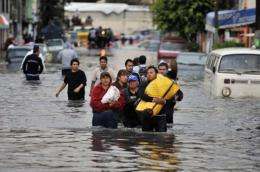
Residents walk through a flooded street in Mexico City in February 2010. Weather experts have said that El Nino, the weather anomaly that wrecks havoc around the Pacific and east Africa, has peaked and would disappear by mid-year.

Weather experts said Tuesday that El Nino, the weather anomaly that wreaks havoc around the Pacific and east Africa, has peaked and would disappear by mid-year.

"The most likely outcome by mid-year 2010 is for the event to have decayed and near-neutral conditions to be re-established across the tropical Pacific," said the World Meteorological Organisation expert Rupa Koumar Kolli.

El Nino is an occasional seasonal warming of the central and eastern Pacific Ocean that upsets normal from the western seaboard of Latin America to east Africa.

According to the UN weather agency, the climate phenomenon may have peaked in November or December.

However, its effects should still be felt through April to June.

"This is because impacts on many climate patterns both close to and remote from the Pacific, can occur even during the decay phase of an El Nino event."

Kolli said that this year's El Nino had a major impact in such as monsoons in southeast Asia and in southern Australia.

In February, the Philippines warned that its farming industry could lose about 433 million dollars due to a drought caused by El Nino.

Meanwhile in the Americas, El Nino was blamed for blizzards in the United States, heatwaves in Brazil, killer floods in Mexico and drought in Ecuador which occurred in February.

Explore further: Sea level influenced tropical climate during the last ice age

add to favorites email to friend print save as pdf

Related Stories

Forecasters say El Nino may be developing

Jun 08, 2009

(AP) -- A new El Nino could be approaching. Sea-surface temperatures have been warming in the tropical Pacific Ocean, suggesting the potential for the development of the El Nino climate phenomenon this summer, according ...

El Nino To Affect Weather In Colorado And Western U.S.

Dec 01, 2006

Colorado's late fall snowstorms could disappear by mid-December due to the influence of an El Niño event in the tropical Pacific Ocean, said Klaus Wolter, a University of Colorado at Boulder and National Oceanic and Atmospheric ...

El Nino may calm 2006 hurricane season

Sep 07, 2006

Hurricane forecasters say a weather phenomenon called El Nino may make the rest of the 2006 Atlantic hurricane season quieter than predicted.

El Nino could last beyond spring

Dec 11, 2006

A University of Colorado weather expert has warned the El Nino weather pattern over the Pacific Ocean could survive past the upcoming spring.

Recommended for you

Alaska volcano shoots ash 15,000 feet into the air

May 18, 2013

(AP)—One of Alaska's most restless volcanoes has shot an ash cloud 15,000 feet into the air in an ongoing eruption that has drawn attention from a nearby community but isn't expected to threaten air traffic.

NASA sees Cyclone Mahasen hit Bangladesh

May 17, 2013

NASA's Tropical Rainfall Measuring Mission satellite known as TRMM measured Cyclone Mahasen's rainfall rates from space as it made landfall on May 16. Mahasen has since dissipated over eastern India.

Rapid climate change ruled out ice age trees

May 17, 2013

Short, sharp fluctuations in the Earth's climate throughout the last ice age may have stopped trees from getting a foothold in Europe and northern Asia, scientists say.

User comments : 0

More news stories

Heat-related deaths in Manhattan projected to rise

Residents of Manhattan will not just sweat harder from rising temperatures in the future, says a new study; many may die. Researchers say deaths linked to warming climate may rise some 20 percent by the 2020s, ...

Mice, gerbils perish in Russia space flight

A number of mice and eight gerbils sent into space in a Russian capsule destined to find out how well organisms can withstand extended flights perished during their journey, scientists said Sunday as the ...

Kinks and curves at the nanoscale

One of the basic principles of nanotechnology is that when you make things extremely small—one nanometer is about five atoms wide, 100,000 times smaller than the diameter of a human hair—they are going ...

Honeybees trained in Croatia to find land mines

(AP)—Mirjana Filipovic is still haunted by the land mine blast that killed her boyfriend and blew off her left leg while on a fishing trip nearly a decade ago. It happened in a field that was supposedly ...