A mission to clear dangerous debris from space (w/ Video)
Mar 28, 2010
CubeSail

(PhysOrg.com) -- New UK technology is set to play a major part in clearing dangerous clouds of debris hurtling around the Earth's lower orbit.

More than 5,500 tonnes of debris is believed to be cluttering space around the planet as a result of 50 years of abandoning spacecraft, leading to a threat of collision to any manned or unmanned spacecraft, the destruction of hugely expensive technology and the potential threat of large debris plummeting back to Earth.

The build-up of debris - expected to grow at a rate of 5% each year - is also believed to obstruct television and other communications signals.

Scientists at the University of Surrey, working on the project funded by the European space company Astrium, have devised a 3 kg miniature satellite or "nanosatellite" fitted with a "".

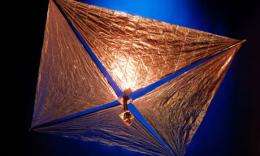
"CubeSail" is a device which can be fitted to satellites or launch vehicle upper stages that are sent into orbit and then can be deployed to successfully de-orbit equipment that has reached the end of its mission.

A 5 x 5 m, 3 kg, deployable sail is being developed to fit in a 10 x 10 x 30 cm nanosatellite and will be used in a demonstration mission to be launched in late 2011 demonstrating passive means of deorbiting for future satellites.

This video is not supported by your browser at this time.

Dr Vaios Lappas, lead researcher on the project and Senior Lecturer in Control at the Surrey Space Centre, said: "Protecting our planet and environment is key for sustainable growth. CubeSail is a novel, low cost which will demonstrate for the first time /satellite deorbiting using an ultra light 5 x 5 sail stowed and supported on a 3 kg nanosatellite.

“Successful deployment and testing of the sail can enable a low cost/mass solution to be used for future satellites and launch vehicle upper stages reducing dramatically the problem of space debris.

"Following successful in orbit demonstration, the proposed deorbit system will be offered as a standard deorbit system for Low Earth missions for satellites with a mass of less than 500 kg at a very low cost." "

CubeSail is due to be ready for launch on new satellites next year, and is expected to be available for shifting existing debris from 2013.

Dr Craig Underwood, Deputy Director of the Surrey Space Centre, and Reader in Spacecraft Engineering at SSC, said: “The launch of this innovative new technology is very timely. This week's announcement of the creation of the UK's space agency is evidence of the commitment to space initiatives and their huge potential for creating growth in the UK economy. At the same time, this exciting future is increasingly dependent on finding a sustainable approach to launching and disposing safely of spacecraft."

Explore further: NASA head views progress on asteroid lasso mission

Provided by University of Surrey

3.9 /5 (14 votes)

Related Stories

First Galileo satellite travels to launch site

Dec 01, 2005

GIOVE A, the first Galileo satellite, departed from ESA's test facility at the European Space Research and Technology Centre in The Netherlands on the morning of 29 November, bound for the Baikonur Cosmodrome ...

Space Image: A Beehive of Satellites

Feb 12, 2009

The launch of the first artificial satellite by the then Soviet Union in 1957 marked the beginning of the utilization of space for science and commercial activity. During the Cold War, space was a prime area ...

Sophisticated weather satellite rockets into orbit

Jun 28, 2009

(PhysOrg.com) -- The latest Geostationary Operational Environmental Satellite, GOES-O, soared into space today after a successful launch from Space Launch Complex 37 at the Cape Canaveral Air Force Station ...

Recommended for you

Dark, massive asteroid to fly by Earth on May 31

30 minutes ago

It's 1.7 miles long. Its surface is covered in a sticky black substance similar to the gunk at the bottom of a barbecue. If it impacted Earth it would probably result in global extinction. Good thing it is ...

Research team explains 'Lazarus' comets

3 hours ago

Astronomers from the University of Antioquia have discovered a graveyard of comets. These once-dormant comets, dubbed by astronomers as "The Lazarus comets," are now rejuvenated.

NASA ships sensors for seafaring satellite to France

4 hours ago

(Phys.org) —Three NASA-built instruments that are integral components of the next in a series of U.S./European ocean altimetry satellites have arrived in France for integration with their spacecraft in ...

Trip into space with DiCaprio costs $1.55m

4 hours ago

Leonardo DiCaprio is going to get closer to stars of a different kind as he heads into space aboard the Virgin Galactic, and a well-heeled bidder at the Cannes Film Festival has paid 1.2 million euros (1.5 million) to be ...

User comments : 6

Adjust slider to filter visible comments by rank

Display comments: newest first

Bob_B
not rated yet Mar 28, 2010
Ya, and all that gold foil and gold contacts and circuit boards, we'll be rich!
eachus
5 / 5 (2) Mar 29, 2010
Toally misleading headline. The dangerous debris in low-earth orbit, are very small objects and pieces of old upper stages that exploded in orbit. (No it wasn't intentional, and yes, once the problem was discovered the rockets were modified to prevent the problem.) Today it is ancient history--except that Cheyanne Mountain is still tracking tens of thousands of such objects.

There are even smaller particles that can't be easily tracked, and many too small to be tracked at all. But one microscopic paint fleck did take a divot of a space shuttle windshield.

So the big pieces, the obsolete spacecraft still on orbit are not a big problem. It is getting the count of pieces orbited per spacecraft down to one.
Sepp
5 / 5 (2) Mar 29, 2010
"The launch of this innovative new technology is very timely. This week's announcement of the creation of the UK's space agency is evidence of the commitment to space initiatives and their huge potential for creating growth in the UK economy."

Sounds like hype to me. As eachus says, there are lots of small pieces up there and this sail (innovative technology?) does nothing to reduce their number.
NickFun
not rated yet Mar 29, 2010
What's to prevent large pieces of space debris from destroying the sails on this satellite?
eurekalogic
not rated yet Mar 30, 2010
we need a lazer program to vaporize all parts smaller than a toaster floating round at least making a clear coridor everyone can use to launch out of earth. Untill pleabs like us can launch a vehicle without international assistance to find a debris window out of eaths low orbit, the earth will continue to be a prison for us budding space explorer pleabs.
LKD
not rated yet Mar 30, 2010
we need a lazer program to vaporize all parts smaller than a toaster floating round at least making a clear corridor everyone can use to launch out of earth.


As simple a resolution that would be, no country will allow a laser weapon to be put into space no matter the purpose. Its stupid, ridiculous, but what can you do?

It would be nice if they simply attached it to the space station so it could be refuel and monitored properly, but that is surely wistful dreaming on my part.

More news stories

Dark, massive asteroid to fly by Earth on May 31

It's 1.7 miles long. Its surface is covered in a sticky black substance similar to the gunk at the bottom of a barbecue. If it impacted Earth it would probably result in global extinction. Good thing it is ...

Source of life running out: water scientists

The majority of people on Earth people will face severe water shortages within a generation or two if pollution and waste continues unabated, scientists warned at a conference in Bonn Friday.

ACOG: Hormone therapy not recommended to prevent CHD

(HealthDay)—Menopausal hormone therapy should not be used for prevention of coronary heart disease, according to a Committee Opinion from the American College of Obstetricians and Gynecologists (ACOG) published ...

Storm chasers: born to be wild?

(HealthDay)—We've all seen them: the surfers who race to the beach when a hurricane hits, the guy who decides to ride out the storm in his overmatched boat, the tornado chasers who fearlessly steer their ...