Fossil feces point to a shark attack 15 million years ago
Mar 26, 2010 by Lin Edwards report
Image credit: Calvert Marine Museum.

(PhysOrg.com) -- Paleontologists Stephen Godfrey and Joshua Smith have been studying marine fossils in the Maryland area of Calvert Cliffs for many years, and Godfrey has catalogued over 26,000 items found on the local beaches. Many of these items are fossilized shark teeth belonging to several genera, but they have also found fossils of a wide range of other creatures, including fish, birds, sea cows, crocodiles, and seals.

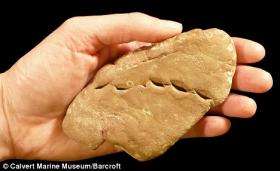
Now, in a new paper, they report on coprolites (fossilized feces) found on the beach, that probably came from a crocodile, and which bear characteristic tooth marks of a prehistoric shark. The coprolites are examples of extremely rare trace fossils, which are fossils that provide evidence of that cannot be determined from body fossils.

Analysis of the two coprolites bearing teeth marks, and a third found nearby, suggested they came from a vertebrate predator that was not a shark, and while it is not certain, Professor Godfrey believes they were most likely produced by a crocodile. One of the coprolites had been severed by teeth, while the other bore a row of impressions of teeth. The fossils were dated to around 15 million years ago. Coprolites are fairly common at Calvert Cliffs, an area that was underwater at the time, but no coprolites had ever been found bearing teeth marks.

The researchers made silicone casts of the tooth impressions to help them identify the creature that made them. There are eight shark genera bearing the characteristic asymmetrical teeth, but the best fit for the tooth marks were the Miocene ancestors of the tiger shark (Galeocerdo cuvier).

Godfrey and Smith reasoned that the positions of the marks and their curvature suggested the bulk of the fecal masses were in the sharks’ mouths. There are several possible explanations: the shark may have bitten into the feces and then spat them out, or it could have bitten into the feces during an attack on the crocodile. Tiger are indiscriminate eaters and do tentatively bite into objects to see if they are palatable, but Godfrey said if the shark had bitten into the feces after they were expelled from the body, there should have been bite marks on both sides, and they should have been deeper. He said the pattern is more consistent with the shark biting into the feces while they were still in the body, or after the animal had been disemboweled.

Godfrey and Smith’s paper is published in Naturwissenschaften. The fossils will be displayed in the Calvert Marine Museum in Solomons, Maryland, where Professor Godfrey is Curator of Paleontology.

Explore further: Shellfish show population growth did not send humans out of Africa

More information: Shark-bitten vertebrate coprolites from the Miocene of Maryland, Naturwissenschaften, March 10, 2010. DOI:10.1007/s00114-010-0659-x

Related Stories

Jaws -- 4 million BC

Mar 16, 2010

It might sound like a mashup of monster movies, but palaeontologists have discovered evidence of how an extinct shark attacked its prey, reconstructing a killing that took place 4 million years ago.

Boy finds giant shark tooth

Mar 11, 2008

A 9-year-old Florida boy found a 5-inch-long fossil of an ancient shark tooth buried in the sand on an Egmont Key beach.

Plesiosaur a victim of shark attack

Oct 06, 2009

(PhysOrg.com) -- An 85 million-year-old plesiosaur fossil has been found with over 80 shark's teeth, suggesting the animal was the victim of sharks in a feeding frenzy. The find is perhaps the most spectacular example of ...

As sharks dwindle, new laws enacted

May 28, 2007

Shark fisheries in Mexico and throughout the world are dealing with proposed rules to curb shark hunting in the interest of preserving these predators.

Recommended for you

Divers begin Lake Michigan search for Griffin ship

Jun 16, 2013

Divers began opening an underwater pit Saturday at a remote site in northern Lake Michigan that they say could be the resting place of the Griffin, a ship commanded by the 17th century French explorer La ...

Lost medieval city found in Cambodia

Jun 15, 2013

A lost medieval city that thrived on a mist-shrouded Cambodian mountain 1,200 years ago has been discovered by archaeologists using revolutionary airborne laser technology, a report said.

User comments : 1

Adjust slider to filter visible comments by rank

Display comments: newest first

mstrkimchee
3.7 / 5 (3) Mar 26, 2010
Awesome! they find new species in spain, giant spheres in costa rica, and evidence of trexs in southern continents but here in maryland they find evidence of some sort of vertebrate that tried to eat another animal that had to take a shit... FANTASTIC, this will put us on the map for sure! maryland does crabcakes and football but here in southern maryland we find fossilized crap and sharks teeth next to nuclear power plants, yea its our favorite past time hahaha

More news stories

US economy: Steady as she goes

America's economy will hum along its path of moderate growth, adding 4.7 million jobs through the end of next year, say University of Michigan economists.

The hidden agenda of Obama's opposition

Is the US Tea Party movement a racial backlash against President Obama? A new study by Angie Maxwell from the University of Arkansas, and Wayne Parent from Louisiana State University, assesses whether racial attitudes are ...

Multiview 3-D photography made simple

Computational photography is the use of clever light-gathering tricks and sophisticated algorithms to extract more information from the visual environment than traditional cameras can.

DNA constructs antenna for solar energy

Researchers at Chalmers University of Technology have found an effective solution for collecting sunlight for artificial photosynthesis. By combining self-assembling DNA molecules with simple dye molecules, ...