First-time cosmonauts set to blast off with toy duck
Mar 19, 2010
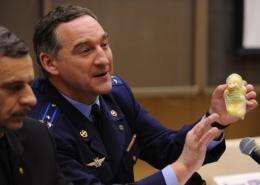
Russian cosmonaut Alexander Skvortsov displays a toy duck, during a press conference outside Moscow in Star City. The tiny toy was picked out by his daughter as an impromptu "weightlessness sensor," said Skvortsov.

Russian cosmonaut Alexander Skvortsov brandished a small toy duck Friday as he and his crewmates prepared to blast off to the International Space Station (ISS) in April.

The tiny toy was picked out by his daughter as an impromptu "weightlessness sensor," said Skvortsov, who will take off from on April 2 along with fellow Russian Mikhail Korniyenko and NASA astronaut Tracy Caldwell-Dyson.

"We thought it was light and pretty enough. I think it should bring us luck," said Skvortsov, a uniformed air force colonel, speaking at the Star City training facility outside Moscow.

The astronauts will spend two days in a cramped before arriving at the ISS, where they will join US astronaut Timothy Creamer, Soichi Noguchi of Japan and Russian Oleg Kotov.

One of the three Russians will have to sleep on the US side of the station, since the Russian side has only two beds, officials said.

Skvortsov, 43, and Korniyenko, 49, are both set to make their first space flight after training together.

"The hardest thing in our profession is the waiting. Sasha (Alexander) and I have been waiting 12 years for this flight," said Korniyenko, a former Moscow policeman, who is set to turn 50 in space.

"The most important thing is not to break down, to keep yourself going, to keep training despite all the difficulties. Then you will achieve success," Korniyenko said.

Caldwell-Dyson made her first space flight in 2007. Speaking Russian and English, she said she had "very little time" to train with her Russian colleagues but described it as "rewarding".

"I think the most challenging part we'll face in orbit will be maintaining our team work during the very busy timeline we have," she said.

Earlier Friday the head of Russia's space agency Roskosmos Anatoly Perminov said that a moratorium on to the ISS would continue "for two or three years," as NASA will remain reliant on the three-seater Soyuz launch.

"There are many people interested. Very many countries have made requests, but now it is physically impossible for us," Perminov said, the Interfax news agency reported.

Explore further: Dark, massive asteroid to fly by Earth on May 31

add to favorites email to friend print save as pdf

Related Stories

Astronauts to taste 'space sushi'

Dec 03, 2009

US astronaut Timothy Creamer said on Thursday he was impatient to taste "space sushi" courtesy of his Japanese crewmate after they arrive on the International Space Station (ISS) later this month.

Russian cargo spacecraft nearing ISS

Jun 17, 2005

MOSCOW, June 17 (UPI) -- A Russian cargo spacecraft has been launched into orbit successfully and will reach the International Space Station Saturday, Russian space officials said.

Russian ship with tourist docks with space station

Mar 28, 2009

A Russian Soyuz capsule carrying second-time space tourist Charles Simonyi docked Saturday at the International Space Station, media reports quoted the control centre near Moscow as saying.

Astronauts dock at International Space Station

Dec 22, 2009

A Russian rocket carrying three astronauts from Japan, Russia and the United States docked at the International Space Station Wednesday, the Russian flight control centre said.

Recommended for you

Dark, massive asteroid to fly by Earth on May 31

20 hours ago

It's 1.7 miles long. Its surface is covered in a sticky black substance similar to the gunk at the bottom of a barbecue. If it impacted Earth it would probably result in global extinction. Good thing it is ...

Research team explains 'Lazarus' comets

23 hours ago

Astronomers from the University of Antioquia have discovered a graveyard of comets. These once-dormant comets, dubbed by astronomers as "The Lazarus comets," are now rejuvenated.

NASA ships sensors for seafaring satellite to France

May 24, 2013

(Phys.org) —Three NASA-built instruments that are integral components of the next in a series of U.S./European ocean altimetry satellites have arrived in France for integration with their spacecraft in ...

Trip into space with DiCaprio costs $1.55m

May 24, 2013

Leonardo DiCaprio is going to get closer to stars of a different kind as he heads into space aboard the Virgin Galactic, and a well-heeled bidder at the Cannes Film Festival has paid 1.2 million euros (1.5 million) to be ...

User comments : 0

More news stories

Galaxies fed by funnels of fuel

(Phys.org) —Computer simulations of galaxies growing over billions of years have revealed a likely scenario for how they feed: a cosmic version of swirly straws.

Source of life running out: water scientists

The majority of people on Earth people will face severe water shortages within a generation or two if pollution and waste continues unabated, scientists warned at a conference in Bonn Friday.

Dark, massive asteroid to fly by Earth on May 31

It's 1.7 miles long. Its surface is covered in a sticky black substance similar to the gunk at the bottom of a barbecue. If it impacted Earth it would probably result in global extinction. Good thing it is ...

Yahoo, pay-TV operators among Hulu bidders

Online video site Hulu is again up for sale, with Yahoo and pay TV operators DirecTV and Time Warner Cable among the seven bidders, according to a person with direct knowledge of the matter.

Radiation leak at Japan lab; small impact expected

An atomic research lab in northern Japan has reported a radiation leak that may have affected about 50 people, though none were hospitalized and no impact was expected outside the facility, the lab's operator ...

Heart failure accelerates male 'menopause'

Heart failure accelerates the aging process and brings on early andropausal syndrome (AS), according to research presented today at the Heart Failure Congress 2013. AS, also referred to as male 'menopause', was four times ...