Chile aftershocks could go on for years: scientists
Mar 05, 2010
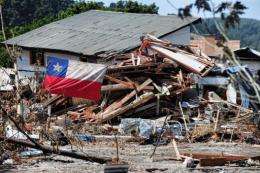
A Chilean flag flutters next to a destroyed house in Constitucion, some 300 km south of Santiago, on March 4th. Chileans will be feeling aftershocks following last week's 8.8-magnitude earthquake for months and possibly years, scientists said Friday, as three strong tremors rocked the country.

Chileans will be feeling aftershocks from the devastating 8.8-magnitude earthquake for months and possibly years to come, scientists said Friday, as three strong tremors rocked the country.

"The larger the earthquake, the larger the aftershocks, the more of them and the longer they're going to last," said John Bellini, a geophysicist at the US Geological Survey (USGS) in Colorado.

"They will wind down in number, but they will probably be noticeable to people for months and could go on possibly for years," he told AFP.

Chile has been rattled by more than 200 aftershocks since the historic monster quake struck the South American country six days ago, killing some 800 people as buildings collapsed and tsunamis swept people to sea.

Several have topped 6.0 on the Richter scale, including Friday's three tremors, which were powerful enough to cause already damaged buildings to collapse.

The aftershocks in Chile were "not more numerous than expected but because of the large size of this earthquake, they are much larger in size than normal aftershocks," said Bill Herbert, a professor of geophysics at the University of Pittsburgh.

In Haiti, where a 7.0-magnitude reduced much of the capital Port-au-Prince to rubble in January and claimed over 200,000 lives, experts estimate there have been "dozens" of aftershocks, not hundreds as in Chile.

"One reason is because the Chile earthquake was a lot bigger than the quake in Haiti -- it released about 500 times more energy," explained USGS geophysicist Jessica Sigala.

"It's a lot of energy that's released, and the Earth is trying to get back to normal. In order to do that it's still moving, and that's what the aftershocks are."

Scientists believe aftershocks could still be occurring years after the 9.1-earthquake off the coast of Sumatra in Indonesia in 2004, which triggered a deadly tsunami that killed around 200,000 people in south Asia.

"There was a 9.1 that happened in December 2004 and then there was an 8.6 that happened in March 2005, and occasionally today, we'll see an earthquake in that area that may be an aftershock from the one that happened in 2004," Sigala said.

Hours afer Sigala had spoken to AFP, a 6.5-magnitude quake struck off the coast of Sumatra.

Explore further: Alaska volcano shoots ash 15,000 feet into the air

add to favorites email to friend print save as pdf

Related Stories

High aftershock risk for Haiti in next 30 days: USGS

Jan 22, 2010

Earthquake-hit Haiti faces a high risk of possibly damaging aftershocks for at least 30 days and is set to suffer further tremors for months or even years to come, the US Geological Survey said Friday.

Chile quake in 'elite class' like 2004 Asian quake

Feb 28, 2010

(AP) -- The huge earthquake that struck off the coast of Chile belongs to an "elite class" of mega earthquakes, experts said, and is similar to the 2004 Indian Ocean temblor that triggered deadly tsunami ...

Strong quake hits Haiti: US geologists

Jan 20, 2010

A strong earthquake that scientists measured at 6.1 magnitude hit Port-au-Prince Wednesday, sending residents running into the streets eight days after the city was razed by a 7.0 quake.

10,000 aftershocks follow Italy quake

Apr 13, 2009

Scientists have detected 10,000 aftershocks since last week's earthquake in Italy of which around 1,000 could be felt, a top expert said on Monday, warning that the tremors will probably get stronger.

Chilean Earthquake Triggers Smaller Than Expected Tsunami

Mar 01, 2010

(PhysOrg.com) -- While a huge earthquake off the coast of Chile triggered a tsunami that moved at the speed of a jet aircraft across the Pacific Ocean Feb. 27, the event was smaller scientists expected, said a University ...

Recommended for you

Alaska volcano shoots ash 15,000 feet into the air

May 18, 2013

(AP)—One of Alaska's most restless volcanoes has shot an ash cloud 15,000 feet into the air in an ongoing eruption that has drawn attention from a nearby community but isn't expected to threaten air traffic.

NASA sees Cyclone Mahasen hit Bangladesh

May 17, 2013

NASA's Tropical Rainfall Measuring Mission satellite known as TRMM measured Cyclone Mahasen's rainfall rates from space as it made landfall on May 16. Mahasen has since dissipated over eastern India.

Rapid climate change ruled out ice age trees

May 17, 2013

Short, sharp fluctuations in the Earth's climate throughout the last ice age may have stopped trees from getting a foothold in Europe and northern Asia, scientists say.

Earth's iron core is surprisingly weak, researchers say

May 17, 2013

The massive ball of iron sitting at the center of Earth is not quite as "rock-solid" as has been thought, say two Stanford mineral physicists. By conducting experiments that simulate the immense pressures deep in the planet's ...

User comments : 3

Adjust slider to filter visible comments by rank

Display comments: newest first

gopher65
not rated yet Mar 05, 2010
Once again, the Richter scale isn't used anymore. The beginning to that sentence should have read "Several have topped magnitude 6.0". Not only is that shorter, it's more accurate. Since journalists strive for both shortness (because of physical space in paper formats, and because of reader attention online) and accuracy, I'd think that they'd be anxious to stop using the term "Richter scale" when they shouldn't.
otto1923
not rated yet Mar 05, 2010
As of today there are no earthquakes in or around puerto Rico where usually one will find 30-100 weekly. Anybody think this is ominous?
http://earthquake....-61.php
Caliban
1 / 5 (1) Mar 05, 2010
It's possible that the release of the fault that caused the chilean earthquake has temporarily relieved some of the pressure on one or more of the central american/caribbean plates, especially after the Haiti quake. Let's hope so.

More news stories

Mice, gerbils perish in Russia space flight

A number of mice and eight gerbils sent into space in a Russian capsule destined to find out how well organisms can withstand extended flights perished during their journey, scientists said Sunday as the ...

Fracking risks to ground water assessed

(Phys.org) —Extraction of "unconventional" gas from sedimentary rocks such as shale could provide a clean energy source and help some regions to become energy independent, but concerns have been raised ...

Honeybees trained in Croatia to find land mines

(AP)—Mirjana Filipovic is still haunted by the land mine blast that killed her boyfriend and blew off her left leg while on a fishing trip nearly a decade ago. It happened in a field that was supposedly ...

German energy shift faces headwinds

Tense engineers have their eyes peeled on complex colour-coded diagrams on a wall-sized screen that makes their control room look like the inside of a spaceship.

Internet in 'coma' as Iran election looms

Iran is tightening control of the Internet ahead of next month's presidential election, mindful of violent street protests that social networkers inspired last time around over claims of fraud, users and ...