Small dogs originated in the Middle East
Feb 23, 2010
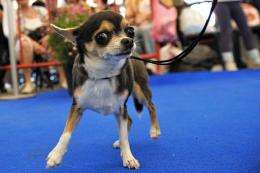
A Chihuahua is walked by its handler at a dog show in the southern Israeli town of Arad in 2008. Small domesticated dogs probably originated in the Middle East more than 12,000 years ago as the descendants of grey wolves, according to a gene study published on Wednesday.

A genetic study has found that small domestic dogs probably originated in the Middle East more than 12,000 years ago. Researchers writing in the open access journal BMC Biology traced the evolutionary history of the IGF1 gene, finding that the version of the gene that is a major determinant of small size probably originated as a result of the domestication of the Middle Eastern gray wolf.

Melissa Gray and Robert Wayne, from the University of California, Los Angeles, led a team of researchers who surveyed a large sample of gray wolf populations. She said, "The mutation for small body size post-dates the domestication of dogs. However, because all small dogs possess this variant of IGF1, it probably arose early in their history. Our results show that the version of the IGF1 gene found in small dogs is closely related to that found in Middle Eastern wolves and is consistent with an ancient origin in this region of small domestic dogs".

Previous archeological work in the Middle East has unearthed the remains of small domestic dogs dating to 12,000 years ago. Sites in Belgium, Germany and Western Russia contain older remains (13,000-31,000 years ago), but these are of larger dogs. These findings support the hypothesis put forward by Gray and colleagues that small body size evolved in the Middle East.

Reduction in body size is a common feature of domestication and has been seen in other domesticated animals including cattle, pigs and goats. According to Gray, "Small size could have been more desirable in more densely packed agricultural societies, in which dogs may have lived partly indoors or in confined outdoor spaces".

Explore further: Honeybees trained in Croatia to find land mines

More information: The IGF1 small dog haplotype is derived from Middle Eastern gray wolves, Melissa M. Gray, Nathan B. Sutter, Elaine A. Ostrander and Robert K. Wayne, BMC Biology (in press), www.biomedcentral.com/bmcbiol/

Related Stories

Black wolves: The first genetically modified predators?

Feb 05, 2009

Emergence of black-colored wolves is the direct result of humans raising dogs as pets and beasts of burden, according to new research by a University of Calgary biologist published today by the prestigious ...

Researchers study genetic evolution of African dogs

Aug 04, 2009

(PhysOrg.com) -- African village dogs are not a mixture of modern breeds but have directly descended from an ancestral pool of indigenous dogs, according to a Cornell-led genetic analysis of hundreds of semi-feral ...

Dog 'laugh' silences other dogs

Dec 05, 2005

Washington state researchers report discovering what might be the sound of dog laughter. The scientists say the long, loud pant they recorded has a calming or soothing effect on the behavior of other dogs, ABC News reported.

Human-dog communication -- breed as important as species

Jul 24, 2009

Dog breeds selected to work in visual contact with humans, such as sheep dogs and gun dogs, are better able to comprehend a pointing gesture than those breeds that usually work without direct supervision. A series of tests, ...

Many in West fear wolf reintroduction

Dec 27, 2005

Some 900 wolves roam Idaho, Oregon, Montana, Wyoming and Colorado thanks to a federal program that reintroduced and protected the wolf in the West.

Recommended for you

Honeybees trained in Croatia to find land mines

9 hours ago

(AP)—Mirjana Filipovic is still haunted by the land mine blast that killed her boyfriend and blew off her left leg while on a fishing trip nearly a decade ago. It happened in a field that was supposedly ...

Front-row seats to climate change

May 17, 2013

By day, insects provide the white noise of the South, but the night belongs to the amphibians. In a typical year, the Southern air hangs heavy from the humidity and the sounds of wildlife.

Captured in silken netting and sticky hairs

May 16, 2013

The great ecological success of spiders is often substantiated by the evolution of silk and webs. Biologists of the Kiel University and the University of Bern now found an alternative adaptation to hunting ...

User comments : 2

Adjust slider to filter visible comments by rank

Display comments: newest first

Birger
not rated yet Feb 24, 2010
The choice of a Chihuahua for the illustration is a bit confusing, since this dog variant must have come into existence after the beginning of New World agricultural settlements, and thus separately from Old World small dog races.
Shootist
not rated yet Feb 24, 2010
This doesn't seem to take into account mastiff, terrier and hound; each of which has its own "small" breeds.

More news stories

Honeybees trained in Croatia to find land mines

(AP)—Mirjana Filipovic is still haunted by the land mine blast that killed her boyfriend and blew off her left leg while on a fishing trip nearly a decade ago. It happened in a field that was supposedly ...

Heat-related deaths in Manhattan projected to rise

Residents of Manhattan will not just sweat harder from rising temperatures in the future, says a new study; many may die. Researchers say deaths linked to warming climate may rise some 20 percent by the 2020s, ...

Kinks and curves at the nanoscale

One of the basic principles of nanotechnology is that when you make things extremely small—one nanometer is about five atoms wide, 100,000 times smaller than the diameter of a human hair—they are going ...