Grizzly bears move into polar bear habitat in Manitoba, Canada
Feb 23, 2010
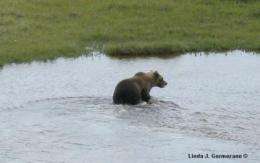
This is a grizzly Bear (Ursus arctos), photographed in Wapusk National Park, Manitoba, Canada, on August 9, 2008. Credit: Linda Gormezano

Biologists affiliated with the American Museum of Natural History and City College of the City University of New York have found that grizzly bears are roaming into what was traditionally thought of as polar bear habitat—and into the Canadian province of Manitoba, where they are officially listed as extirpated. The preliminary data was recently published in Canadian Field Naturalist and shows that sightings of Ursus arctos horribilis in Canada's Wapusk National Park are recent and appear to be increasing in frequency.

"Grizzly bears are a new guy on the scene, competition and a potential predator for the polar bears that live in this area," says Robert F. Rockwell, a research associate at the Museum and a professor of Biology at CUNY. "The first time we saw a grizzly we were flying over the middle of Wapusk, counting fox dens, when all of the sudden Linda Gormezano, a graduate student working with Rockwell and a co-author of the paper, shouted 'Over there, over there—a grizzly bear.' And it wasn't a dirty or a moose—we saw the hump."

That sighting in August 2008 spurred Rockwell and Gormezano to look through records to get a better picture of the bear population in the park. There was no evidence of grizzly bears before 1996, not even in the trapping data from centuries of Hudson Bay Company operation. But between 1996 and 2008 the team found nine confirmed sightings of grizzly bears, and in the summer of 2009 there were three additional observations.

"The opportunistic sightings seem to be increasing," says Gormezano. "This is worrying for the polar bears because grizzly bears would likely hibernate in polar bear maternity denning habitat. They would come out of hibernation at the same time and can kill polar cubs."

Before this study, researchers thought that the barren landscape north of the Hudson Bay was an impassable gap in resources for potentially migrating grizzly bears. But some U. arctos horribilis have managed to move from their historic ranges in the Rockies, the Yukon, and Nunavut, probably because of their flexible, mixed diet of berries and meat. The potential gap was navigable, and now some grizzly bears have reached the abundant caribou, moose, fish, and berries found to the south in Canada's Wapusk National Park.

"Although we don't yet know if they are wandering or staying—the proof will come from an observed den or cubs—these animals will eventually be residents of this national park," says Rockwell. "The Cree elders we talked to feel that now that grizzly bears have found this food source they will be staying."

"A big question is how to deal with these new residents," continues Gormezano. "In Canada, both the polar and grizzly bear are federally listed as species of special concern. In Manitoba, the polar bear is provincially listed as threatened while the prairie population of the grizzly bear is listed as extirpated."

Explore further: Navy dolphins discover rare old torpedo off Calif. coast near Coronado

Provided by American Museum of Natural History

3.7 /5 (3 votes)
add to favorites email to friend print save as pdf

Related Stories

Grizzly bears feast on diverse diet

Feb 15, 2007

There’s no such thing as picky grizzly bears—they’ll eat almost anything they can find. A new University of Alberta study that tracked food habits of the Alberta grizzly bear living in the foothills sheds ...

There's no such thing as a picky grizzly bear

Feb 22, 2007

A new University of Alberta study, which tracked eating habits of grizzly bears living in the Alberta foothills, sheds some light on the animal's varied diet and their activity pattern.

Goose eggs may help polar bears weather climate change

Dec 15, 2008

As polar bears adapt to a warming Arctic—a frozen seascape that cleaves earlier each spring—they may find relief in an unlikely source: snow goose eggs. New calculations show that changes in the timing ...

Global Warming Reduces Polar Bear Survival

Nov 15, 2006

Researchers for the first time have shown a connection between global warming and decreased polar bear survival, says a University of Wyoming scientist.

Recommended for you

Scientists take a new look at an ancient crop

5 hours ago

Though the price makes you wince, you might just buy that bottle of your favorite olive oil anyway. Perhaps it's exactly what you want for the salad dressing you're making tonight and for your special stir-fry ...

Bittersweet: Bait-averse cockroaches shudder at sugar

23 hours ago

Sugar isn't always sweet to German cockroaches, especially to the ones that avoid roach baits. In a study published May 24 in the journal Science, North Carolina State University entomologists show the ne ...

White tiger mystery solved

May 23, 2013

White tigers today are only seen in zoos, but they belong in nature, say researchers reporting new evidence about what makes those tigers white. Their spectacular white coats are produced by a single change ...

User comments : 0

More news stories

EU bans three pesticides harmful to bees

The European Commission said Friday that it will ban for two years beginning in December pesticides blamed for killing the bees that pollinate food and fruit crops.

Dark, massive asteroid to fly by Earth on May 31

It's 1.7 miles long. Its surface is covered in a sticky black substance similar to the gunk at the bottom of a barbecue. If it impacted Earth it would probably result in global extinction. Good thing it is ...

ACOG: Hormone therapy not recommended to prevent CHD

(HealthDay)—Menopausal hormone therapy should not be used for prevention of coronary heart disease, according to a Committee Opinion from the American College of Obstetricians and Gynecologists (ACOG) published ...

Storm chasers: born to be wild?

(HealthDay)—We've all seen them: the surfers who race to the beach when a hurricane hits, the guy who decides to ride out the storm in his overmatched boat, the tornado chasers who fearlessly steer their ...