Monkeys keep their words short, just like us
Jan 29, 2010 by Lin Edwards report
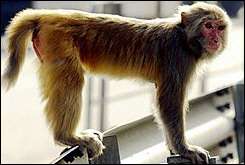
Rhesus macaque

(PhysOrg.com) -- A new study has found that Formosan macaque monkeys prefer to keep their "words" short, using long vocalizations only occasionally.

Humans also predominantly use short words that do not take much time to say, such as “of”, “a”, “it”, “or”, and “the”. The relationship between how often a word is used and its length is known as the law of brevity, and the fact that follow the same law may shed some light on the origins of .

The scientists, led by Dr Stuart Semple of the Roehampton University in London, U.K., said the law of brevity, which appears to apply to all languages, means the words used most often are short, while the words used least often are long, and this makes communication more efficient. Dr Semple and his team wanted to see if the same rule would apply to other animals, and to find out, they studied macaques (Macaca cyclopsis) living on Mount Longevity in Taiwan. The macaques were chosen because they are known for their extensive use of .

Formosan macaques have 35 calls of varying duration, and the scientists studied the relationship between the call duration and how often the call was used. The exact meanings of the calls are so far unknown, but they include greetings, screams and whines. The researchers found that the calls most often used were very short, while the longer calls, such as whines, were rarely heard.

Dr Semple said this was the first time the law of brevity had been observed in non-human vocal communications, but it makes sense because keeping conversations short saves time and energy and also avoids drawing the attention of potential predators. The observations also suggest that the common primate could also have followed the law of brevity, which reveals more about why humans also communicate in this way.

The scientists plan to follow up their research by studying other species, including non-primates, to see if they also keep their vocal communications short.

The paper is published in the journal of the Royal Society, Biology Letters.

Explore further: City-life changes blackbird personalities, study shows

More information: Efficiency of coding in macaque vocal communication, Biology Letters, DOI:10.1098/rsbl.2009.1062

Related Stories

Syntax in our primate cousins

Dec 11, 2009

(PhysOrg.com) -- A study carried out in Ivory Coast has shown that monkeys of a certain forest-dwelling species called Campbell's monkeys emit six types of alert calls. The primates combine these calls into ...

Genetic variation cues social anxiety in monkeys and humans

Jan 14, 2009

A genetic variation involving the brain chemical serotonin has been found to shape the social behavior of rhesus macaque monkeys, which could provide researchers with a new model for studying autism, social anxiety and schizophrenia. ...

Researchers studying how singing bats communicate

Oct 18, 2007

Bats are the most vocal mammals other than humans, and understanding how they communicate during their nocturnal outings could lead to better treatments for human speech disorders, say researchers at Texas A&M University.

Recommended for you

City-life changes blackbird personalities, study shows

9 hours ago

The origins of a young animal might have a significant impact on its behavior later on in life. Researchers at the Max Planck Institute for Ornithology in Radolfzell, Germany, have been able to demonstrate ...

Origins of 'The Hoff' crab revealed (w/ Video)

9 hours ago

The history of a new type of crab, nicknamed 'The Hoff' because of its hairy chest, which lives around hydrothermal vents deep beneath the Southern Ocean and Indian Ocean, has been revealed for the first ...

Personality test finds some mouse lemurs shy, others bold

14 hours ago

Anyone who has ever owned a pet will tell you that it has a unique personality. Yet only in the last 10 years has the study of animal personality started to gain ground with behavioral ecologists, said Jennifer ...

Lonely bees make better guests

22 hours ago

Solitary bees are twice as likely to pollinate the flowers they visit as their more sociable counterparts, according to a new study.

User comments : 0

More news stories

Origins of 'The Hoff' crab revealed (w/ Video)

The history of a new type of crab, nicknamed 'The Hoff' because of its hairy chest, which lives around hydrothermal vents deep beneath the Southern Ocean and Indian Ocean, has been revealed for the first ...

New Zealand emerges as guinea pig for global tech firms

When Google chose New Zealand to unveil secret plans for a balloon-driven wi-fi network last weekend, it cemented the country's reputation as a test bed for global tech companies looking to trial their latest innovations, ...