Quakes were biggest disaster killers of decade: UN
Jan 28, 2010
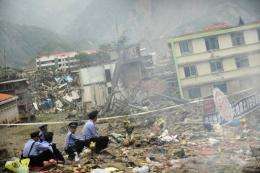
Chinese policemen survey the devastated town of Beichuan in May 2009, a year after the Sichuan earthquake that left over 87,000 people dead. Earthquakes triggered the deadliest disasters of the past decade and remain a major threat for millions of people worldwide who live in some of the world's megacities, the United Nations said.

Earthquakes triggered the deadliest disasters of the past decade and remain a major threat for millions of people worldwide who live in some of the world's megacities, the United Nations said Thursday.

A UN-backed study said nearly 60 percent of about 780,000 people killed by in 2000 to 2009 died during earthquakes.

But climate events affected far more people -- nearly three quarters of the two billion hit by catastrophes.

Storms accounted for 22 percent of the overall death toll while claimed 11 percent of lives lost in 3,852 disasters over the period.

Officials and researchers also maintained their alarm over climate or weather-related disasters as the overall number of catastrophes more than doubled compared to the previous decade.

The global bill for disasters reached 960 billion dollars according to the study by the Center for Research on Epidemiology of Disasters (CRED) at Belgium's Catholic University of Louvain.

"Earthquakes are the deadliest natural hazard of the past 10 years and remain a serious threat for millions of people worldwide as eight out of the 10 most populous cities in the world are on earthquake fault-lines," said Margareta Wahlstroem, UN Special Representative for Disaster Risk Reduction.

But just four percent of those hit by catastrophes over the decade suffered in earthquakes, while 44 percent of them were affected by floods and 30 percent by droughts, the study found.

The deadliest disasters in the first decade of the 21st century were the in 2004, which killed 226,408 people in several countries, Cyclone Nargis in Myanmar, which claimed 136,366 lives in 2008 and the Sichuan earthquake in China that year, with 87,476 deaths.

Some 73,338 people were also killed in an earthquake in Pakistan (2005) and 72,210 in heat waves in Europe (2003).

The current decade has got off to an equally deadly start, with about 170,000 feared dead in the powerful and unprecedented that struck Haiti's capital Port-au-Prince and the surrounding area on January 12.

Explore further: Sea level influenced tropical climate during the last ice age

add to favorites email to friend print save as pdf

Related Stories

UN warns of 'megadisasters' linked to climate change

Jun 17, 2009

The United Nations on Tuesday raised the prospect of "megadisasters" affecting millions of people in some of the world's biggest cities unless more is done to heed the threat of climate change.

UN: Growth of slums boosting natural disaster risk

May 17, 2009

(AP) -- The rampant growth of urban slums around the world and weather extremes linked to climate change have sharply increased the risks from "megadisasters" such as devastating floods and cyclones, a U.N. ...

Fewer earthquake fatalities in 2005

Jan 14, 2006

There were fewer deaths worldwide in 2005 due to earthquakes, but almost 90,000 casualties were reported, the U.S. Geological Survey reported.

Why Haiti keeps getting hammered by disasters

Jan 13, 2010

(AP) -- When it comes to natural disasters, Haiti seems to have a bull's-eye on it. That's because of a killer combination of geography, poverty, social problems, slipshod building standards and bad luck, ...

UN sketches countries with climate risk profile

Jun 11, 2009

Disasters caused by climate change will inflict the highest losses in poor countries with weak governments that have dashed for growth and failed to shield populations which settle in exposed areas, a UN report ...

Recommended for you

Alaska volcano shoots ash 15,000 feet into the air

May 18, 2013

(AP)—One of Alaska's most restless volcanoes has shot an ash cloud 15,000 feet into the air in an ongoing eruption that has drawn attention from a nearby community but isn't expected to threaten air traffic.

NASA sees Cyclone Mahasen hit Bangladesh

May 17, 2013

NASA's Tropical Rainfall Measuring Mission satellite known as TRMM measured Cyclone Mahasen's rainfall rates from space as it made landfall on May 16. Mahasen has since dissipated over eastern India.

Rapid climate change ruled out ice age trees

May 17, 2013

Short, sharp fluctuations in the Earth's climate throughout the last ice age may have stopped trees from getting a foothold in Europe and northern Asia, scientists say.

User comments : 18

Adjust slider to filter visible comments by rank

Display comments: newest first

croghan27
5 / 5 (1) Jan 28, 2010
Was not "the Indian Ocean Tsunami in 2004" caused by an earthquake - underwater, but nevertheless an earthquake.
Skeptic_Heretic
1 / 5 (3) Jan 30, 2010
It was indeed.

When did we replace the term "weather event" with "climate event"?

Lots of mention of the European heatwave but no mention of the current deep freeze that's claimed twice as many people.
croghan27
not rated yet Jan 30, 2010
It was indeed.

When did we replace the term "weather event" with "climate event"?

Lots of mention of the European heatwave but no mention of the current deep freeze that's claimed twice as many people.


Oh dear .... while I find the article rather confusing - particularly the first two paragraphs: "

"A UN-backed study said nearly 60 percent of about 780,000 people killed by disasters in 2000 to 2009 died during earthquakes.

But climate events affected far more people -- nearly three quarters of the two billion hit by catastrophes."

The segue from deaths to 'effected by' is confusing.

The only reference to weather or climate problems is one about 'extreme temperatures' - nothing about European chills of heat waves.

Do we have the same article?
marjon
1 / 5 (1) Jan 30, 2010
Apparently it is considered gauche to point out that earthquakes of equal or greater energy kill far fewer people in developed nations with prosperous economies.
croghan27
not rated yet Jan 30, 2010
Apparently it is considered gauche to point out that earthquakes of equal or greater energy kill far fewer people in developed nations with prosperous economies.


marjon I am glad you used the word 'gauche' - as the only references I have seen to the horrid way the prosperous economies have treated Haiti and impoverished it has been in the 'gauche' press - left wing. Indeed, I saw a clip from FOX where some commentator extolled all the 'charity' that has been visited upon the unfortunate country. The suggestion being that it is all their fault - and has nothing to do with years of deliberate animosity toward Haiti.
Skeptic_Heretic
1 / 5 (2) Jan 30, 2010
The only reference to weather or climate problems is one about 'extreme temperatures' - nothing about European chills of heat waves.
Ahem,
Officials and researchers also maintained their alarm over climate or weather-related disasters as the overall number of catastrophes more than doubled compared to the previous decade.
Not done yet.
and 72,210 in heat waves in Europe (2003).

Do we have the same article?

Read the entire article first.
marjon
1 / 5 (1) Jan 30, 2010
Apparently it is considered gauche to point out that earthquakes of equal or greater energy kill far fewer people in developed nations with prosperous economies.


marjon I am glad you used the word 'gauche' - as the only references I have seen to the horrid way the prosperous economies have treated Haiti and impoverished it has been in the 'gauche' press - left wing. Indeed, I saw a clip from FOX where some commentator extolled all the 'charity' that has been visited upon the unfortunate country. The suggestion being that it is all their fault - and has nothing to do with years of deliberate animosity toward Haiti.

Whose fault is it then when such kleptocracies continue to be subsidized by the USA and other governments? The USA does bear some responsibility for not demanding a better, more accountable government in Haiti in exchange for aid.
croghan27
not rated yet Jan 31, 2010
The US did not back Papa Doc and his dreadful son? Even yet I thoroughly agree with you - if the 'right thing' were done years ago - the extent of the disaster would certainly have been lessened.
marjon
1 / 5 (1) Jan 31, 2010
Here is an solid engineering solution to help Haiti:
http://www.monoli...or-haiti

After building such housing, the next step is to have a government that would protect the owner's property rights.

Skeptic_Heretic
1 / 5 (2) Jan 31, 2010
It doesn't matter who backed him. He was the better of the 8 options at the time. Haiti has never had central leadership or economic control over it's own fate. That's the problem with being an economically desolate island nation with few natural resources.
marjon
1 / 5 (1) Jan 31, 2010
It doesn't matter who backed him. He was the better of the 8 options at the time. Haiti has never had central leadership or economic control over it's own fate. That's the problem with being an economically desolate island nation with few natural resources.

If Haiti had no resources where did the ruling class acquire their wealth? (Of course they steal it, but it must come from some type of natural resource.)
How are Haiti's natural resources any less than their neighbor's that are not as poor?
croghan27
1 / 5 (1) Jan 31, 2010
It doesn't matter who backed him. He was the better of the 8 options at the time. Haiti has never had central leadership or economic control over it's own fate. That's the problem with being an economically desolate island nation with few natural resources.


The major portion of the wealth of France came from Haiti for years before it claimed independence. (Which pissed off Napoleon to no end.)

The US withheld recognition of the island state for fear it would energize slaves in other states to throw off their shackles.
croghan27
not rated yet Jan 31, 2010
Here is an solid engineering solution to help Haiti:
http://www.monoli...or-haiti

After building such housing, the next step is to have a government that would protect the owner's property rights.


marjon, are you an engineer? I remember a quote from somewhere that said if you want the solution of a problem ask and engineer and they will give you an engineering solution: a soldier and they will give you a military solution: a scientist and they will give you a scientific solution.

That you bothered to look into it shows the depth of your compassion - I think that the second part of the posting is more important than the first.
Skeptic_Heretic
1 / 5 (2) Feb 01, 2010
It doesn't matter who backed him. He was the better of the 8 options at the time. Haiti has never had central leadership or economic control over it's own fate. That's the problem with being an economically desolate island nation with few natural resources.

If Haiti had no resources where did the ruling class acquire their wealth? (Of course they steal it, but it must come from some type of natural resource.)
How are Haiti's natural resources any less than their neighbor's that are not as poor?

You think the Dominican Republic is wealthy? Ridiculous. The only countries that do well in the caribbean are the tourist traps, the tobacco exporters, and the drug cartels.
marjon
3 / 5 (2) Feb 01, 2010
Here is an solid engineering solution to help Haiti:
http://www.monoli...or-haiti

After building such housing, the next step is to have a government that would protect the owner's property rights.


marjon, are you an engineer? I remember a quote from somewhere that said if you want the solution of a problem ask and engineer and they will give you an engineering solution: a soldier and they will give you a military solution: a scientist and they will give you a scientific solution.

That you bothered to look into it shows the depth of your compassion - I think that the second part of the posting is more important than the first.

Is it more compassionate to keep people dependent or to promote independence?
Skeptic_Heretic
1 / 5 (3) Feb 01, 2010
Is it more compassionate to keep people dependent or to promote independence?

Promoting independence allows the one at play to determine which is better.

Creating dependence removes the ability to choose. I prefer to give people the choice and allow their own morality to decide what's best.
marjon
1 / 5 (1) Feb 01, 2010
Is it more compassionate to keep people dependent or to promote independence?

Promoting independence allows the one at play to determine which is better.

Creating dependence removes the ability to choose. I prefer to give people the choice and allow their own morality to decide what's best.

You believe it compassionate to allow people to chose to be dependent?
Skeptic_Heretic
not rated yet Feb 04, 2010
You believe it compassionate to allow people to chose to be dependent?

If they choose to lead a life I do not agree with, is it compassionate for me to force my views upon them?

More news stories

Heat-related deaths in Manhattan projected to rise

Residents of Manhattan will not just sweat harder from rising temperatures in the future, says a new study; many may die. Researchers say deaths linked to warming climate may rise some 20 percent by the 2020s, ...

Mice, gerbils perish in Russia space flight

A number of mice and eight gerbils sent into space in a Russian capsule destined to find out how well organisms can withstand extended flights perished during their journey, scientists said Sunday as the ...

Kinks and curves at the nanoscale

One of the basic principles of nanotechnology is that when you make things extremely small—one nanometer is about five atoms wide, 100,000 times smaller than the diameter of a human hair—they are going ...

Honeybees trained in Croatia to find land mines

(AP)—Mirjana Filipovic is still haunted by the land mine blast that killed her boyfriend and blew off her left leg while on a fishing trip nearly a decade ago. It happened in a field that was supposedly ...