High aftershock risk for Haiti in next 30 days: USGS
Jan 22, 2010
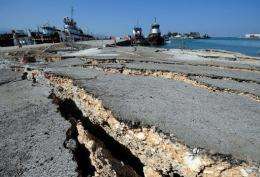
A Haitian worker (L) inspects the port in Port-au-Prince on January 22 following the massive 7.0-magnitude quake that shattered the country. Earthquake-hit Haiti faces a high risk of possibly damaging aftershocks for at least 30 days and is set to suffer further tremors for months or even years to come, the US Geological Survey said Friday.

Earthquake-hit Haiti faces a high risk of possibly damaging aftershocks for at least 30 days and is set to suffer further tremors for months or even years to come, the US Geological Survey said Friday.

The capital Port-au-Prince was hit by two fresh aftershocks on Friday, 10 days after the initial 7.0-magnitude quake killed at least 75,000 people and left half a million others homeless.

"The aftershock sequence of the magnitude-7 that struck near Port-au-Prince, Haiti, on January 12, 2010, will continue for months, if not years," the USGS warned in a bulletin on its website.

"The frequency of events will diminish with time, but damaging earthquakes will remain a threat."

There was only a three percent chance of another 7.0-magnitude quake in the next 30 days but there was a 25 percent chance of at least one 6.0-magnitude tremor and a 90 percent likelihood of at least one 5.0-magnitude quake.

Any above 5.0-magnitude will be widely felt and "has the potential to cause additional damage, particularly to vulnerable, already damaged structures," the USGS said.

Nearly 50 aftershocks have rocked Haiti since the initial earthquake, the strongest being a 5.9-magnitude tremor on Wednesday.

The strongest of Friday's new shocks was of magnitude 4.4, the USGS said.

The geological fault responsible for the January 12 is part of a seismic zone located between the American and Carribbean .

Explore further: NASA's BARREL mission launches 20 balloons

add to favorites email to friend print save as pdf

Related Stories

Strong quake hits Haiti: US geologists

Jan 20, 2010

A strong earthquake that scientists measured at 6.1 magnitude hit Port-au-Prince Wednesday, sending residents running into the streets eight days after the city was razed by a 7.0 quake.

Ill. earthquake a wake-up call

Apr 20, 2008

A U.S. seismologist said the earthquake that jolted the Midwest Friday is a reminder of the risks seismic events pose outside familiar quake areas.

Fewer earthquake fatalities in 2005

Jan 14, 2006

There were fewer deaths worldwide in 2005 due to earthquakes, but almost 90,000 casualties were reported, the U.S. Geological Survey reported.

Taiwan hit by 6.4-magnitude quake: USGS

Dec 20, 2009

A strong 6.4-magnitude earthquake hit off eastern Taiwan on Saturday evening, the US Geological Survey said, the biggest tremor to rock the island this year.

Killer quake struck just below the surface

Jan 13, 2010

The quake that struck Haiti erupted just below the surface on a notorious fault where two plates of the Earth's crust jostle and grind, scientists said.

After Haiti, Worries About Other Big Quakes

Jan 18, 2010

In the last several days, while the attention of the world has been focused on the human toll of Tuesday's earthquake in Haiti, scientists have begun to look at the quake's geological toll. What is the danger ...

Recommended for you

NASA's BARREL mission launches 20 balloons

3 hours ago

(Phys.org) —In Antarctica in January, 2013 – the summer at the South Pole – scientists released 20 balloons, each eight stories tall, into the air to help answer an enduring space weather question: ...

Power of US tornado dwarfs Hiroshima bomb

4 hours ago

Wind, humidity and rainfall combined precisely to create Monday's massive killer tornado in Oklahoma. The awesome amount of energy released dwarfed the power of the atomic bomb that leveled Hiroshima.

Origins of human culture linked to rapid climate change

10 hours ago

Rapid climate change during the Middle Stone Age, between 80,000 and 40,000 years ago, during the Middle Stone Age, sparked surges in cultural innovation in early modern human populations, according to new research.

User comments : 0

More news stories

Power of US tornado dwarfs Hiroshima bomb

Wind, humidity and rainfall combined precisely to create Monday's massive killer tornado in Oklahoma. The awesome amount of energy released dwarfed the power of the atomic bomb that leveled Hiroshima.

If you can remember it, you can remember it wrong

(Medical Xpress)—Native peoples in regions where cameras are uncommon sometimes react with caution when their picture is taken. The fear that something must have been stolen from them to create the photo ...

B vitamins could delay dementia

(Medical Xpress)—Despite spending billions of dollars on research and development, drug companies have been unable to come up with effective treatments for dementia and Alzheimer's Disease (AD). Now, A. ...

Reducing caloric intake delays nerve cell loss

Activating an enzyme known to play a role in the anti-aging benefits of calorie restriction delays the loss of brain cells and preserves cognitive function in mice, according to a study published in the May ...