Tsunami-generating quake possible off Indonesia: scientists
January 17, 2010 by Richard Ingham

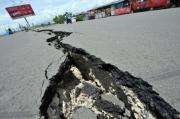
Motorists past a damaged road in the Sumatran city of Padang in 2009 after a 7.6-magnitude quake.

Enlarge

Motorists past a damaged road in the Sumatran city of Padang in 2009 after a 7.6-magnitude quake. A huge wave-generating quake capable of killing as many people as in the 2004 Indian Ocean tsunami could strike off the Indonesian island of Sumatra, and the city of Padang is in the firing line, a team of seismologists said on Sunday.

A huge wave-generating quake capable of killing as many people as in the 2004 Indian Ocean tsunami could strike off the Indonesian island of Sumatra, and the city of Padang is in the firing line, a team of seismologists said on Sunday.

The group -- led by a prominent scientist who predicted a 2005 Sumatran with uncanny accuracy -- issued the warning in a letter to the journal Nature Geoscience.

The peril comes from a relentless buildup of pressure over the last two centuries on a section of the Sunda Trench, one of the world's most notorious zones, which runs parallel to the western coast, they said.

This section, named after the Mentawai islands, "is near failure," the letter warned bluntly.

"The threat of a great tsunamigenic earthquake with a magnitude of more than 8.5 on the Mentawai patch is unabated. (...) There is potential for loss of life on the scale of the 2004 ."

The letter gave no timeframe for this event but warned starkly of the danger for Padang, a city of 850,000 people that lies broadside to the risky segment.

"The threat from such an event is clear and the need for urgent mitigating action remains extremely high," it said.

More than 220,000 people lost their lives in the killer wave of December 26 2004 when a 9.3-magnitude earthquake, occurring farther north on the Sunda Trench, ruptured the boundary where the Australian plate of Earth's crust plunges beneath the Eurasian plate.

The authors of the letter are led by John McCloskey, a professor of the Environmental Sciences Research Institute at the University of Ulster, Northern Ireland.

In March 2005, McCloskey warned that the December 26 2004 quake had built up major stress in an adjoining part of the fault to the south. He declared a temblor in the region of 8.5 magnitude with the capacity to generate a tsunami was imminent and urged the authorities to beef up preparations.

Such predictions are extraordinarily rare in the world of seismology. Knowledge of where earthquakes strike is extensive but the ability to say when they will occur remains elusive.

But McCloskey was proven right within two weeks. On March 28 2005, a quake measuring 8.6 erupted at Simeulue island, generating a three-metre (10-feet) tsunami.

In the letter to Nature Geoscience, his team explained their calculations for the vulnerable Mentawai segment in the aftermath of a 7.6-magnitude quake that occurred 60 kilometers (37 miles) near Padang on September 30 last year, killing more than 1,000 people.

Despite its size, this event did not ease the pressure on the Mentawai section, especially under the island of Siberut. Stresses there have been accumulating since an 8.7-magnitude quake in 1797 that caused fault slippage of 10 metres (32.5 feet) and unleashed a tsunami that inundated Padang and neighbouring areas.

Under Siberut, the largest of the Mentawai islands, "the megathrust strain-energy budget remains substantially unchanged" after the 2009 quake, McCloskey's team said.

"It is imperative that the Indonesian authorities, with the assistance of the international community and non-governmental organisations, ensure that they complete the relief effort and earthquake-resistant reconstruction following this earthquake, and work with the people in Padang to help prepare them for the next one."

(c) 2010 AFP

4.6 /5 (9 votes)  

Rank 4.6 /5 (9 votes)
Relevant PhysicsForums posts

More news stories

Land and sea species differ in climate change response: study

(Phys.org) -- Marine and terrestrial species will likely differ in their responses to climate warming, new research by Simon Fraser University and Australia’s University of Tasmania has found.

Space & Earth / Environment

created 8 hours ago | popularity 4 / 5 (5) | comments 6 | with audio podcast

Yale study concludes public apathy over climate change unrelated to science literacy

Are members of the public divided about climate change because they don't understand the science behind it? If Americans knew more basic science and were more proficient in technical reasoning, would public consensus match ...

Space & Earth / Environment

created 10 hours ago | popularity 4.8 / 5 (6) | comments 24 | with audio podcast

10 million years needed to recover from mass extinction

It took some 10 million years for Earth to recover from the greatest mass extinction of all time, latest research has revealed.

Space & Earth / Earth Sciences

created 10 hours ago | popularity 4 / 5 (4) | comments 1 | with audio podcast

Sophisticated simulations predict future warming

The chances of our planet being hit by a global warming of 3 degrees Celsius by 2050 is as likely as it being hit by an increase of 1.4 degrees, new research shows. Presented in the journal Nature Geoscience, the British study ...

Space & Earth / Earth Sciences

created May 22, 2012 | popularity 3.8 / 5 (11) | comments 51

Aliens don't want to eat us, says former SETI director

Alien life probably isn’t interested in having us for dinner, enslaving us or laying eggs in our bellies, according to a recent statement by former SETI director Jill Tarter.

Space & Earth / Space Exploration

created May 25, 2012 | popularity 4.4 / 5 (15) | comments 41


'Unzipped' carbon nanotubes could help energize fuel cells, batteries

Multi-walled carbon nanotubes riddled with defects and impurities on the outside could replace some of the expensive platinum catalysts used in fuel cells and metal-air batteries, according to scientists at ...

Change in developmental timing was crucial in the evolutionary shift from dinosaurs to birds: study

At first glance, it's hard to see how a common house sparrow and a Tyrannosaurus Rex might have anything in common. After all, one is a bird that weighs less than an ounce, and the other is a dinosaur that ...

Computer model used to pinpoint prime materials for efficient carbon capture

When power plants begin capturing their carbon emissions to reduce greenhouse gases – and to most in the electric power industry, it's a question of when, not if – it will be an expensive undertaking.

T cells 'hunt' parasites like animal predators seek prey, study shows

By pairing an intimate knowledge of immune-system function with a deep understanding of statistical physics, a cross-disciplinary team at the University of Pennsylvania has arrived at a surprising finding: T cells use a movement ...

Stunning image of smallest possible five-ringed structure

Scientists have created and imaged the smallest possible five-ringed structure – about 100,000 times thinner than a human hair – and you'll probably recognise its shape.

Browser wars flare in mobile space

The browser wars are heating up again, but this time the fight is for dominance of the mobile Internet.