Hunt for bird mummy in Conn. comes up empty
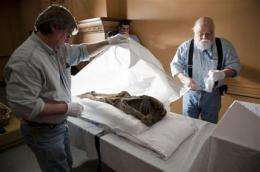
(AP) -- Researchers who examined an Egyptian mummy with the latest imaging technology found no evidence that a packet inside her was an offering to the gods of the ancient world.
Previous tests led to speculation that the packet was a bird mummy - something researchers said would be an unusual and exciting find - but high-resolution tests Thursday at Quinnipiac University showed no remnants of a bird. Instead, researchers said the packet and a few others in the mummy likely contained organs, which were sometimes preserved and placed back in mummies for use in the afterlife.
The mummy, known as Pa-Ib and believed to be about 4,000 years old, has been in the Barnum Museum in Bridgeport since the 1890s and was a prized exhibit of the flamboyant showman P.T. Barnum.
It was transported Thursday in a coffin complete with a police escort from the museum to the university's campus in North Haven.
A CT scanner took thousands of images that are eight times the resolution of tests done in 2006, and a tiny camera was inserted inside the mummy's skull. Researchers expect to report their conclusions in March.
Researchers said her teeth were worn, suggesting the diet of a commoner. The woman could have been a servant but probably didn't do a lot of manual labor, given the condition of her joints, said Gerald Conlogue, co-director of the Bioanthropology Research Institute at Quinnipiac.
The embalming process also appeared rushed, further evidence that the woman was not royalty, Conlogue said.
Researchers believe the woman was 30 to 40 years old when she died. Based on the new tests, they're leaning closer to 30.
Researchers also are trying to figure out whether the woman ever gave birth, because earlier tests showed evidence of arthritis in the pelvic area, which is common with women who have given birth. Conlogue offered no definitive answer Thursday, but said wrappings put on tightly could change the position of bones.
The tests did not determine a cause of death, but researchers were looking at possible signs of a calcium buildup in one of the packets that could suggest an infection.
The type of stitch on the wrappings on the mummy may offered clues as to where she lived in Egypt, said Kathy Maher, executive director of the Barnum Museum.
Lorelei Corcoran, director of the Institute of Egyptian art and archaeology at the University of Memphis, said confirmation that there was no bird mummy is important because it eliminates any doubt about that possibility. She said experts will keep looking for other examples.
Corcoran said she knows of only two other human mummies with bird mummies, one at the J. Paul Getty Museum in California and another in Switzerland. She said birds such as a falcon and an ibis were associated with the Egyptian god Thoth, who was believed to play an influential role in the final stage of judgment of the dead.
"He's the one whose opinion you would want to influence in order to get to the eternal afterlife," she said.
Ronald Beckett, co-director of the Bioanthropology Research Institute, said he was not surprised there was no bird mummy.
Conlogue noted that high school students witnessed the new tests.
"This mummy is actually very active today," Conlogue said. "She's creating interest in Egypt. If we spark one of the students to get interested in science, she's responsible for that."
© 2010 The Associated Press. All rights reserved. This material may not be published, broadcast, rewritten or redistributed.


