Older dental fillings contain form of mercury unlikely to be toxic
Dec 09, 2009
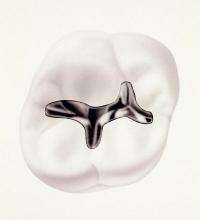
Older mercury-based dental fillings contain a form of mercury that scientists say is unlikely to be toxic. Credit: American Dental Association

A new study on the surface chemistry of silver-colored, mercury-based dental fillings suggests that the surface forms of mercury may be less toxic than previously thought. It appears online in ACS' journal Chemical Research in Toxicology.

In the study, Graham George and colleagues note that mercury-based fillings, also called amalgams, have been used by dentists to repair teeth for well-over a century. In recent decades their use has become controversial because of concerns about exposure to potentially toxic mercury. However, mercury can potentially exist in several different chemical forms, each with a different toxicity. Prior to this report, little was known about how the chemical forms of mercury in might change over time.

Using a special X-ray technique, the scientists analyzed the surface of freshly prepared metal fillings and compared these with the surface of aged fillings (about 20 years old) from a dental clinic. Fresh fillings contained metallic mercury, which can be toxic. Aged fillings, however, typically contain a form of mercury, called beta-mercuric or metacinnabar, which is unlikely to be toxic in the body.

The scientists found that the surfaces of metal fillings seem to lose up to 95 percent of their mercury over time. Loss of potentially toxic mercury from amalgam may be due to , exposure to some kinds of dental hygiene products, exposure to certain foods, or other factors. The scientists caution that "human exposure to mercury lost from fillings is still of concern."

More information: "The Chemical Forms of in Aged and Fresh Dental Amalgam Surfaces", http://pubs.acs.org/stoken/presspac/presspac/full/10.1021/tx900309c

Source: American Chemical Society (news : web)

Explore further: Protein study suggests drug side effects are inevitable

add to favorites email to friend print save as pdf

Related Stories

FDA concludes mercury in dental fillings not risky

Jul 28, 2009

(AP) -- The government declared Tuesday that silver dental fillings contain too little mercury to harm the millions who've had cavities filled with them - including young children - and that only people allergic to mercury ...

Dental chair a possible source of neurotoxic mercury waste

Mar 26, 2008

Mercury is a large component of dental fillings, but it is not believed to pose immediate health risks in that form. When exposed to sulfate-reducing bacteria, however, mercury undergoes a chemical change and becomes methylated, ...

Recommended for you

Protein study suggests drug side effects are inevitable

14 hours ago

A new study of both computer-created and natural proteins suggests that the number of unique pockets – sites where small molecule pharmaceutical compounds can bind to proteins – is surprisingly small, meaning drug side ...

Attacking MRSA with metals from antibacterial clays

May 17, 2013

In the race to protect society from infectious microbes, the bugs are outrunning us. The need for new therapeutic agents is acute, given the emergence of novel pathogens as well as old foes bearing heightened antibiotic resistance.

Keeping fruit, vegetables and cut flowers fresh longer

May 15, 2013

New technology offers the promise of reducing billions of dollars of losses that occur each year from the silent, invisible killer of fruits, vegetables and cut flowers—a gas whose effects are familiar to everyone who has ...

Why don't beetles freeze in the winter?

May 14, 2013

For 37 years, Queen's University Biochemistry professor Peter Davies has been unraveling the mystery of why some organisms including insects and fish don't freeze in the winter. His research into insect antifreeze protein ...

User comments : 0

More news stories

Protein study suggests drug side effects are inevitable

A new study of both computer-created and natural proteins suggests that the number of unique pockets – sites where small molecule pharmaceutical compounds can bind to proteins – is surprisingly small, meaning drug side ...

Non-wetting fabric drains sweat

(Phys.org) —Waterproof fabrics that whisk away sweat could be the latest application of microfluidic technology developed by bioengineers at the University of California, Davis.

Beautiful 'flowers' self-assemble in a beaker

By simply manipulating chemical gradients in a beaker of fluid, materials scientists at Harvard have found that they can control the growth behavior of crystals to create precisely tailored structures—such ...

Attacking MRSA with metals from antibacterial clays

In the race to protect society from infectious microbes, the bugs are outrunning us. The need for new therapeutic agents is acute, given the emergence of novel pathogens as well as old foes bearing heightened antibiotic resistance.

No new H7N9 cases in China for a week

No new human cases of the H7N9 virus have been recorded in China for a week, national health authorities said, for the first time since the outbreak began in March.

Slow pokes: Acupuncture helps hypothermic turtles

Two endangered sea turtles that are shells of their former selves after getting stranded on Cape Cod during a cold spell are getting some help easing back into the wild—from an acupuncturist.