NASA captures a visible image of Cleo's new eye
Dec 08, 2009
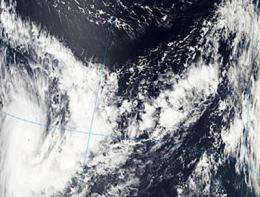
This is a visible image of Cleo (left) on December 8 at 08:15 UTC from the Moderate Imaging Spectroradiometer, MODIS, instrument on NASA's Aqua satellite. The blue longitude line helps show the curvature of the Earth. Credit: NASA MODIS Rapid Response Team

The Moderate Imaging Spectroradiometer or MODIS instrument that flies on NASA's Aqua satellite has amazing resolution from space, and captured Cleo's cloudless eye early this morning. Cleo has intensified from a Tropical Storm into a Cyclone.

MODIS captured an image of Cleo today, December 8 at 08:15 UTC (03:15 a.m. ET) as it passed overhead from its orbit in space. The development of an eye is an indication that Cleo strengthened overnight, and is now a tropical cyclone. Cleo has sustained winds near 109 mph (95 knots) with higher gusts. Hurricane-force winds only extend out to 25 miles from the center right now, while tropical storm-force winds extend as far as 65 miles. Cleo is at the top end of the Category Two Saffir-Simpson scale. Category three cyclones have sustained winds from 111-130 mph.

Cleo was located 340 miles southeast of Diego Garcia, near 10.8 degrees South latitude and 76.4 degrees East longitude. It was moving west-southwest near 12 mph. Currently, Cleo isn't threatening any landmasses.

Because Cleo is in a favorable area for strengthening, it is expected to reach Category 3 status later today or tomorrow. The current forecast track takes Cleo passing well to the north of La Reunion and Mauritius.

Source: NASA's Goddard Space Flight Center (news : web)

Explore further: Astonishing hi-resolution satellite views of the destruction from the Moore, Oklahoma tornado

add to favorites email to friend print save as pdf

Related Stories

Cyclone Anja hits wind shear, weakens drastically

Nov 17, 2009

This morning, Cyclone Anja was a powerful Category 4 cyclone on the Saffir-Simpson scale. Wind shear has now giving Anja a strong "punch in the gut" as the storm has weakened to a Category 1 cyclone.

Baja California residents watching for Hurricane Rick

Oct 16, 2009

Based on computer forecast models, the residents of southern and central Baja California should prepare over the weekend for now Tropical Storm Rick. Rick formed late yesterday, October 15, and is expected ...

Recommended for you

Strong earthquake at exceptional depth

21 hours ago

This morning at 05:45 CEST, the earth trembled beneath the Okhotsk Sea in the Pacific Northwest. The quake, with a magnitude of 8.2, took place at an exceptional depth of 605 kilometers. Because of the great ...

Marine forecasting on the horizon for Indian Ocean Rim

21 hours ago

Nearly all of the member countries of the Indian Ocean Rim Association for Regional Cooperation (IOR-ARC) will attend the week-long workshop to further cooperation and understanding on international ocean ...

Russia evacuates drifting Arctic research station

May 23, 2013

Russia has ordered the urgent evacuation of the 16-strong crew of a drifting Arctic research station after ice floe that hosts the floating laboratory began to disintegrate, officials said Thursday.

User comments : 1

Adjust slider to filter visible comments by rank

Display comments: newest first

omatumr
1 / 5 (1) Dec 09, 2009
NASA's Remarkable Adjustment

It is amazing how quickly NASA has turned its attention from the distant stars to Mother Earth.

Congratulations!

Unfortunately, NASA ignored "Earth's Heat Source - The Sun" while studying distant stars, and now NASA has switched its focus back to Mother Earth while still ignoring "Earth's Heat Source - The Sun."

That "hot ball of fire" that rolls across the sky each day sustains our very lives and controls Earth's climate.

It is time for NASA to grow up, study and accept the fact that experimental data shows Earth Heat Source is NOT a ball of hydrogen, although this lightest of all elements covers 91% of the top of the Sun's atmosphere.

With kind regards,
Oliver K. Manuel
Former NASA IP for Apollo

More news stories

Galaxies fed by funnels of fuel

(Phys.org) —Computer simulations of galaxies growing over billions of years have revealed a likely scenario for how they feed: a cosmic version of swirly straws.

Source of life running out: water scientists

The majority of people on Earth people will face severe water shortages within a generation or two if pollution and waste continues unabated, scientists warned at a conference in Bonn Friday.

Dark, massive asteroid to fly by Earth on May 31

It's 1.7 miles long. Its surface is covered in a sticky black substance similar to the gunk at the bottom of a barbecue. If it impacted Earth it would probably result in global extinction. Good thing it is ...

Drones may violate international law

(Phys.org) —As President Obama gives a speech on national security—including defending U.S. use of drones to combat terrorism—Leila Sadat, JD, international law expert and professor of law at Washington University in ...