Smokeless tobacco called 'moist snuff' is contaminated with harmful substances
Dec 03, 2009
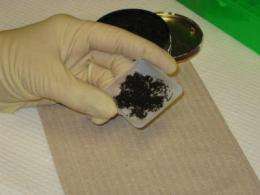
Smokeless tobacco contains surprisingly high levels of certain toxic and cancer-causing substances. Credit: Keith Lindsey

A new study on the smokeless tobacco product called moist snuff — placed between lip and gum — has led scientists in Minnesota to urge the tobacco industry to change manufacturing practices to reduce snuff's content of carcinogens. Their study is published online in ACS' monthly journal Chemical Research in Toxicology.

It reports that this category of contains surprisingly high levels of certain toxic and cancer-causing substances. Called (PAHs), they may contribute to carcinogenic effects associated with use.

Irina Stepanov and colleagues note that use of moist snuff increased by almost 80 fold between 1986-2003, partially because of the notion that it is safer then cigarettes. While smokeless tobacco use is indeed associated with lower risk of cancer as compared to cigarette smoking, it can lead to precancerous oral lesions and oral, esophageal, and pancreatic cancer. Only trace amounts of one of the PAHs has been reported to be present in smokeless tobacco prior to the recent discovery by Stepanov and colleagues that at least eight PAHs are present in smokeless tobacco. This finding inspired the new research.

The scientists analyzed the PAHs in 23 moist snuff samples that included various flavors of the most popular brands sold in the U.S. They identified 23 different PAHs in the samples, of which 9 are classified as carcinogens. They conclude that PAHs are one of the most abundant groups of cancer-causing substances in moist snuff. "Urgent measures are required from the U.S. to modify manufacturing processes so that the levels of these toxicants and carcinogens in U.S. moist snuff are greatly reduced," the article notes.

More information: "Analysis of 23 Polycyclic Aromatic Hydrocarbons in Smokeless Tobacco by Gas Chromatography-Mass Spectrometry", pubs.acs.org/stoken/presspac/presspac/full/10.1021/tx900281u

Source: American Chemical Society (news : web)

Explore further: Attacking MRSA with metals from antibacterial clays

add to favorites email to friend print save as pdf

Related Stories

Is snuff the answer to quitting smoking?

Sep 18, 2006

Researchers in Washington say smokeless tobacco is much safer than cigarettes but the jury is out on whether smokers should be encouraged to switch habits.

Smokeless tobacco safer than smoking

Jul 28, 2009

Smokeless tobacco products, as used in Europe and North America, do not appear to increase cancer risk. A large meta-analysis, published in the open access journal BMC Medicine, has shown that snuff as used in Scandinavia has no ...

Recommended for you

Attacking MRSA with metals from antibacterial clays

May 17, 2013

In the race to protect society from infectious microbes, the bugs are outrunning us. The need for new therapeutic agents is acute, given the emergence of novel pathogens as well as old foes bearing heightened antibiotic resistance.

Keeping fruit, vegetables and cut flowers fresh longer

May 15, 2013

New technology offers the promise of reducing billions of dollars of losses that occur each year from the silent, invisible killer of fruits, vegetables and cut flowers—a gas whose effects are familiar to everyone who has ...

Why don't beetles freeze in the winter?

May 14, 2013

For 37 years, Queen's University Biochemistry professor Peter Davies has been unraveling the mystery of why some organisms including insects and fish don't freeze in the winter. His research into insect antifreeze protein ...

The molecular basis of strawberry aroma

May 13, 2013

You know that summer is here when juicy red strawberries start to appear on the shelves. In Germany, this seasonal fruit has never been more popular: on average 3.5 kilos per head were consumed in 2012—a ...

A new dimension for 3-D protein structures

May 13, 2013

(Phys.org) —3D structures of biological molecules like proteins directly affect the way they behave in our bodies. EPFL scientists have developed a new infrared-UV laser method to more accurately determine ...

User comments : 0

More news stories

Attacking MRSA with metals from antibacterial clays

In the race to protect society from infectious microbes, the bugs are outrunning us. The need for new therapeutic agents is acute, given the emergence of novel pathogens as well as old foes bearing heightened antibiotic resistance.

Beautiful 'flowers' self-assemble in a beaker

By simply manipulating chemical gradients in a beaker of fluid, materials scientists at Harvard have found that they can control the growth behavior of crystals to create precisely tailored structures—such ...

Making gold green: New non-toxic method for mining gold

Northwestern University scientists have struck gold in the laboratory. They have discovered an inexpensive and environmentally benign method that uses simple cornstarch—instead of cyanide—to isolate gold from raw materials ...

Morocco to harness the wind in energy hunt

Morocco is ploughing ahead with a programme to boost wind energy production, particularly in the southern Tarfaya region, where Africa's largest wind farm is set to open in 2014.

Galaxy's Ring of Fire

Johnny Cash may have preferred this galaxy's burning ring of fire to the one he sang about falling into in his popular song. The "starburst ring" seen at center in red and yellow hues is not the product of ...