'Smell of old books' offers clues to help preserve them
Dec 02, 2009
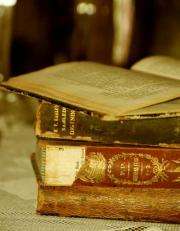
Old books give off an unmistakable, musty odor that scientists can use to assess the book's condition. Credit: Wikimedia Commons

Scientists may not be able to tell a good book by its cover, but they now can tell the condition of an old book by its smell. In a report in ACS' Analytical Chemistry, a semi-monthly journal, they describe development of a new test that can measure the degradation of old books and precious historical documents based on their smell. The nondestructive "sniff" test could help libraries and museums preserve a range of prized paper-based objects, some of which are degrading rapidly due to advancing age, the scientists say.

Matija Strlic and colleagues note in the new study that the familiar musty smell of an old book, as readers leaf through the pages, is the result of hundreds of so-called (VOCs) released into the air from the paper. Those substances hold clues to the paper's condition, they say. Conventional methods for analyzing library and archival materials involve removing samples of the document and then testing them with traditional laboratory equipment. But this approach destroys part of the document.

The new technique, called "material degradomics," analyzes the gases emitted by old books and documents without altering the documents themselves. They used it to "sniff" 72 historical papers from the 19th and 20th centuries, including papers containing rosin (pine tar) and wood fiber, which are the most rapidly degrading paper types in old books. The scientists identified 15 VOCs that seem good candidates as markers to track the degradation of paper in order to optimize their preservation. The method also could help preserve other historic artifacts, they add.

More information: "Material Degradomics: On the Smell of Old ", , http://pubs.acs.org/stoken/presspac/presspac/full/10.1021/ac9016049

Source: American Chemical Society (news : web)

Explore further: Chemical probe confirms that body makes its own H2S to benefit health

add to favorites email to friend print save as pdf

Related Stories

An inexpensive 'dipstick' test for pesticides in foods

Nov 04, 2009

Scientists in Canada are reporting the development of a fast, inexpensive "dipstick" test to identify small amounts of pesticides that may exist in foods and beverages. Their paper-strip test is more practical ...

Recommended for you

Counting small RNA in disease-causing organisms

Jun 18, 2013

Small molecules of RNA (tens to hundreds of nucleotides in length) play a key regulatory role in bacteria. Due to their small size, directly measuring the number of small RNA (sRNA) present in a single bacterium ...

Detecting homemade explosives, not toothpaste

Jun 13, 2013

(Phys.org) —Sandia National Laboratories researchers want airports, border checkpoints and others to detect homemade explosives made with hydrogen peroxide without nabbing people whose toothpaste happens ...

User comments : 0

More news stories

Unexpected behavior of well-known catalysts

Industrial palladium-copper catalysts change their structures before they get to work, already during the activation process. As a result, the reaction is catalysed by a catalyst that is different from the ...

DNA constructs antenna for solar energy

Researchers at Chalmers University of Technology have found an effective solution for collecting sunlight for artificial photosynthesis. By combining self-assembling DNA molecules with simple dye molecules, ...

LA to give every student an iPad; $30M order

Los Angeles' school system, the second largest in the United States, is ordering iPads for all its students, handing Apple a major success in its quest to make the tablet computer a replacement for textbooks.