Researchers create 'synthetic magnetic fields' for neutral atoms
Dec 02, 2009
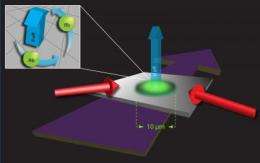
A pair of laser beams (red arrows) impinges upon an ultracold gas cloud of rubidum atoms (green oval) to create synthetic magnetic fields (labeled Beff). (Inset) The beams, combined with an external magnetic field (not shown) cause the atoms to "feel" a rotational force; the swirling atoms create vortices in the gas. Credit: JQI

(PhysOrg.com) -- Achieving an important new capability in ultracold atomic gases, researchers at the Joint Quantum Institute, a collaboration of the National Institute of Standards and Technology and the University of Maryland, have created "synthetic" magnetic fields for ultracold gas atoms, in effect "tricking" neutral atoms into acting as if they are electrically charged particles subjected to a real magnetic field. The demonstration, described in the latest issue of the journal Nature, not only paves the way for exploring the complex natural phenomena involving charged particles in magnetic fields, but may also contribute to an exotic new form of quantum computing.

As researchers have become increasingly proficient at creating and manipulating gaseous collections of atoms near , these ultracold gases have become ideal laboratories for studying the complex behavior of material systems. Unlike usual crystalline materials, they are free of obfuscating properties, such as impurity atoms, that exist in normal solids and liquids. However, studying the effects of magnetic fields is problematic because the gases are made of neutral atoms and so do not respond to magnetic fields in the same way as charged particles do. So how would you simulate, for example, such important exotic phenomena as the quantum Hall effect, in which electrons can "divide" into quasiparticles carrying only a fraction of the electron's electric charge?

The answer Ian Spielman and his colleagues came up with is a clever physical trick to make the neutral atoms behave in a way that is mathematically identical to how charged particles move in a . A pair of laser beams illuminates an ultracold gas of rubidium atoms already in a collective state known as a Bose-Einstein condensate. The laser light ties the atoms' internal energy to their external (kinetic) energy, modifying the relationship between their energy and momentum. Simultaneously, the researchers expose the atoms to a real magnetic field that varies along a single direction, so that the alteration also varies along that direction.
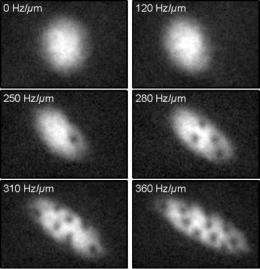
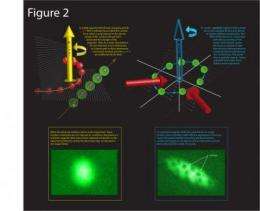
A harbinger of the synthetic magnetic fields is the formation of vortices (spots). These spots, the number of which increases with increasing synthetic field, mark the points about which atoms swirled with a whirlpool-like motion. The measurement units in each panel indicate the size of the external magnetic field gradient applied to the gas of atoms, with larger external fields producing more vortices. Credit: JQI

In a strange inversion, the laser-illuminated neutral atoms react to the varying magnetic field in a way that is mathematically equivalent to the way a charged particle responds to a uniform magnetic field. The neutral atoms experience a force in a direction perpendicular to both their direction of motion and the direction of the magnetic field gradient in the trap. By fooling the atoms in this fashion, the researchers created vortices in which the atoms swirl in whirlpool-like motions in the gas clouds. The vortices are the "smoking gun," Spielman says, for the presence of synthetic magnetic fields.

Previously, other researchers had physically spun gases of ultracold atoms to simulate the effects of magnetic fields, but rotating gases are unstable and tend to lose atoms at the highest rotation rates. In their next step, the JQI researchers plan to partition a nearly spherical system of 20,000 rubidium atoms into a stack of about 100 two-dimensional "pancakes" and increase their currently observed 12 vortices to about 200 per-pancake. At a one-vortex-per-atom ratio, they could observe the and control it in unprecedented ways. In turn, they hope to coax to behave like a class of quasiparticles known as "non-abelian anyons," a required component of "topological quantum computing," in which anyons dancing in the gas would perform logical operations based on the laws of quantum mechanics.
Credit: JQI

More information: Y.J. Lin, R.L. Compton, K. Jimenez-Garcia, J.V. Porto and I.B. Spielman. Synthetic magnetic fields for ultracold . Nature, Dec. 3, 2009.

Source: National Institute of Standards and Technology (news : web)

Explore further: Making quantum encryption practical

add to favorites email to friend print save as pdf

Related Stories

Cross-Dressing Rubidium May Reveal Clues for Exotic Computing

Feb 25, 2009

(PhysOrg.com) -- Neutral atoms--having no net electric charge--usually don't act very dramatically around a magnetic field. But by “dressing them up” with light, researchers at the Joint Quantum Institute, a collaborative ...

Atom 'noise' may help design quantum computers

Mar 02, 2007

As if building a computer out of rubidium atoms and laser beams weren't difficult enough, scientists sometimes have to work as if blindfolded: The quirks of quantum physics can cause correlations between the ...

Physicist confines plasma components in a trap within a trap

May 06, 2008

A University of Michigan professor has taken a step toward simulating a type of matter found in the crusts of neutron stars, in the cores of gas giant planets, and in exotic plasmas thought to be present in the earliest universe.

'Tornadoes' are transferred from light to sodium atoms

Nov 09, 2006

For the first time, tornado-like rotational motions have been transferred from light to atoms in a controlled way at the National Institute of Standards and Technology. The new quantum physics technique can ...

Recommended for you

Hydrogen atoms under the magnifying glass

2 hours ago

To describe the microscopic properties of matter and its interaction with the external world, quantum mechanics uses wave functions, whose structure and time dependence is governed by the Schrödinger equation. ...

Making quantum encryption practical

May 21, 2013

One of the many promising applications of quantum mechanics in the information sciences is quantum key distribution (QKD), in which the counterintuitive behavior of quantum particles guarantees that no one can eavesdrop on ...

Lab sets a new record for creating heralded photons

May 20, 2013

(Phys.org) —Entanglement, by general consensus of physicists, is the weirdest part of quantum science. To say that two particles, A and B, are entangled means that they are actually two parts of an inseparable ...

Competition in the quantum world

May 20, 2013

Innsbruck physicists led by Rainer Blatt and Peter Zoller experimentally gained a deep insight into the nature of quantum mechanical phase transitions. They are the first scientists that simulated the competition ...

User comments : 2

Adjust slider to filter visible comments by rank

Display comments: newest first

sender
not rated yet Dec 02, 2009
One small wavelength of light for spintronics one giant leap for nuclear fusion confinement!
Nik_2213
not rated yet Dec 02, 2009
Sorry, this applies to ultra-cold only ??

More news stories

Theorists weigh in on where to hunt dark matter

(Phys.org) —Now that it looks like the hunt for the Higgs boson is over, particles of dark matter are at the top of the physics "Most Wanted" list. Dozens of experiments have been searching for them, but ...

Hydrogen atoms under the magnifying glass

To describe the microscopic properties of matter and its interaction with the external world, quantum mechanics uses wave functions, whose structure and time dependence is governed by the Schrödinger equation. ...

Physicists help design, build cargo X-ray scanners

(Phys.org) —Two SLAC physicists with decades of particle accelerator experience helped a Silicon Valley company design and build X-ray devices that scan cargo containers for nuclear materials and other ...

DNA damage: The dark side of respiration

(Phys.org) —Adventitious changes in cellular DNA can endanger the whole organism, as they may lead to life-threatening illnesses like cancer. Researchers at LMU now report how byproducts of respiration cause mispairing ...