'Super-river' formed the English Channel
Dec 02, 2009 by Lin Edwards weblog
Credit: Google Maps

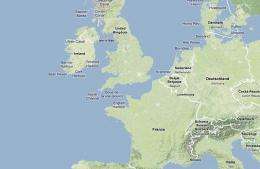
(PhysOrg.com) -- A team of Anglo-French scientists studying sedimentary deposits in the Bay of Biscay have concluded that Britain and France were separated by a "super-river" during three periods of glaciations, and they have produced a more complete picture of the process of separation than previously available.

Approximately 500,000 years ago, south-east Britain was connected by a land bridge, near present day Dover, to the Artois region of northern . Then, roughly 450,000 years ago during a glaciation (), water became trapped between the British and Fennoscandian ice sheets, and an enormous glacial lake was formed bounded by glaciers in the north and the land bridge in the south.

Many rivers fed into the lake (located under what is now the North ), and it eventually burst its banks and flooded into the wide river valley, gouging through the soft chalk and taking sediment with it into the Bay of Biscay. The "super-river" is known to geographers as the Fleuve Manche (Channel River).

In the study, published in Quaternary Science Reviews, the researchers tested the sediments found at the sea bottom and identified three periods at which sediment was deposited by the Fleuve Manche. Their results show the super-river existed during three glaciations, approximately 450,000, 160,000, and from 90 to 30,000 years ago. In the interglacial warm periods the English Channel was filled with water and separated Britain from Continental Europe.

One of the project leaders, Professor Phil Gibbard of the Department of Geography, University of Cambridge, said they were the first to examine the sedimentary material left by the Fleuve Manche in the Bay of Biscay. Until the present study, the only data available to scientists was from sediments in coastal Europe, but many deposits have been eroded and are incomplete. The Bay of Biscay deposits have been undisturbed at the bottom of the sea for thousands of years, and give a much more complete picture than previously available.

Professor Gibbard said the study adds profoundly to the knowledge of how was populated. During glaciations the sea level dropped sufficiently to allow people, plants and animals to cross from the Continent, until the glacial lake overflowed and the Fleuve Manche was formed. At this time the large amount of cold water entering the Bay of Biscay would also have affected sea currents and the environment of the time.

© 2009 PhysOrg.com

Explore further: Professor argues Earth's mantle affects long-term sea-level rise estimates

add to favorites email to friend print save as pdf

Related Stories

Scientists trace how rivers change course

Dec 25, 2005

U.S. scientists have used laboratory techniques and sediment cores from the ocean to help explain the how rivers have changed course over millions of years.

Danube delta holds answers to 'Noah's flood' debate (Video)

Jan 23, 2009

Did a catastrophic flood of biblical proportions drown the shores of the Black Sea 9,500 years ago, wiping out early Neolithic settlements around its perimeter? A geologist with the Woods Hole Oceanographic Institution (WHOI) ...

Gulf bay double whammy: rising seas, dammed rivers

Oct 23, 2006

New research finds that every U.S Gulf Coast bay in Texas and Louisiana is vulnerable to significant flooding and expansion within the coming century due to a combination of rising seas and reduced silt flowing from dammed ...

Bays on US Gulf Coast vulnerable to flooding

Oct 02, 2008

The most comprehensive geological review ever undertaken of the upper U.S. Gulf Coast suggests that a combination of rising seas and dammed rivers could flood large swaths of wetlands this century in one or more bays from ...

Recommended for you

Strong earthquake at exceptional depth

11 hours ago

This morning at 05:45 CEST, the earth trembled beneath the Okhotsk Sea in the Pacific Northwest. The quake, with a magnitude of 8.2, took place at an exceptional depth of 605 kilometers. Because of the great ...

Marine forecasting on the horizon for Indian Ocean Rim

11 hours ago

Nearly all of the member countries of the Indian Ocean Rim Association for Regional Cooperation (IOR-ARC) will attend the week-long workshop to further cooperation and understanding on international ocean ...

Russia evacuates drifting Arctic research station

May 23, 2013

Russia has ordered the urgent evacuation of the 16-strong crew of a drifting Arctic research station after ice floe that hosts the floating laboratory began to disintegrate, officials said Thursday.

User comments : 0

More news stories

Galaxies fed by funnels of fuel

(Phys.org) —Computer simulations of galaxies growing over billions of years have revealed a likely scenario for how they feed: a cosmic version of swirly straws.

Dark, massive asteroid to fly by Earth on May 31

It's 1.7 miles long. Its surface is covered in a sticky black substance similar to the gunk at the bottom of a barbecue. If it impacted Earth it would probably result in global extinction. Good thing it is ...

Source of life running out: water scientists

The majority of people on Earth people will face severe water shortages within a generation or two if pollution and waste continues unabated, scientists warned at a conference in Bonn Friday.

Google eyes emerging markets networks

Google has become deeply involved in a series of projects to build and operate wireless networks in emerging markets including sub-Saharan Africa and Southeast Asia, a report said Friday.