GOES-14 (O) moving into on-orbit storage around the Earth
Nov 30, 2009
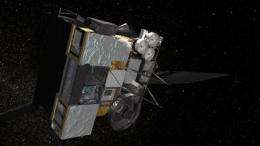
This is an artist's concept of GOES-O in orbit. Credit: NASA/Honeywell Tech Solutions, C. Meaney

The Geostationary Operational Environmental Satellite named GOES-14, is being placed in on-orbit storage this month to await its call to duty.

Since it was launched, scientists and engineers on the ground have been monitoring the instruments on GOES-14, formerly known as GOES-O, and it is operating well. "The GOES-14 (O) Post Test phase continues with the specification testing of the Image Navigation and Registration (INR) System and performance is excellent," said Andre' Dress, GOES N-P Deputy Project Manager at NASA's Goddard Space Flight Center in Greenbelt, Md. "The fall eclipse season has come to an end and the power and thermal performance was exactly what we expected."

Twice a year, around the spring and fall equinoxes the GOES spacecraft experience a period by which the sunlight is blocked by the Earth's shadow (eclipse). The maximum shadow duration is approximately 72 min out of the spacecraft's 24 hour orbit period. The shadow (or eclipse season) lasts for approximately 45 days, twice a year.

The GOES-14 team worked the satellite through a successful North/South station keeping maneuver at the end of October. Maneuvers are necessary to maintain the spacecraft's orbit.

GOES-14 is currently being moved at the rate of 1 degree per day from 90 West longitude to its storage location at 105 West longitude over the central United States and is expected to be there on November 20, 2009. Once in the storage mode the spacecraft will be turned over to the (NOAA) around December 14, 2009, where they will continue to operate the spacecraft for the remainder of its mission.

GOES-14 will remain in on-orbit storage until it is needed to replace GOES-EAST or GOES-WEST.

If GOES-14 were stored on the Earth, it would have to be to be called out of deep storage to replace an on-orbit failure. There would be 9 to 12 months of preparation between call-up and launch, followed by 3 months of post-launch deployment and testing before it could become operational. On-orbit storage reduces this delay from one year to less than one week, and avoids the chance of a launch failure when you can least afford it.

NOAA's GOES-O satellite is the second in the GOES-N Series that will improve weather forecasting and monitor environmental events around the world. On June 27, 2009, GOES-O, soared into space during a spectacular launch from the Cape Canaveral Air Force Station in Florida. GOES-O was renamed GOES-14 when it reached orbit.

NASA contracted with Boeing to build and launch the GOES-14 spacecraft. NASA's Launch Services Program at NASA's Kennedy Space Center in Florida supported the launch in an advisory role. NOAA manages the GOES program, establishes requirements, provides all funding and distributes environmental satellite data for the United States. Goddard procures and manages the design, development and launch of the satellites for NOAA.

Source: JPL/NASA (news : web)

Explore further: NASA head views progress on asteroid lasso mission

add to favorites email to friend print save as pdf

Related Stories

Sophisticated weather satellite rockets into orbit

Jun 28, 2009

(PhysOrg.com) -- The latest Geostationary Operational Environmental Satellite, GOES-O, soared into space today after a successful launch from Space Launch Complex 37 at the Cape Canaveral Air Force Station ...

GOES-O satellite reaches orbit, renamed GOES-14

Jul 10, 2009

On June 27, 2009, the Geostationary Operational Environmental Satellite, GOES-O, soared into space during a spectacular launch from the Cape Canaveral Air Force Station in Florida. GOES-O has now been renamed ...

NASA Finally Launches Environmental Satellite

May 20, 2005

NASA successfully launched a new environmental satellite today for the National Oceanic and Atmospheric Administration (NOAA). It will improve weather forecasting and monitor environmental events around the world. The NOA ...

NASA's Goes-N Satellite Ready for Launch

Jul 27, 2005

NASA announced the Geostationary Operational Environmental Satellite-N (GOES-N) is ready to launch. The GOES-N launch window is from 6:23 to 7:01 p.m. EDT, Friday, July 29, 2005. Liftoff is from Space Launch Complex 37, Cape ...

New Environmental Satellite Successfully Launched

Feb 06, 2009

(PhysOrg.com) -- A new environmental satellite that will improve weather forecasting and monitor environmental events around the world soared into space this morning after a picture-perfect launch from Vandenberg ...

NASA, NOAA set to launch new environmental satellite

May 04, 2005

NASA is set to launch the new National Oceanic and Atmospheric Administration (NOAA) Polar-orbiting Operational Environmental Satellite (POES), another critical link in the development of a global Earth-observation program. The spa ...

Recommended for you

Research team explains 'Lazarus' comets

1 hour ago

Astronomers from the University of Antioquia have discovered a graveyard of comets. These once-dormant comets, dubbed by astronomers as "The Lazarus comets," are now rejuvenated.

NASA ships sensors for seafaring satellite to France

2 hours ago

(Phys.org) —Three NASA-built instruments that are integral components of the next in a series of U.S./European ocean altimetry satellites have arrived in France for integration with their spacecraft in ...

Trip into space with DiCaprio costs $1.55m

2 hours ago

Leonardo DiCaprio is going to get closer to stars of a different kind as he heads into space aboard the Virgin Galactic, and a well-heeled bidder at the Cannes Film Festival has paid 1.2 million euros (1.5 million) to be ...

User comments : 0

More news stories

Source of life running out: water scientists

The majority of people on Earth people will face severe water shortages within a generation or two if pollution and waste continues unabated, scientists warned at a conference in Bonn Friday.

Research team explains 'Lazarus' comets

Astronomers from the University of Antioquia have discovered a graveyard of comets. These once-dormant comets, dubbed by astronomers as "The Lazarus comets," are now rejuvenated.