Plan to breed lab monkeys splits Puerto Rican town
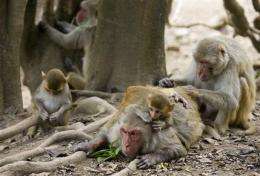
(AP) -- Puerto Rico has such a bad history with research monkeys running amok that some residents are stunned that its government has tentatively approved a plan to import and breed thousands of primates for sale to U.S. researchers.
Bioculture Ltd., with facilities at 19 sites around the world, has secured construction permits and hopes to begin operating next summer in Guayama, a small, depressed mountain district in southeastern Puerto Rico.
They want to turn the Caribbean territory into a major supplier of primates, much to the dismay of islanders already dealing with a plague of patas monkeys - descendants of lab escapees that run though backyards, stop traffic and destroy crops.
The company, based in the African island nation of Mauritius, says the operation will employ at least 50 people and buy fruit from local farmers, an important consideration on an island where unemployment is nearly 16 percent.
"This will help many people in the community," said Olga Colon, a local school principal who has collected 300 signatures in support of the facility. She said Bioculture has pledged to buy supplies for her school.
But the project is opposed by many - from Guayama Mayor Glorimari Jaime to Puerto Rican actor Benicio del Toro, who says it's unethical to breed monkeys for research, and renowned primatologist Jane Goodall.
"We know now that monkeys have minds, personalities, and, above all, they have feelings," Goodall said during a recent visit to Puerto Rico. "What we do for monkeys in medical research - if you were a monkey, it would be torture."
Local residents have filed a lawsuit supported by People for the Ethical Treatment of Animals that says Bioculture failed to submit a full environmental impact statement or hold public hearings.
They say Bioculture allegedly paid fees for a $2 million project, when the project costs $12 million. The company denies the allegations.
A judge could decide as early as Monday whether to order an injunction to halt construction. Either side could appeal the ruling to the state Court of Appeals.
The company expects to soon apply for permits to import monkeys to Puerto Rico.
Bioculture's facility, the first in a U.S. jurisdiction, plans to start with 1,000 Crab-eating Macaques, natives of Southeast Asia, and eventually hold up to 3,000.
The U.S. territory has long struggled to control hundreds of patas monkeys, descendants of primates that escaped in recent decades from research projects and now thrive in the lush tropical environment.
No labs want the patas monkeys because they're no longer right for research, and many are diseased. There isn't much demand from zoos, either. So rangers from the island's Department of Natural Resources trap and kill them.
Wilson Nazario Torres fears the people of Guayama will suffer like those in his hometown, Lajas, which has been overrun by patas monkeys. The three that live in his back yard are so used to humans, he can't scare them away.
"If this project was offered in any state in the United States, they wouldn't allow it," said Roberto Cintron, a 46-year-old resident of Carmen, a Guayama neighborhood close to the facility site. "So they come to an isolated community, a neglected community, and offer jobs, and people buy it."
Bioculture Vice President Moses Mark Bushmitz said some groups are just trying to stir up panic. It happens at all new facilities.
The Guayama facility is one of many already inside the United States, he said, where about 70,000 research monkeys were used in 2007, according to the U.S. Department of Agriculture.
The company assures people in Carmen and all of the Guayama district that its monkeys can't escape multiple levels of security.
"You have monkeys in MIT, you have monkeys in Harvard," Bushmitz said. "So why isn't it an issue if the monkey will escape in Harvard, but it is an issue if a monkey will escape in Carmen?"
Bushmitz called the protesters a small minority.
"This area was neglected for so many years," he said. "The people here have no chance. The young guys have no work."
But Carla Cappalli, a local animal rights activist, says opponents will keep fighting, no matter what the judge rules.
"This is going to be a long case," she said. "We're going to fight this to the end."
©2009 The Associated Press. All rights reserved. This material may not be published, broadcast, rewritten or redistributed.


