NASA: Floating 'junk' no threat to space station
Nov 28, 2009 By MARCIA DUNN , AP Aerospace Writer
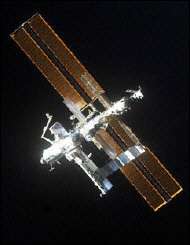
The International Space Station

(AP) -- NASA says a piece of old space junk that it's been tracking for a few days is no threat to the International Space Station.

But there's another piece of debris in the space station's neighborhood.

Mission Control decided late Friday that the outpost would not need to dodge a 10-year-old rocket chunk. The Delta rocket was launched in 1999 with NASA's comet-chasing spacecraft, Stardust. Experts concluded the junk would come no closer than five-and-a-half miles Saturday. In fact, it was moving away from the station.

On Friday, NASA spotted an old science payload from a previous in the vicinity of the 220-mile-high space station. It's expected to come within nine miles Monday. For now, it's not considered a threat.

©2009 The Associated Press. All rights reserved. This material may not be published, broadcast, rewritten or redistributed.

Explore further: Engineering students develop a super 'space stethoscope'

add to favorites email to friend print save as pdf

Related Stories

NASA analyzing junk that could threaten astronauts

Sep 02, 2009

(AP) -- A piece of space junk was drifting toward the shuttle-station complex and its 13 astronauts Wednesday, though NASA officials said the threat would not delay an upcoming spacewalk.

Space shuttle Atlantis, 7 astronauts back on Earth

Nov 27, 2009

Space shuttle Atlantis and its crew of seven astronauts ended an 11-day journey of nearly 4.5 million miles with a 9:44 a.m. EST landing Friday at NASA's Kennedy Space Center in Florida.

Recommended for you

NASA's IRIS mission readies for a new challenge

4 hours ago

(Phys.org) —The time draws near. NASA is getting ready to launch a new mission, a mission to observe a largely unexplored region of the solar atmosphere that powers its dynamic million-degree outer atmosphere and drives ...

Building a better team—on Mars

May 21, 2013

Sometime in the next quarter-century, NASA plans to send the first humans to Mars, a mission that will push the boundaries of teamwork for a handful of astronauts who will spend as long as three years together ...

User comments : 0

More news stories

Volcanoes cause climate gas concentrations to vary

Trace gases and aerosols are major factors influencing the climate. With the help of highly complex installations, such as MIPAS on board of the ENVISAT satellite, researchers try to better understand the ...

NASA's IRIS mission readies for a new challenge

(Phys.org) —The time draws near. NASA is getting ready to launch a new mission, a mission to observe a largely unexplored region of the solar atmosphere that powers its dynamic million-degree outer atmosphere and drives ...

Costs to treat stroke in America may double by 2030

Costs to treat stroke are projected to more than double and the number of people having strokes may increase 20 percent by 2030, according to the American Heart Association/American Stroke Association.