The Energy Sources of Ultraluminous Galaxies
Nov 27, 2009
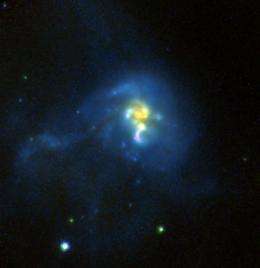
The ultraluminous galaxy IRAS 19297-0406 as seen by the Hubble Space Telescope. An infrared study finds that in about one-third of such galaxies there is a supermassive black hole in the nucleus dominating the energy production. Credit: NASA, the NICMOS Group (STScI, ESA), and the NICMOS Science Team (University of Arizona)

(PhysOrg.com) -- Ultraluminous infrared galaxies ((ULIRGs) are galaxies whose luminosity exceeds that of a trillion suns; for comparison, the Milky Way galaxy has a typical (and much more modest) luminosity of only about ten billion suns. ULIRGs were discovered by an all-sky infrared survey satellite in the 1980's, and since then the origin(s) of their huge infrared emission has been widely debated. Extreme infrared activity is known to be associated with interacting galaxies, and optical imaging indeed shows that many ULIRGs are in collision, but this fact does not answer the question of what physical mechanism powers the luminosity. Might the same process be underway at a low level in our galaxy?

The two primary known sources of global energy production in are star formation and accretion activity around a massive black hole in the nucleus (a so-called active ). Both of them produce radiation that heats up the dust -- the origin of the intense infrared emission.

The dust obscures optical light and makes conventional diagnostics difficult, but the dust emission itself has specific color characteristics that can distinguish between the two cases. SAO astronomer Guido Risaliti and seven of his colleagues have used the to study the infrared emission from seventy-one ULIRGs in an attempt to quantify the relative role each process plays in the energetics of ULIRGs.

The scientists find that approximately 70% of the sources have the characteristic signature of an active nucleus, a significant conclusion made possible by the use of their dust emission diagnostic technique. Furthermore, they find that, with regard to energy production, predominates in approximately two-thirds of the sources; in the other one-third of ULIRGs the nucleus plays the dominant role in powering the galaxy, and this fraction increases among the most luminous ULIRGs.

Our does have a massive black hole at its nucleus, but now activity around it is very quiescent. Perhaps when the Milky Way collides with the Andromeda galaxy in a few billion years, an event many astronomers suspect will occur, the interaction will trigger the nucleus to become more active, and our galaxy to become, if not ultraluminous, then at least more luminous than it is today.

Provided by Harvard-Smithsonian Center for Astrophysics (news : web)

Explore further: Hubble reveals the ring nebula's true shape

add to favorites email to friend print save as pdf

Related Stories

Galaxies cluster near dark matter, study finds

Apr 20, 2006

Try mixing caramel into vanilla ice cream -- you will always end up with globs and swirls of caramel. Scientists are finding that galaxies may distribute themselves in similar ways throughout the universe and ...

Hubble Eyes Star Birth in the Extreme

Jun 13, 2006

Staring into the crowded, dusty core of two merging galaxies, NASA's Hubble Space Telescope has uncovered a region where star formation has gone wild.

Recommended for you

Hubble reveals the ring nebula's true shape

27 minutes ago

(Phys.org) —The Ring Nebula's distinctive shape makes it a popular illustration for astronomy books. But new observations by NASA's Hubble Space Telescope of the glowing gas shroud around an old, dying, ...

A hidden population of exotic neutron stars

5 hours ago

(Phys.org) —Magnetars – the dense remains of dead stars that erupt sporadically with bursts of high-energy radiation - are some of the most extreme objects known in the Universe. A major campaign using ...

Very Large Telescope celebrates 15 years of success

10 hours ago

(Phys.org) —With this new view of a spectacular stellar nursery ESO is celebrating 15 years of the Very Large Telescope—the world's most advanced optical instrument. This picture reveals thick clumps ...

Fragile mega-galaxy is missing link in history of cosmos

May 22, 2013

Two hungry young galaxies that collided 11 billion years ago are rapidly forming a massive galaxy about 10 times the size of the Milky Way, according to UC Irvine-led research published Wednesday in the journal ...

User comments : 3

Adjust slider to filter visible comments by rank

Display comments: newest first

omatumr
1 / 5 (3) Nov 30, 2009
Does anyone doubt that the energy source is repulsive interactions between neutrons?

With kind regards,
Oliver K. Manuel
Former NASA PI for Apollo
Alexa
1 / 5 (1) Dec 03, 2009
Does anyone doubt that the energy source is repulsive interactions between neutrons?
Of course, because these repulsive interactions are like strings - they must be charged by something. Which force has made neutrons so close?
omatumr
2 / 5 (2) Dec 03, 2009
Like particles oppose each other, and they also pair up in atomic and nuclear structures.

a.) Electrons
b.) Protons
c.) Neutrons

Why do you think that they "must be charged by something"?

With kind regards,
Oliver K. Manuel

More news stories

Hubble reveals the ring nebula's true shape

(Phys.org) —The Ring Nebula's distinctive shape makes it a popular illustration for astronomy books. But new observations by NASA's Hubble Space Telescope of the glowing gas shroud around an old, dying, ...

NASA head views progress on asteroid lasso mission

Surrounded by engineers, NASA chief Charles Bolden inspected a prototype spacecraft engine that could power an audacious mission to lasso an asteroid and tow it closer to Earth for astronauts to explore.

A hidden population of exotic neutron stars

(Phys.org) —Magnetars – the dense remains of dead stars that erupt sporadically with bursts of high-energy radiation - are some of the most extreme objects known in the Universe. A major campaign using ...

Solar Kettle allows for boiling water off the grid

(Phys.org) —A company called Contemporary Energy has unveiled a new device it calls the Solar Kettle. It looks very much like a normal coffee thermos, but has flaps on one side that open to allow for collecting ...