The Crab Nebula: Energy for 100,000 Suns
Nov 23, 2009
Credits: X-ray: NASA/CXC/SAO/F.Seward; Optical: NASA/ESA/ASU/J.Hester & A.Loll; Infrared: NASA/JPL-Caltech/Univ. Minn./R.Gehrz

(PhysOrg.com) -- A star's spectacular death in the constellation Taurus was observed on Earth as the supernova of 1054 A.D.

Now, almost a thousand years later, a super dense object -- called a neutron star -- left behind by the explosion is seen spewing out a blizzard of high-energy particles into the expanding debris field known as the Crab Nebula. X-ray data from Chandra provide significant clues to the workings of this mighty cosmic "generator," which is producing energy at the rate of 100,000 suns.

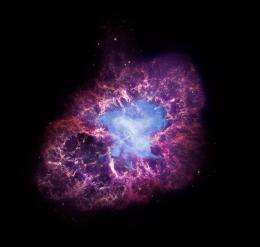
This composite image uses data from three of NASA's Great Observatories.

The Chandra X-ray image is shown in blue, the optical images are in yellow and red, and the Spitzer Space Telescope's is in purple. The X-ray image is smaller than the others because extremely energetic electrons emitting X-rays radiate away their energy more quickly than the lower-energy electrons emitting optical and infrared light.

Along with many other telescopes, Chandra has repeatedly observed the Crab Nebula over the course of the mission’s lifetime. The is one of the most studied objects in the sky, truly making it a cosmic icon.

Provided by JPL/NASA (news : web)

Explore further: NASA builds unusual testbed for analyzing X-ray navigation technologies

add to favorites email to friend print save as pdf

Related Stories

A young pulsar shows its hand

Apr 03, 2009

A small, dense object only twelve miles in diameter is responsible for this beautiful X-ray nebula that spans 150 light years. At the center of this image made by NASA's Chandra X-ray Observatory is a very ...

Peering into the Pillars of Creation

Feb 15, 2007

A new look at the famous "Pillars of Creation" with NASA’s Chandra X-ray Observatory has allowed astronomers to peer inside the dark columns of gas and dust. This penetrating view of the central region of ...

Fingers, Loops and Bays in the Crab Nebula

Nov 06, 2008

(PhysOrg.com) -- This image gives the first clear view of the faint boundary of the Crab Nebula's X-ray-emitting pulsar wind nebula. The nebula is powered by a rapidly-rotating, highly-magnetized neutron star, ...

A Super-Efficient Particle Accelerator

Jul 01, 2009

This image of data from NASA's Chandra X-ray Observatory and the European Southern Observatory's Very Large Telescope shows a part of the roughly circular supernova remnant known as RCW 86.

Stellar forensics with striking new image from Chandra

Oct 23, 2007

A spectacular new image shows how complex a star’s afterlife can be. By studying the details of this image made from a long observation by NASA’s Chandra X-ray Observatory, astronomers can better understand ...

Recommended for you

Galaxy's Ring of Fire

May 18, 2013

Johnny Cash may have preferred this galaxy's burning ring of fire to the one he sang about falling into in his popular song. The "starburst ring" seen at center in red and yellow hues is not the product of ...

User comments : 1

Adjust slider to filter visible comments by rank

Display comments: newest first

omatumr
1 / 5 (3) Nov 24, 2009
The energy source for nuclear and stellar explosions is repulsive interactions between neutrons.

With kind regards,
Oliver K. Manuel

More news stories

Volcanoes cause climate gas concentrations to vary

Trace gases and aerosols are major factors influencing the climate. With the help of highly complex installations, such as MIPAS on board of the ENVISAT satellite, researchers try to better understand the ...

Explainer: Why are tornadoes so destructive?

Tornadoes are a part of life for people living in the Great Plains of the United States. In Oklahoma, a state that averages 62 tornadoes a year, people are prepared as best as they can be and are well warned.

Could pond waste be the 'new' fertiliser?

The University of Stirling is to lead a new project to develop a strategy for using nutrient-rich aquatic biomass waste – from ponds, wetlands and other water-bodies – in farming, as an environmentally ...

Theorists weigh in on where to hunt dark matter

(Phys.org) —Now that it looks like the hunt for the Higgs boson is over, particles of dark matter are at the top of the physics "Most Wanted" list. Dozens of experiments have been searching for them, but ...

DNA damage: The dark side of respiration

(Phys.org) —Adventitious changes in cellular DNA can endanger the whole organism, as they may lead to life-threatening illnesses like cancer. Researchers at LMU now report how byproducts of respiration cause mispairing ...