Terra satellite spots Tropical Cyclone Anja, the first of the southern season
Nov 16, 2009
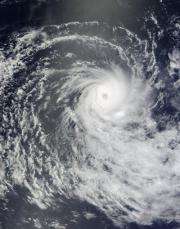
NASA's MODIS instrument on the Terra satellite captured Cyclone Anja in the southern Indian Ocean on Nov. 16 at 1 a.m. ET (0600 UTC). Credit: NASA, MODIS Rapid Response

NASA's Terra satellite captured a stunning image of Anja, the first tropical cyclone of the southern Hemisphere cyclone season. When Anja formed on Saturday, November 14, in the Southern Indian Ocean, about 330 miles south-southwest of Diego Garcia it was designated Tropical Cyclone 01S ("S" for south). By Sunday, November 15, 01S had strengthened into a tropical storm and was named Anja.

On Monday, November 16, Anja had grown into a Category Three cyclone on the Saffir-Simpson Scale, packing near 105 knots (120 mph). NASA's Terra satellite flew over Anja, and the Moderate Imaging Spectroradiometer (MODIS) instrument captured an image of the storm that showed a cloud-filled eye in the center of circulation. Anja was located 795 miles east-northeast of Port Louis, Mauritius, near 13.4 North and 69.3 East. Anja was moving southwest at 4 mph.

Anja was a medium-sized cyclone with tropical storm-force winds extending out to 100 miles from its center, and (or hurricane)-force winds out to 45 miles from its center. Anja was generating waves as high as 24 feet, and is not threatening any landmasses.

Forecasters at the U.S. Navy's Joint Typhoon Warning Center expect that Anja will move south over the next couple of days and weaken under .

Source: JPL/NASA (news : web)

Explore further: Slow earthquakes: It's all in the rock mechanics

add to favorites email to friend print save as pdf

Related Stories

Two NASA satellites capture monster Super Typhoon Melor

Oct 05, 2009

NASA's Terra and Aqua satellites flew over Super Typhoon Melor early today, October 5 and captured some impressive images of the storm's clouds on a track toward Japan. The Western Pacific Ocean has the edge ...

Recommended for you

Slow earthquakes: It's all in the rock mechanics

2 hours ago

(Phys.org) —Earthquakes that last minutes rather than seconds are a relatively recent discovery, according to an international team of seismologists. Researchers have been aware of these slow earthquakes, ...

Cracking the ice code

7 hours ago

(Phys.org) —What happened the last time a vegetated Earth shifted from an extremely cold climate to desert-like conditions? And what does it tell us about climate change today?

Alaska volcano shoots ash 15,000 feet into the air

May 18, 2013

(AP)—One of Alaska's most restless volcanoes has shot an ash cloud 15,000 feet into the air in an ongoing eruption that has drawn attention from a nearby community but isn't expected to threaten air traffic.

User comments : 0

More news stories

Slow earthquakes: It's all in the rock mechanics

(Phys.org) —Earthquakes that last minutes rather than seconds are a relatively recent discovery, according to an international team of seismologists. Researchers have been aware of these slow earthquakes, ...

Cracking the ice code

(Phys.org) —What happened the last time a vegetated Earth shifted from an extremely cold climate to desert-like conditions? And what does it tell us about climate change today?

Advance in nanotech gene sequencing technique

(Phys.org) —The allure of personalized medicine has made new, more efficient ways of sequencing genes a top research priority. One promising technique involves reading DNA bases using changes in electrical ...

Finnish start-up launches smartphone to rival giants

A group of ex-Nokia employees who quit over the company's decision to abandon the planned MeeGo operating system in favour of Windows presented their own smartphone on Monday, hoping to rival the sector's ...