Leonid meteor shower peaks Tuesday, Nov. 17 (w/ Video)
Nov 12, 2009
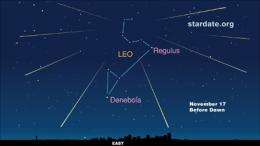
Meteors appear to fall from the constellation Leo.

(PhysOrg.com) -- The Leonid meteor shower best viewing this year will be in the hours before dawn on Nov. 17.

There is uncertainty on the intensity of this year's shower. Viewers will definitely see a dozen or more meteors per hour. Some predict, however, that the rate could be greater than 100. The Moon will not wash out any meteors: It rises after daybreak, and in its almost-new phase will be nearly invisible.

This video is not supported by your browser at this time.

Leonid meteors appear to fall from the constellation Leo, the lion, but they are not associated with it. They are leftover debris from comet Tempel-Tuttle. As the comet orbits the Sun, it leaves a trail of debris. The Leonids meteors recur each year when Earth passes through the comet's debris trail.

Each time comet Tempel-Tuttle gets closest to the Sun in its orbit, called "perihelion," it sheds a significant amount of material. This creates clumps along its orbit. If the Earth passes through one of these clumps on Nov. 17, viewers could see hundreds of meteors per hour. If Earth simply passes through the "normal" part of the comet's debris trail, the number of visible will be much lower.

For the best view, get away from city lights. Look for state or city parks or other safe, dark sites. Lie on a blanket or reclining chair to get a full-sky view. If you can see all of the stars in the Little Dipper, you have good dark-adapted vision.

Provided by University of Texas at Austin (news : web)

Explore further: Dark, massive asteroid to fly by Earth on May 31

add to favorites email to friend print save as pdf

Related Stories

Perseid Meteor Shower Peaks Tuesday, Aug. 12

Aug 07, 2009

(PhysOrg.com) -- It's time once again for nature to put on its late-summer fireworks show: the Perseid meteor shower. This year's best viewing will be before dawn on Aug. 12, with a second chance after sunset ...

Orionid meteor shower peaks Wednesday

Oct 19, 2009

(PhysOrg.com) -- The annual Orionid meteor shower will peak in the hours before dawn on Oct. 21, according to the editors of StarDate magazine, who said the shower could produce up to 20 meteors per hour.

The 2009 Leonid Meteor Shower

Nov 10, 2009

This year's Leonid meteor shower peaks on Tuesday, Nov. 17th. If forecasters are correct, the shower should produce a mild but pretty sprinkling of meteors over North America followed by a more intense outburst ...

Return of the Leonids

Dec 05, 2008

Astronomers from Caltech and NASA say a strong shower of Leonid meteors is coming in 2009. Their prediction follows an outburst on Nov. 17, 2008, that broke several years of "Leonid quiet" and heralds even ...

Perseid Meteor Shower To Peak Aug. 12

Aug 07, 2008

The annual Perseid meteor shower will be visible in the night sky throughout Colorado and will peak during the early morning hours of Aug. 12, according to an astronomy expert at the University of Colorado ...

Recommended for you

Dark, massive asteroid to fly by Earth on May 31

8 hours ago

It's 1.7 miles long. Its surface is covered in a sticky black substance similar to the gunk at the bottom of a barbecue. If it impacted Earth it would probably result in global extinction. Good thing it is ...

Research team explains 'Lazarus' comets

11 hours ago

Astronomers from the University of Antioquia have discovered a graveyard of comets. These once-dormant comets, dubbed by astronomers as "The Lazarus comets," are now rejuvenated.

NASA ships sensors for seafaring satellite to France

12 hours ago

(Phys.org) —Three NASA-built instruments that are integral components of the next in a series of U.S./European ocean altimetry satellites have arrived in France for integration with their spacecraft in ...

Trip into space with DiCaprio costs $1.55m

12 hours ago

Leonardo DiCaprio is going to get closer to stars of a different kind as he heads into space aboard the Virgin Galactic, and a well-heeled bidder at the Cannes Film Festival has paid 1.2 million euros (1.5 million) to be ...

User comments : 0

More news stories

Galaxies fed by funnels of fuel

(Phys.org) —Computer simulations of galaxies growing over billions of years have revealed a likely scenario for how they feed: a cosmic version of swirly straws.

Dark, massive asteroid to fly by Earth on May 31

It's 1.7 miles long. Its surface is covered in a sticky black substance similar to the gunk at the bottom of a barbecue. If it impacted Earth it would probably result in global extinction. Good thing it is ...

Source of life running out: water scientists

The majority of people on Earth people will face severe water shortages within a generation or two if pollution and waste continues unabated, scientists warned at a conference in Bonn Friday.

Google eyes emerging markets networks

Google has become deeply involved in a series of projects to build and operate wireless networks in emerging markets including sub-Saharan Africa and Southeast Asia, a report said Friday.