Unsettled Youth: Spitzer Observes a Chaotic Planetary System
Nov 04, 2009
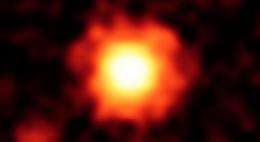
NASA's Spitzer Space Telescope captured this infrared image of a giant halo of very fine dust around the young star HR 8799. Image credit: NASA/JPL-Caltech/Univ. of Ariz.

(PhysOrg.com) -- Before our planets found their way to the stable orbits they circle in today, they wiggled and jostled about like unsettled children. Now, NASA's Spitzer Space Telescope has found a young star with evidence for the same kind of orbital hyperactivity. Young planets circling the star are thought to be disturbing smaller comet-like bodies, causing them to collide and kick up a huge halo of dust.

The star, called HR 8799, was in the news last November 2008, for being one of the first of two stars with imaged planets. Ground-based telescopes at the W.M. Keck Observatory and the Gemini Observatory, both in Hawaii, took images of three planets orbiting in the far reaches of the system, all three being roughly 10 times the mass of . Another imaged planet was also announced at the same time around the star Fomalhaut, as seen by NASA's . Both HR 8799 and Fomalhaut are younger and more massive than our sun.

Astronomers had previously used both Spitzer and Hubble to image a rotating disk of planetary debris around Fomalhaut, which is 25 light-years from Earth. HR 8799 is about five times farther away, so scientists weren't sure if Spitzer would be able to capture a picture of its disk. To their amazement and delight, Spitzer succeeded.

The Spitzer team, led by Kate Su of the University of Arizona, Tucson, says the giant cloud of fine dust around the disk is very unusual. They say this dust must be coming from collisions among small bodies similar to the comets or icy bodies that make up today's Kuiper Belt objects in our solar system. The gravity of the three large planets is throwing the smaller bodies off course, causing them to migrate around and collide with each other. Astronomers think the three planets might have yet to reach their final stable orbits, so more violence could be in store.
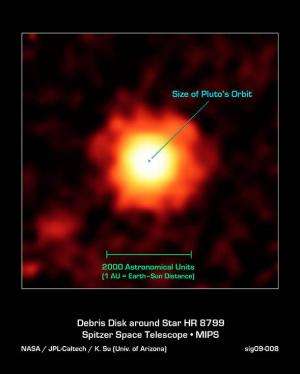
NASA's Spitzer Space Telescope captured this infrared image of a giant halo of very fine dust around the young star HR 8799, located 129 light-years away in the constellation Pegasus. The brightest parts of this dust cloud (yellow-white) likely come from the outer cold disk similar to our own Kuiper belt (beyond Neptune's orbit). The huge extended dust halo is seen as orange-red. Astronomers think that the three large planets known to orbit the star are disturbing small comet-like bodies, causing them to collide and kick up dust. The extended dust halo has a diameter of about 2,000 astronomical units, or 2,000 times the distance between Earth and the sun. For reference, the size of Pluto's orbit is tiny by comparison, with a diameter of about 80 astronomical units. This image was captured by Spitzer's multiband imaging photometer at an infrared wavelength of 70 microns in Jan. 2009.

"The system is very chaotic and collisions are spraying up a huge cloud of fine dust," said Su. "What's exciting is that we have a direct link between a planetary disk and imaged planets. We've been studying disks for a long time, but this star and Fomalhaut are the only two examples of systems where we can study the relationships between the locations of and the disks."

When our solar system was young, it went through similar planet migrations. Jupiter and Saturn moved around quite a bit, throwing comets around, sometimes into Earth. Some say the most extreme part of this phase, called the late heavy bombardment, explains how our planet got water. Wet, snowball-like comets are thought to have crashed into Earth, delivering life's favorite liquid.

The Spitzer results were published in the Nov. 1 issue of Astrophysical Journal. The observations were made before Spitzer began its "warm" mission and used up its liquid coolant.

Provided by JPL/NASA (news : web)

Explore further: Researchers explain magnetic field misbehavior in solar flares

add to favorites email to friend print save as pdf

Related Stories

Making Jupiters

Aug 21, 2009

IC348 is a glowing nebula of young stars, hot gas, and cold dust seen in the direction of the constellation of Perseus. It is the nearest rich cluster of young stars to earth, being only about one thousand ...

Spitzer Finds Evidence for Planets with Four Parents

Jul 24, 2007

How many stars does it take to "raise" a planet? In our own solar system, it took only one – our sun. However, new research from NASA's Spitzer Space Telescope shows that planets might sometimes form in ...

Planets Living on the Edge

Dec 17, 2008

(PhysOrg.com) -- Some stars have it tough when it comes to raising planets. A new image from NASA's Spitzer Space Telescope shows one unlucky lot of stars, born into a dangerous neighborhood. The stars themselves ...

Spitzer And Hubble Capture Evolving Planetary Systems

Dec 09, 2004

Two of NASA's Great Observatories, the Spitzer Space Telescope and the Hubble Space Telescope, have provided astronomers an unprecedented look at dusty planetary debris around stars the size of our sun. Spitzer has ...

Recommended for you

Fragile mega-galaxy is missing link in history of cosmos

10 hours ago

Two hungry young galaxies that collided 11 billion years ago are rapidly forming a massive galaxy about 10 times the size of the Milky Way, according to UC Irvine-led research published Wednesday in the journal ...

Galaxy's Ring of Fire

May 18, 2013

Johnny Cash may have preferred this galaxy's burning ring of fire to the one he sang about falling into in his popular song. The "starburst ring" seen at center in red and yellow hues is not the product of ...

User comments : 0

More news stories

Forecast for Titan: Wild weather could be ahead

(Phys.org) —Saturn's moon Titan might be in for some wild weather as it heads into its spring and summer, if two new models are correct. Scientists think that as the seasons change in Titan's northern hemisphere, ...

Theorists weigh in on where to hunt dark matter

(Phys.org) —Now that it looks like the hunt for the Higgs boson is over, particles of dark matter are at the top of the physics "Most Wanted" list. Dozens of experiments have been searching for them, but ...