October 22, 2009 weblog
Mummy's tooth yields DNA
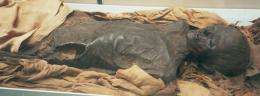
(PhysOrg.com) -- A four thousand year old Egyptian mummy's tooth has yielded its DNA to probing scientists.
A team of doctors from Massachusetts General Hospital and scientists from Boston's Museum of Fine Arts first tried unsuccessfully to extract genetic material from a piece of neck skin and a finger, recovered from the mummy's tomb in Deir el-Bersha near Cairo. They next tried to obtain DNA from the pulp of a tooth, and after a delicate three-hour operation successfully extracted the tooth and obtained the genetic material.
Dr. Paul Chapman, a neurosurgeon from the Massachusetts General Hospital, who was part of the operating team, was concerned not to disturb the fragile head because of its importance as an artifact. Simply yanking the tooth was not possible, so the doctors approached it via the open neck, inserting a scope fitted with a camera. The first tooth they tried could not be moved, but the second yielded after patient work without damage to the rest of the head.
The tomb, belonging to Governor and Lady Djehutynakht, rulers of the Hermopolis district around 186 miles from Cairo, was first excavated in 1915. Dating from around 2000 BC, the tomb had been disturbed, but the disembodied head, a torso, examples of Egyptian art, other artifacts and scattered mummy wrappings remained.
The DNA should enable the scientists to identify the ancient Egyptian owner's gender, and perhaps learn about its ancestry. The genetic material was deemed so precious that one of the hospital team, Dr. Fabio Nunes, drove the tooth to the New York medical examiner's office himself. The medical examiner's office which was chosen to do the analysis because of its experience with degraded DNA.
Rita E. Freed, from the Museum of Fine Arts, said the 19th century saw the unwrapping of mummies, and the 20th saw the ability to X-ray mummies develop. Now scientists realize you can also examine them for genetic material.
The mummy's head and other artifacts are currently on show at The Secrets of Tomb 10: Egypt 2000 BC in the Museum of Fine Arts, which gives visitors an insight into the lives of people in Deir el-Bersha between 2040 to 1640 BC, during the 11th and 12th dynasty.
© 2009 PhysOrg.com


