Social memory in Drosophila
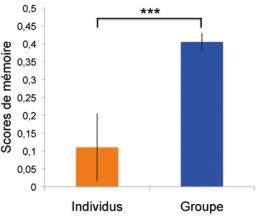
Positive social interactions exist within Drosophila: when in a group, Drosophila flies have better memory than when they are isolated. Thomas Preat's team at the Laboratoire de Neurobiologie (CNRS, France) has recently highlighted this phenomenon through olfactory memory tests.
This work, published in the journal Current Biology on 13 October 2009, has paved the way for new research avenues for understanding the role of social environment on memory modulation and decision making.
In a large number of animal species, individuals draw advantages from social life by observing their congeners. In particular, they are capable of adapting their behavior when faced with diverse situations, such as seeking food or defending themselves against predators. Thomas Preat's team at the Laboratoire de Neurobiologie (CNRS) has studied the behavior of Drosophila using olfactory memory tests to investigate the potential effects of interactions between individuals.
During their experiments, the neurobiologists exposed a group of Drosophila flies, homogenous from a genetic viewpoint, to an odor associated with weak electric shocks. After this conditioning, the scientists conducted olfactory memory tests on the flies, either individually or in groups. Memory was evaluated through the ability of the flies to avoid the odor associated previously with an unpleasant stimulus, for example 24 or 48 hours after conditioning.
This study has shown that Drosophila flies demonstrate poorer memory when they are tested individually than when tested in a group. However, individual flies have poorer memory not because they do not remember but because they have difficulty in extracting the information. In addition, a fly conditioned beforehand does not simply have to be placed in a group for its memory to be improved. The group must itself have been conditioned to be able to produce the interactions that lie behind this memory facilitation.
The hypothesis that has been put forward is that, during the test (in other words in the presence of the odor that represents a potential danger), the conditioned flies give off an alarm signal that arouses the attention of surrounding flies and enhances their memory retrieval. In rats, several nerve centers such as amygdala or certain stress hormones such as adrenaline play the role of modulators in such retrieval. This work, carried out on Drosophila, has opened new avenues of research on memory modulation and decision making as a function of the perception of the social environment, emotions or stress.
More information: Chabaud, M.-A., Isabel, G., Kaiser, L. and Preat, T. (2009). “Social facilitation of long-lasting memory retrieval in Drosophila”. Current Biology, 19(19): 1654-1659.
Provided by CNRS


