Researcher hunts for new planets, seeking clues on solar system's origin
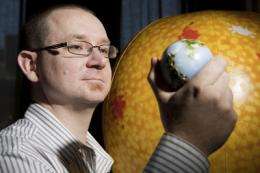
(PhysOrg.com) -- The Cornell assistant professor of astronomy works on instrumentation that searches the night skies for planets outside our solar system, called extrasolar planets.
Somewhere in the galaxy, a rocky, blue-green planet like Earth, teeming with oxygen, water and life, might be orbiting its own sun. Jamie Lloyd wants to find it.
The Cornell assistant professor of astronomy works on instrumentation that searches the night skies for planets outside our solar system, called extrasolar planets or exoplanets. So far, about 370 exoplanets have been discovered, and more might lead to hints about the origins of our solar system.
"We don't know whether our solar system is an incredibly rare configuration, or an incredibly common configuration," said Lloyd, who joined the Cornell faculty in 2004. "And that has a profound implication for how much life there might be out there in the universe."
An experimental astrophysicist who has spent time in Chicago, California and at the South Pole, Lloyd develops instruments to search for new kinds of planets -- ones with a hard surface, like ours, called terrestrial planets, and ones that exist in the so-called habitable zone, the distance from a star in which life could be possible.
Up until recently, none of the known exoplanets were terrestrial -- most are gas giants, like Jupiter and Saturn. But in recent weeks, a French-led team of scientists announced the discovery of the first confirmed rocky exoplanet, named CoRoT-7b. Calling this planet "Earthlike," however, would be a stretch, Lloyd said.
"This is a rocky planet, but it's nothing like the Earth," Lloyd explained. It orbits so closely to its star that its surface is a molten lava lake of 3,600 degrees Fahrenheit, and molten rock and lava rain from the sky. Not exactly a habitable environment, at least by Earth's standards. But if a planet like CoRoT-7b were to be found orbiting a less massive, less luminous star -- the kind that interests Lloyd -- life on it would certainly be possible, he said.
Nearly all the known exoplanets, including CoRoT-7b, have been detected indirectly with a technique called precision Doppler spectroscopy, in which scientists infer the existence of a planet by observing the motion of the parent star through the Doppler effect on the star's light.
One of Lloyd's major projects focuses on an advanced form of the indirect measurement of exoplanets using an instrument called the Triple Spec Exoplanet Discovery Instrument (TEDI). Built at Cornell, the spectrometer is attached now to the Mount Palomar 200-Inch Hale Telescope operated by the California Institute of Technology. The project is funded by the National Science Foundation.
TEDI will allow scientists to detect planets that orbit red stars, which cannot be measured with existing Doppler technology. These stars, Lloyd said, are interesting because they have less mass than the already-discovered sunlike stars with exoplanets. Thus, red stars would be "pulled around" much more easily by the mass of its orbiting planet.
Having a low-mass star orbited by a higher-mass planet has advantages for detection. If the planet passes in front of a relatively small star, the planet would block a lot of the star, so the planet would be easier to see.
"We still have a lot of work to do to find an Earthlike planet," Lloyd said. "But there is tremendous focus worldwide on searching for habitable planets orbiting red stars. It is only a matter of time before we find one."
Provided by Cornell University (news : web)


