A Hazy View of Early Earth
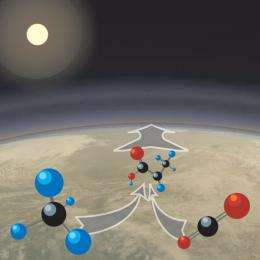
Haze in the early Earth atmosphere could have played a crucial role in the origin of life. By forming a protective shield, the haze would have safeguarded organic substances from harmful ultraviolet (UV) radiation.
“Knowing more about the atmospheric conditions right before life began to develop could give researchers clues to how exactly life developed,” says H. Langley DeWitt of the Department of Chemistry and Biochemistry at the University of Colorado at Boulder.
Many scientists believe hazy conditions existed on early Earth, and DeWitt is the lead scientist of a new study investigating the effects of this haze. The paper detailing this study was published in the June edition of the journal Astrobiology.
Haze is produced when sunlight comes in contact with certain gases in the atmosphere. The types of aerosols formed through this photochemical reaction depend on the specific composition of the atmosphere.
The amount and the composition of the haze would determine whether it produced a warming or cooling effect for the planet. This new study shows that the amount of haze on early Earth was inadequate to have the type of cooling effect that scientists had previously predicted.
Tips from Titan
Scientists have looked to Titan, Saturn’s largest moon, to try to better understand the organic haze that may have existed on early Earth. Titan has a thick atmosphere containing 95 percent nitrogen, three percent methane and two percent of hydrogen and other hydrocarbons, and an atmospheric pressure about 1.6 times that of Earth. Titan is also the only planetary body other than Earth with surface liquid (on Earth that surface liquid is water, while on Titan the surface liquid is ethane and methane.)
In a 2006 NASA study, a group of researchers that included DeWitt replicated the atmospheres of Titan and early Earth. They then compared the aerosols produced in the laboratory to the haze observed in Titan’s atmosphere during NASA’s Cassini mission. The group concluded that the two atmospheres were similar.
But there was one troubling result. An important distinction between the atmospheres of Titan and Earth is the carbon dioxide that is present in the Earth’s atmosphere. The laboratory results in the 2006 study suggested that the reaction of carbon dioxide and methane would produce more haze on early Earth than the amount found on Titan. That implies that the Earth would have been subjected to a large anti-greenhouse or cooling effect.
The current study puts that concern to rest. DeWitt and her colleagues did additional laboratory experiments that expanded upon the 2006 study. They added hydrogen to the atmospheric composition and found that it reduced aerosol formation to the point where any potential anti-greenhouse effect would be negligible.

Mixing It Up
DeWitt’s team also looked at how varying quantities of the three main substances—hydrogen, methane and carbon dioxide—may have affected the haze that formed on Earth billions of years ago.
“Many models calculate the amount of haze that would be present at the different ratios of these chemicals,” DeWitt explains. “However, the models don’t always include experimental data in their calculations and instead use assumptions about the chemistry.”
The new study used a simplified version of an atmospheric model to examine two scenarios. One mixture contained high quantities of hydrogen and carbon dioxide with low amounts of methane. In the second simulation, the team analyzed the effects of hydrogen in a mixture that contained high amounts of methane. After the gas mixtures were exposed to UV radiation, the scientists measured the aerosols that were formed.
Their findings showed that an increase in hydrogen levels reduced the haze formation rate. They also concluded that the amount of hydrogen present in the early Earth atmosphere most likely resulted in warmer surface temperatures.
“If an organic haze did form on early Earth, the consequences of its presence beg all sorts of interesting questions,” says co-author Christa Hasenkopf of the Cooperative Institute for Research in Environmental Sciences, also at the University of Colorado at Boulder.
A question for astrobiologists is what role haze would have played in the formation of life. The scientists stated that the aerosols produced on early Earth provided a major source of organic substances to the Earth’s surface. Scientists think these organics played an important role in the origin of life on our planet. Understanding the characteristics of haze that make a planet’s surface ripe for organic material could be immensely helpful in the quest for life on other planetary bodies.
Hasenkopf says some scientists believe that the early Earth atmosphere was “virtually oxygen-free when life first formed.” That allows astrobiologists to think more broadly about what types of environments on other planets could possibly support life.
“We only know of one place in the entire universe that life was able to initially form and develop, and that was on the early Earth,” says Hasenkopf. “The climactic conditions on early Earth provide clues to our own origins.”
Calculating Climate
Scientists don’t know enough about our planet’s environment approximately four billion years ago to be able to precisely mimic the atmospheric conditions back then. The laboratory re-creation of early Earth therefore was based on many assumptions.
The study model used simplified calculations for determining surface temperature, and the chemical reactions were based on shorter reaction times than what would have occurred under actual conditions. Additionally, the researchers only focused on three gases: methane, carbon dioxide and hydrogen. While these are believed to be the major constituents of the early Earth atmosphere, there could have been other components, such as sulfur dioxide, which were not taken into account in this study. Still, DeWitt says their study could improve the accuracy of models that predict chemical reactions in the atmosphere.
Hasenkopf says the findings also can contribute to the understanding of the current effects of climate change.
Some scientists believe that the early Earth atmosphere contained higher levels of carbon dioxide and methane than current atmospheric levels. Hasenkopf explains that the interaction between the gases that produce greenhouse warming and the haze that brings about the anti-greenhouse cooling is similar to the present-day emissions caused by human activity.
“On one hand, humans emit greenhouse gases, such as carbon dioxide, causing warming,” Hasenkopf says. “Yet humans also emit large amounts of particulate pollution, which may have a net cooling effect, similar to the early Earth haze.”
Source: Astrobio.net, by Anuradha K. Herath


