Termites travel with fungi as take-away food
Oct 08, 2009 by Broer Scholtens
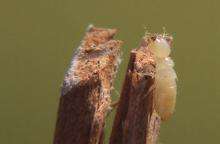
Worker termite
Worker termite. Credit: Wikimedia

Fungi travelled to Madagascar in the intestines of termites. Fungus serves as a source of food and helps in cellulose conversion.

Termites which formed colonies on the island of Madagascar took with them fungi living with them in symbiosis. This is stated in an article by post-doc student Tânia Nobre of the Laboratory of Genetics of Wageningen Universit. The article, with co-author Duur Aanen, also from Genetics, is published this week in the British journal .

'The termite colonies on Madagascar have, so to speak, brought their own seed potatoes with them, just like farmers moving to new settlements', explains Nobre.

The female harboured fungus spores of the species Termitomyces in their intestines. Fungus and termite therefore travelled inseparably from the mainland to the island off the South African coast. This vertical transmission had an evolutionary advantage during the long distance travel and the subsequent colonization 'We date this unique combined transport to the hitherto termite-free island to 13 million years ago', says the Portuguese termite expert.

To unravel the evolutionary history of termites and fungi, the Wageningen researchers reconstructed genealogies of present day termites and fungus varieties. The termites were collected in Africa and Madagascar between 2000 and 2006. In the laboratory in Wageningen, DNA have been isolated from more than 150 different termite colonies and their symbiotic fungi.

Termites live in tropical and sub-tropical areas. A queen and a king are at the head of each colony. Countless numbers of workers and soldiers build the nest and supply the food. For some termites, the fungi are important sources of food. They also help the insects to break down hardly digestible plant materials into manageable mouthfuls.

Most of the termite species pick up fungi from their surroundings when a new colony is formed. The Wageningen research shows that all the termite colonies on originate from a single joint emigration of termites and from Africa to the island, perhaps with the wind, on driftwood or with help from birds, suggests Nobre.

Provided by Wageningen University

Explore further: Researchers develop technique to test manatees for heart disease

add to favorites email to friend print save as pdf

Related Stories

Birds do it, bees do it; termites don't, necessarily

Mar 26, 2009

Scientists at North Carolina State University and three universities in Japan have shown for the first time that it is possible for certain female termite "primary queens" to reproduce both sexually and asexually ...

Termites get the vibe on what tastes good

Mar 20, 2007

Researchers from CSIRO and UNSW@ADFA have shown that termites can tell what sort of material their food is made of, without having to actually touch it. The findings may lead to improvements in the control of feeding termites. ...

Termites eavesdrop on competitors to survive

Aug 26, 2009

(PhysOrg.com) -- The drywood termite, Cryptotermes secundus, eavesdrops on its more aggressive subterranean competitor, Coptotermes acinaciformis, to avoid contact with it, according to scientists from CSIRO ...

Recommended for you

City-life changes blackbird personalities, study shows

15 hours ago

The origins of a young animal might have a significant impact on its behavior later on in life. Researchers at the Max Planck Institute for Ornithology in Radolfzell, Germany, have been able to demonstrate ...

Origins of 'The Hoff' crab revealed (w/ Video)

15 hours ago

The history of a new type of crab, nicknamed 'The Hoff' because of its hairy chest, which lives around hydrothermal vents deep beneath the Southern Ocean and Indian Ocean, has been revealed for the first ...

Personality test finds some mouse lemurs shy, others bold

20 hours ago

Anyone who has ever owned a pet will tell you that it has a unique personality. Yet only in the last 10 years has the study of animal personality started to gain ground with behavioral ecologists, said Jennifer ...

User comments : 0

More news stories

Surprise species at risk from climate change

(Phys.org) —Most species at greatest risk from climate change are not currently conservation priorities, according to an International Union for Conservation of Nature (IUCN) study that has introduced a ...

Origins of 'The Hoff' crab revealed (w/ Video)

The history of a new type of crab, nicknamed 'The Hoff' because of its hairy chest, which lives around hydrothermal vents deep beneath the Southern Ocean and Indian Ocean, has been revealed for the first ...

EUROnu project recommends building Neutrino Factory

(Phys.org) —The European Union's Seventh Framework Programme, EUROnu, has submitted its findings to a panel at CERN. Charged with choosing a project to study the nature of matter and antimatter, the project ...

'Ugly' finding: Unattractive workers suffer more

People who are considered unattractive are more likely to be belittled and bullied in the workplace, according to a first-of-its-kind study led by a Michigan State University business scholar.