New analyzers to unlock mineral value
Oct 06, 2009
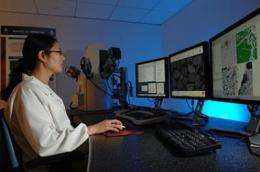
This is Sophia Morrell with the QEMSCAN unit at CSIRO's Australian Minerals Research Centre, in Waterford, Western Australia. Credit: Darryl Peroni

Scientists are working on a new range of materials characterisation analysers and techniques that could help unlock the value contained in Australia's mineral deposits and improve processing performance, according to the October issue of Process.

Machine-mounted sensors, being developed through CSIRO Minerals Down Under Flagship, could help locate ore deposits, characterise the mining environment, and differentiate ore grades.

This will enable automated mining machines to respond 'intelligently' to the changing detail of the environment and offer real-time amendments to the mine plan.

Another prototype in development combines the best features of two existing materials characterisation techniques - and - into a new slurry analyser.

The new prototype, dubbed XRDF for its dual origins, is capable of measuring both mineralogy and ultra-low elemental composition directly on a process-stream, without the need for labour-intensive, time-consuming and potentially error-prone sampling.

CSIRO scientist Dr James Tickner said the new prototype could offer a number of benefits over existing on-stream analysers.

"We're not aware of any other system capable of doing accurate, on-stream mineralogy," Dr Tickner said.

"The ability to detect elements at parts-per-billion levels in an on-stream system is unique."

Dr Tickner and his team are also working on gamma-activation analysis - a new analysis method that may deliver all the benefits of neutron activation without the need for a .

The method is expected to provide accurate, multi-element analysis of mineral samples without extensive sample preparation, and measure very low levels of more than 30 elements in samples weighing just a few hundred grams.

The method could significantly improve sampling accuracy.

More information: A pdf of the magazine is available now at: www.csiro.au/resources/Process-Oct-09.html

Source: CSIRO Australia

Explore further: Bold action, big money needed to curb Asia floods

add to favorites email to friend print save as pdf

Related Stories

New X-ray microscope for science and industry

Jul 03, 2006

Australian researchers have taken X-ray technology to a new level, developing and using high-powered microscopes to see inside objects and capture high-resolution images of their subsurface structures.

CSIRO scientist discovers natural 'invisible' gold

Jun 23, 2008

The search for these natural but 'invisible' nanoparticles is important. If they can be proved to exist, the knowledge will help give us a deeper understanding of how gold can be transported and deposited by geological processes, ...

New approach to measuring carbon in forests

Mar 26, 2008

CSIRO is collaborating in a NASA-funded project, using a CSIRO-designed instrument, to help develop new methods of measuring forest carbon stores on a large scale.

Nerve cell software keeps track of brain change

Oct 13, 2006

Brain research will get a boost tomorrow as CSIRO launches in the United States its HCA-Vision nerve cell analysis software at Neuroscience 2006 in Atlanta, Georgia, the world's largest conference for brain researchers.

Recommended for you

Unraveling the Napo's mystery

6 hours ago

In the United States, rivers and their floodplains are well-documented and monitored. Ecuador's largest river, however, remains largely mysterious. Research led by Michigan State University is helping the ...

Hong Kong launches plan to tackle waste crisis

6 hours ago

Hong Kong on Monday launched a ten-year plan to reduce waste by 40 percent per person as part of efforts to catch up with other leading Asian cities and avert a looming environmental crisis.

User comments : 0

More news stories

Lab sets a new record for creating heralded photons

(Phys.org) —Entanglement, by general consensus of physicists, is the weirdest part of quantum science. To say that two particles, A and B, are entangled means that they are actually two parts of an inseparable ...

Protein study suggests drug side effects are inevitable

A new study of both computer-created and natural proteins suggests that the number of unique pockets – sites where small molecule pharmaceutical compounds can bind to proteins – is surprisingly small, meaning drug side ...