Two NASA satellites capture monster Super Typhoon Melor
Oct 05, 2009
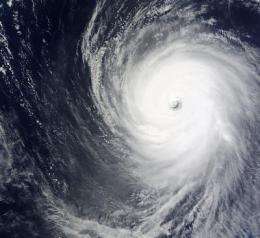
The Moderate Imaging Spectroradiometer (MODIS) instrument on NASA's Terra satellite captured an image of Super Typhoon Melor in the Western Pacific Ocean during the early morning hours of Oct. 5, 2009. Melor has intensified to Super Typhoon strength and is currently a category 5 typhoon (with maximum sustained winds near 161 mph) on the Saffir Simpson scale. Credit: NASA MODIS Rapid Response Team

NASA's Terra and Aqua satellites flew over Super Typhoon Melor early today, October 5 and captured some impressive images of the storm's clouds on a track toward Japan. The Western Pacific Ocean has the edge on super typhoons, and Melor's maximum sustained winds near 161 mph are more proof.

Typhoon Melor tracked through the channel between Saipan and Agrihan on Saturday night, and became a Super Typhoon on Sunday. Melor's winds dropped to 130 mph just before it passed near the island of Saipan this weekend and it was far enough away to not cause any major damage, according to local news reports. Downed trees and heavy rain were experienced Saturday afternoon and overnight into Sunday (local time), but no major flooding was reported.

On October 5 at 5 a.m. EDT (0900 UTC), Super Typhoon Melor's winds were up to 161 mph, and it was located approximately 585 nautical miles southeast of Okinawa, near 19.6 North and 134.3 East. Melor is moving west-northwestward at 19 mph.

NASA's Terra satellite flew over Melor during the early morning hours on October 5. The Moderate Imaging Spectroradiometer (MODIS) instrument on Terra provided a dramatic image of Melor at Category 5 strength on the Saffir-Simpson scale with maximum sustained winds near 161 mph!
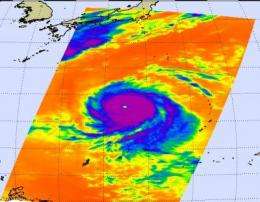
Aqua's Atmospheric Infrared Sounder (AIRS) instrument captured Melor's high thunderstorm cloud temperatures (in purple) that were colder than minus 63 Fahrenheit. This image from Oct. 4 at 12:29 EDT clearly shows Melor's eye. Credit: NASA JPL, Ed Olsen

NASA's Aqua satellite flew over Super Typhoon Melor mid-day on October 4 and captured an of the monster typhoon. Aqua's Atmospheric Infrared Sounder (AIRS) instrument and Moderate Imaging Spectroradiometer (MODIS) analyzed temperatures in Melor's . AIRS revealed the cold high cloud temperatures were colder than minus 63 Fahrenheit indicating a very strong tropical cyclone.

Forecasters at the U.S. Navy's Joint Typhoon Warning Center have amended the forecast track for Melor, and take the super typhoon on a path resembling the letter "C" in the Western Pacific Ocean. The storm is forecast to swing just east of Kadena island Japan, then turn northeast (because westerly winds will push it northeast) and its center is now expected to brush Tokyo before it swings northeast back into the open Western Pacific.

There's good news about the storm's strength however. Melor will slowly weaken as a because of increased vertical shear (winds blowing sometimes at different directions, at different levels of the atmosphere that can tear a storm apart) and cooler waters. When Melor is south of Tokyo, it's expected to interact with a baroclinic boundary (i.e. a front) and become extratropical.

Source: NASA/Goddard Space Flight Center

Explore further: Astonishing hi-resolution satellite views of the destruction from the Moore, Oklahoma tornado

add to favorites email to friend print save as pdf

Related Stories

Super Typhoon Melor crossing Guam this weekend

Oct 02, 2009

Melor has become a Super Typhoon with sustained winds near 130 mph, and is crossing Guam and its islands this weekend. Warnings and watches are already up for the region.

Marianas on alert: Melor joins the typhoon group

Oct 01, 2009

Being a typhoon seems to be the "in thing" lately for tropical cyclones in the Western Pacific, and Melor is now one of the "in crowd." NASA's QuikScat and Aqua satellites helped the U.S. Navy's Joint Typhoon ...

Tropical Storm Koppu poised for China landfall

Sep 14, 2009

The latest tropical storm in the western Pacific formed on Sunday, and is poised to make landfall in mainland China on Tuesday, near typhoon strength (74 mph). Two NASA satellites captured different views ...

Recommended for you

Strong earthquake at exceptional depth

22 hours ago

This morning at 05:45 CEST, the earth trembled beneath the Okhotsk Sea in the Pacific Northwest. The quake, with a magnitude of 8.2, took place at an exceptional depth of 605 kilometers. Because of the great ...

Marine forecasting on the horizon for Indian Ocean Rim

23 hours ago

Nearly all of the member countries of the Indian Ocean Rim Association for Regional Cooperation (IOR-ARC) will attend the week-long workshop to further cooperation and understanding on international ocean ...

Russia evacuates drifting Arctic research station

May 23, 2013

Russia has ordered the urgent evacuation of the 16-strong crew of a drifting Arctic research station after ice floe that hosts the floating laboratory began to disintegrate, officials said Thursday.

User comments : 1

Adjust slider to filter visible comments by rank

Display comments: newest first

omatumr
3 / 5 (2) Oct 05, 2009
Congratulations!

It is gratifying to see that NASA is starting to pay attention to planet Earth.

To understand Earth's climate, I hope that the new NASA Administrator will also ask NASA to go back and re-examine NASA's past attitude toward experimental data that suggested Earth's heat source is not a ball of Hydrogen, but a plasma diffuser that selectively moves lightweight isotopes and elements to its surface.

Isotope data from the first analysis on lunar soils would be a good place to start [LSPET (The Lunar Sample Preliminary Examination Team): 1969, “Preliminary examination of lunar samples from Apollo 11”, Science 165, 1211-1227].

With kind regards,
Oliver K. Manuel
Former NASA PI for Apollo

More news stories

Galaxies fed by funnels of fuel

(Phys.org) —Computer simulations of galaxies growing over billions of years have revealed a likely scenario for how they feed: a cosmic version of swirly straws.

Source of life running out: water scientists

The majority of people on Earth people will face severe water shortages within a generation or two if pollution and waste continues unabated, scientists warned at a conference in Bonn Friday.

Dark, massive asteroid to fly by Earth on May 31

It's 1.7 miles long. Its surface is covered in a sticky black substance similar to the gunk at the bottom of a barbecue. If it impacted Earth it would probably result in global extinction. Good thing it is ...

Heart failure accelerates male 'menopause'

Heart failure accelerates the aging process and brings on early andropausal syndrome (AS), according to research presented today at the Heart Failure Congress 2013. AS, also referred to as male 'menopause', was four times ...

Radiation leak at Japan lab; small impact expected

An atomic research lab in northern Japan has reported a radiation leak that may have affected about 50 people, though none were hospitalized and no impact was expected outside the facility, the lab's operator ...