Building a better qubit: Combining 6 photons together results in highly robust qubits
Oct 05, 2009
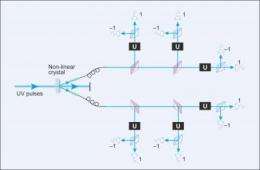
A new method for combining six photons together results in a highly robust qubit capable of transporting quantum information over long distances. Credit: Image courtesy of Carin Cain

Exploiting quantum mechanics for transmitting information is a tantalizing possibility because it promises secure, high speed communications. Unfortunately, the fragility of methods for storing and sending quantum information has so far frustrated the enterprise. Now a team of physicists in Sweden and Poland have shown that photons that encode data have strength in numbers. Their experiment is reported in Physical Review Letters and Physical Review A and highlighted in the October 5 issue of Physics.

In classical communications, a bit can represent one of two states - either 0 or 1. But because photons are quantum mechanical objects, they can exist in multiple states at the same time. Photons can also be combined, in a process known as entanglement, to store a bit of (i.e. a qubit).

Unlike data stored in a computer or typically sent through conventional fiber optic cables, however, qubits are extremely fragile. A kink in a cable, the properties of the cable material, or even changes in temperature can corrupt a and destroy the information it carries. But now a group lead by Magnus Rľdmark at Stockholm University has shown that six entangled photons can encode information that stands up to some knocking around.

Rľdmark and his team proved experimentally that their six qubits are robust and should be able to reliably carry information over long distances. The technology to encode useful information on the qubits and subsequently read it back is still lacking, but once those problems are solved, we will be well on our way to secure, reliable, and speedy quantum communication.

More information:

• Experimental filtering of two-, four-, and six-photon singlets from a single parametric down-conversion source, Magnus Rľdmark, Marcin Wieśniak, Marek Żukowski, and Mohamed Bourennane, Phys. Rev. A 80, 040302 (2009) - Published October 05, 2009, Download PDF (free)

• Experimental Test of Fidelity Limits in Six-Photon Interferometry and of Rotational Invariance Properties of the Photonic Six-Qubit Entanglement Singlet State, Magnus Rľdmark, Marek Żukowski, and Mohamed Bourennane, Phys. Rev. Lett. 103, 150501 (2009) - Published October 05, 2009, Download PDF (free)

Source: American Physical Society

Explore further: Hydrogen atoms under the magnifying glass

add to favorites email to friend print save as pdf

Related Stories

Quantum Communication Over Flawed Networks may be Possible

Dec 14, 2007

If successfully implemented, quantum communication could be an extremely secure method of transmitting information – but there are major roadblocks to pass. Recently, physicists suggested a way, at least in theory, to overcome ...

Physicists Investigate Unusual Four-Qubit Entanglement

Sep 30, 2009

(PhysOrg.com) -- For the first time, physicists have experimentally demonstrated a four-qubit bound-entangled state - a peculiar form of entanglement that cannot be distilled (optimized) by the usual means. ...

Physicists Entangle Photon and Atom in Atomic Cloud

Jul 26, 2005

Quantum communication networks show great promise in becoming a highly secure communications system. By carrying information with photons or atoms, which are entangled so that the behavior of one affects the ...

Recommended for you

Hydrogen atoms under the magnifying glass

10 hours ago

To describe the microscopic properties of matter and its interaction with the external world, quantum mechanics uses wave functions, whose structure and time dependence is governed by the Schrödinger equation. ...

Making quantum encryption practical

May 21, 2013

One of the many promising applications of quantum mechanics in the information sciences is quantum key distribution (QKD), in which the counterintuitive behavior of quantum particles guarantees that no one can eavesdrop on ...

Lab sets a new record for creating heralded photons

May 20, 2013

(Phys.org) —Entanglement, by general consensus of physicists, is the weirdest part of quantum science. To say that two particles, A and B, are entangled means that they are actually two parts of an inseparable ...

Competition in the quantum world

May 20, 2013

Innsbruck physicists led by Rainer Blatt and Peter Zoller experimentally gained a deep insight into the nature of quantum mechanical phase transitions. They are the first scientists that simulated the competition ...

User comments : 0

More news stories

Theorists weigh in on where to hunt dark matter

(Phys.org) —Now that it looks like the hunt for the Higgs boson is over, particles of dark matter are at the top of the physics "Most Wanted" list. Dozens of experiments have been searching for them, but ...

Hydrogen atoms under the magnifying glass

To describe the microscopic properties of matter and its interaction with the external world, quantum mechanics uses wave functions, whose structure and time dependence is governed by the Schrödinger equation. ...

FDA panel backs experimental Merck insomnia drug

(AP)—A federal panel of medical experts says that an experimental insomnia drug from Merck & Co Inc. appears safe and effective, despite evidence from company trials that the pill can cause daytime sleepiness and difficulty ...