Super Typhoon Melor crossing Guam this weekend
Melor has become a Super Typhoon with sustained winds near 130 mph, and is crossing Guam and its islands this weekend. Warnings and watches are already up for the region.
A typhoon warning is in force for Saipan and Tinian. A typhoon watch is in force for Rota and Agrihan, and a tropical storm warning is in effect for Guam, Rota and Agrihan, meaning that tropical storm conditions are expected within 24 hours.
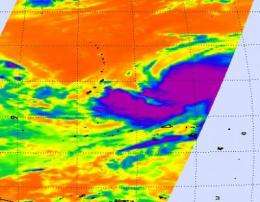
NASA's Aqua satellite flew over Super Typhoon Melor on October 1 at 15:59 UTC (1:59 a.m. Guam local time), and captured in infrared image of the storm's clouds using the Atmospheric Infrared Sounder (AIRS) instrument. AIRS takes the temperature of the storm's highest, cold clouds and revealed very high, powerful thunderstorms. Those cloud tops were as cold as or colder than 220 degrees Kelvin or minus 63 degrees Fahrenheit (F). The colder the clouds are, the higher they are, and the more powerful the thunderstorms are that make up the tropical storm.
The National Weather Service (NWS) in Guam issued a special statement about Super Typhoon Melor, and warned residents not to focus on where Melor's center is located, because the storm is very large and dangerous winds extend far from the center. The NWS statement reads "Islands hundreds of miles from the typhoon eye will experience tropical storm-force winds. Melor is expected to intensify and move toward the Marianas. The onset of damaging winds is expected in the northern Marianas after Midnight tonight (local time)." For updated information: http://www.prh.noaa.gov/guam/localHazards.php.
How far do Melor's winds extend? Tropical storm-force winds of (39 mph) 34 knots or higher occur within 185 to 225 miles of the center, while typhoon (hurricane)-force winds of (73 mph) 64 knots or higher occur within 60 miles of the center.
The National Weather Service forecast for Guam, specifically where Andersen Air Force Base is located is as follows: Today (Saturday, October 2)...Damaging winds. Northwest winds 25 to 30 mph shifting to the west 30 to 40 mph in the afternoon. Cloudy. Scattered showers and isolated thunderstorms in the morning...then numerous locally heavy showers and isolated thunderstorms in the afternoon. Highs around 83. Tonight (Saturday Night...Damaging winds. Southwest winds 35 to 45 mph. Cloudy with numerous locally heavy showers and isolated thunderstorms. Lows around 77. For live National Weather Service radar at the Andersen Air Force Base, Guam: http://radar.weather.gov/radar.php?rid=GUA&product=NCR&overlay=11101111&loop=yes.
Super Typhoon Melor had maximum sustained winds near 132 mph (115 knots) on October 2 at 1500 UTC (at 1 a.m. Saturday, October 2). It was located 305 miles east-northeast of Saipan, near 15.0 North and 149.9 East. Melor is moving northwest near 9 mph and is creating 29-foot high waves.
After passing Guam, Melor is forecast to steer northeast and approach central Japan.
Source: NASA/Goddard Space Flight Center


